*Part 1 of 5*
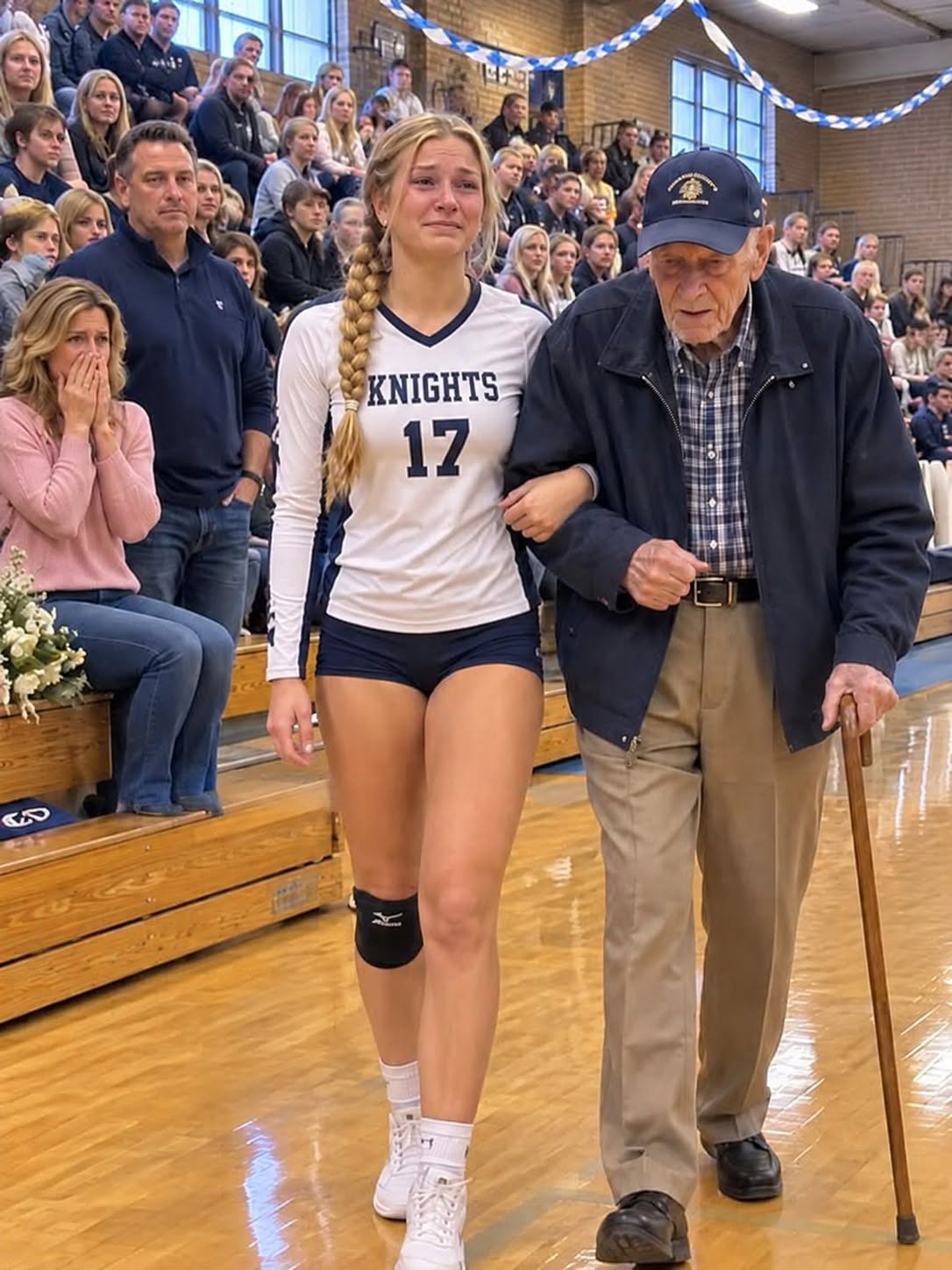
My husband refused to walk my 17-year-old daughter, his stepdaughter for nine years, at her high school senior night. “That’s something a real father should do,” he told her. But when her name was announced Thursday evening, her 79-year-old grandfather appeared with his walking cane and proudly accompanied her onto the court.
The conversation happened during Tuesday dinner, just two days before the big game.
Our tater tot casserole was still hot on the table.
Kaylee was seventeen, a high school senior, and a middle hitter on the volleyball team.
She asked Travis directly, as she always did.
“Will you walk with me on senior night Thursday?”
Her biological father hadn’t contacted her in six years.
Meanwhile, Travis had taken her to nearly every volleyball practice since seventh grade.
He lowered his fork.
“Kay, that moment is meant for actual fathers.”
Then he explained himself.
“I wouldn’t feel right taking a place that doesn’t belong to me.”
Kaylee didn’t argue.
“Okay,” she replied.
She washed her plate and disappeared upstairs.
She didn’t even close her bedroom door loudly.
Our eight-year-old son, Mason, glanced at me, waiting for me to intervene.
But I remained silent.
I had my reasons.
I could have insisted Travis accompany her.
He was generally a caring husband who usually listened when something mattered to me.
But I didn’t want Kaylee standing beside someone who was there only because I’d pressured him.
I wanted Travis to make that decision willingly.
So I gave him time.
He headed outside to the seed shed.
And he never changed his mind.
Later that evening, Kaylee approached me with a question.
“Mom, could Grandpa walk with me instead?”
My father, Duane, was seventy-nine.
He’d spent fifty-one years milking Holstein cows.
Since undergoing hip surgery, he needed a cane to get around.
I telephoned him Wednesday and explained what had happened.
Dad didn’t criticize Travis.
He didn’t ask why Kaylee had been rejected.
He simply said, “What time should I show up?”
Thursday evening, the school gym was filled with the familiar scents of popcorn and freshly polished floors.
Maroon and gold decorations hung along the railings.
At our school, seniors were introduced before the varsity volleyball match.
Each player walked to center court with a family member and presented that person with a red rose.
There were six graduating seniors.
Kaylee was scheduled fourth.
I took my seat in the front row, wearing my maroon booster club sweatshirt.
Travis sat beside me in his fleece vest.
He didn’t know my father would be there.
I hadn’t mentioned it.
And I knew that was my decision to answer for.
At 6:12, the side entrance opened.
Dad stepped inside wearing his tan Sunday jacket.
His favorite seed corn cap, the one he saved for special occasions, sat on his head.
His shoes were polished.
He held his hickory walking cane in his right hand.
Without drawing attention to himself, he crossed toward the opposite end of the gym.
Then he stood beside Kaylee.
Travis turned and looked at me.
I said nothing.
A moment later, the announcer spoke.
“Number seventeen, Kaylee, escorted this evening by her grandfather, Mr. Duane Ostrem.”
My daughter slipped her arm through Grandpa’s.
Together, they began crossing the court.
They moved slowly.
Dad couldn’t walk quickly anymore.
First his cane.
Then one foot.
Then the other.
The rubber end of his cane made a faint squeaking noise against the polished gym floor.
Suddenly, someone in the upper bleachers rose to their feet.
Then another row stood.
Within moments, the entire home crowd was standing.
Men who’d spent years hauling milk alongside my father.
Mothers and fathers.
High school students.
Even the visiting volleyball players joined the applause.
Dad never raised his head to acknowledge the crowd.
He concentrated on each step, just as he’d once carefully crossed the floor of his dairy barn.
I sat there with both hands pressed against my mouth.
Then Travis rose from his seat beside me.
But he wasn’t clapping.
His eyes were fixed on the steps leading down from the bleachers.
His jaw shifted slightly, the way it always did when he was struggling to say something important.
In nine years together, I’d witnessed that expression only twice.
He gripped the railing with one hand.
And then, without speaking, he began walking.
At first I thought he intended to leave.
The thought struck me with such force that I caught his sleeve.
“Travis.”
He looked at my hand and then at me.
“I’m not leaving.”
“Then where are you going?”
His gaze moved toward the court.
Dad and Kaylee were halfway across now.
The applause had softened into something steadier, warmer. Kaylee was matching Grandpa’s pace instead of making him match hers. Every few steps she glanced down at his feet, almost imperceptibly adjusting her stride.
“I don’t know yet,” Travis said.
Then he continued down the bleacher steps.
He stopped at the bottom.
He did not step onto the court.
He did not interrupt them.
He simply stood near the sideline, hands hanging uselessly at his sides.
Kaylee and Dad reached center court.
The announcer read the short biography Kaylee had submitted.
“Kaylee plans to attend North Plains State University next fall, where she intends to study agricultural education. She would like to thank her family, coaches, teammates, and everyone who has supported her throughout the years.”
Kaylee accepted the red rose from Coach Jensen.
Then she turned to Grandpa.
She hugged him first.
Dad’s hat tipped backward.
The gym laughed softly.
Then Kaylee handed him the rose.
Dad stared at it as if nobody had warned him about that part.
He said something to her.
I couldn’t hear it from the stands.
But Kaylee laughed.
Later she told me what he’d said.
“Well, I didn’t bring a vase.”
They finished crossing the court.
Near the sideline, Kaylee looked up.
She saw Travis.
Her smile disappeared.
Not dramatically.
It simply faded.
Travis took one step toward her.
“Kay—”
Coach Jensen waved Kaylee toward the team.
Warmups were beginning.
Kaylee looked at him for another second, then followed her teammates.
Dad remained beside Travis.
The two men stood facing each other.
From where I sat, I could see Dad’s red rose between them.
Travis spoke first.
Dad listened.
Then Dad said something.
Travis lowered his head.
I couldn’t hear a word.
When my father eventually climbed the bleacher steps, he sat on my other side.
“Everything okay?” I whispered.
Dad placed the rose carefully across his knees.
“Game’s starting.”
“Dad.”
He kept his eyes on the court.
“Not here, Jenny.”
That was how I knew something had happened.
My father was not a man who believed every conversation deserved a dramatic setting. He’d discussed cattle prices at weddings and kidney stones at Christmas dinner. If he said not here, it meant the words mattered.
The match began.
Kaylee played beautifully.
Not perfectly.
Beautifully.
There was a difference.
She missed an early block and sent one serve long. But she recovered. In the second set, she stuffed the opposing outside hitter twice in a row, and Mason nearly fell over the railing screaming.
“That’s my sister!”
Travis usually shouted louder than anyone.
That night, he barely spoke.
He clapped.
He stood when everyone stood.
When Kaylee scored the final point of the third set, he smiled.
But something inside him had gone quiet.
After the match, the gym became a confusion of bouquets, photographs, parents, teammates, jackets, and children weaving between adults.
Kaylee accepted flowers from me.
Mason wrapped himself around her waist.
Dad received three handshakes and one kiss on the cheek from women he’d known since 1968.
Travis stayed a few yards away.
Eventually Kaylee noticed.
“You can come in the picture,” she said.
He hesitated.
“I don’t have to.”
Her face changed.
“Nobody said you didn’t.”
Travis stepped beside us.
Coach Jensen took the phone.
Dad stood on one side of Kaylee.
Travis stood on the other.
Just before the picture was taken, Mason announced, “Grandpa’s rose is upside down.”
Everybody laughed except Travis.
The flash went off.
In the photograph, which I would study many times afterward, five people are smiling.
Travis is not.
He is looking at Kaylee.
We drove home separately because Dad needed me to follow him down the county road in case his hip stiffened.
Travis took Mason.
Kaylee rode with Grandpa.
When we reached Dad’s farmhouse, Kaylee helped him inside.
I followed.
“Coffee?” Dad asked.
“It’s almost ten.”
“So?”
I knew better than to argue.
Kaylee sat at the kitchen table where I’d done my algebra homework thirty years earlier.
Dad filled the old percolator.
He still refused to own one of those machines with pods.
“Grandpa,” Kaylee said, “thank you.”
He shrugged.
“Didn’t have anything else going on.”
“You polished your shoes.”
“Coincidence.”
“And wore the good jacket.”
“Couldn’t find the bad one.”
She smiled.
Then her eyes filled.
Dad saw it.
He turned away and fussed unnecessarily with the coffee tin.
“I thought I was okay,” Kaylee whispered.
I sat beside her.
“You don’t have to be.”
She wiped one cheek.
“I don’t understand why he said that.”
Neither did I.
That was the part I hadn’t admitted aloud.
For nine years, Travis had behaved like a father.
He’d taught Kaylee to ride a bicycle after her biological father stopped showing up on weekends.
He’d built a plywood serving target in the machine shed.
He’d driven through freezing rain to collect her from a tournament when the team bus broke down.
He’d sat awake beside her after her first serious breakup because she didn’t want advice but didn’t want to be alone.
When she got her driver’s license, he gave her the old Ford Escape he’d spent two winters repairing.
He called her “Kay.”
She called him Travis.
Neither seemed bothered by that arrangement.
Until Tuesday.
Dad placed three coffee cups on the table.
Then he sat.
He looked at Kaylee.
“Do you want to know what he said to me tonight?”
I stiffened.
Kaylee hesitated.
“Travis?”
Dad nodded.
“What?”
“He asked me whether I thought he’d failed you.”
Kaylee stared at the table.
Dad continued.
“I told him that wasn’t my question to answer.”
“What did he say?”
“He said he thought he was trying to respect something.”
“What?”
Dad rubbed one thumb along the handle of his cup.
“A boundary.”
Kaylee gave a small, humorless laugh.
“What boundary? Apparently the one where he can pay for braces but can’t stand next to me in a gym?”
“Kaylee,” I said gently.
“No, Mom. I’m not being mean. I really don’t understand.”
Dad nodded.
“That’s fair.”
The kitchen clock ticked.
Then Dad looked at me.
“Jenny, you need to ask your husband about his father.”
I frowned.
“His father died when Travis was twenty.”
“I know.”
Dad’s expression remained steady.
“I’m not talking about the man who raised him.”
For several seconds, none of us spoke.
Kaylee looked at me.
I looked at Dad.
“What are you talking about?”
Dad reached into the inside pocket of his Sunday jacket.
He removed a folded envelope.
“I wasn’t going to give you this tonight,” he said. “But after what happened, I think keeping quiet would make me part of the problem.”
He placed the envelope on the table.
My name was written across the front.
Not Jenny.
Jennifer.
Only two people regularly called me Jennifer.
My mother, who had been dead eleven years.
And Travis.
I unfolded the flap.
Inside was a photocopy of a letter.
The original had been written twenty-eight years earlier.
Dad watched me read the first paragraph.
My stomach tightened.
“Dad, where did you get this?”
“He brought it to me last month.”
“Who?”
Dad glanced toward the dark window.
“Travis.”
Kaylee leaned closer.
“What does it say?”
I read the first lines again, certain I’d misunderstood them.
I hadn’t.
The letter was addressed to Travis.
It had been written by the man Travis had believed was his biological father.
And one sentence had been underlined in blue ink.
*Being a father has never depended on whose blood you carry.*
Below it, in Travis’s handwriting, were four words.
*Then why wasn’t I enough?*
I looked at my father.
“What happened to him?”
Dad shook his head.
“That’s the question Travis has been trying to answer.”
Kaylee went still.
“Grandpa…”
Dad folded both hands over the head of his cane.
“The man Travis called Dad wasn’t his biological father either.”
The kitchen seemed suddenly smaller.
Outside, the security light illuminated the empty gravel yard.
“And Travis only found out three weeks ago.”
**-END OF Chapter 1–**
*Part 2 of 5*
By the time I reached home, the kitchen light was still on.
Travis sat at the table alone.
Mason had gone to bed.
A mug of coffee rested near Travis’s hand, untouched.
For one irrational moment, I was angry about the coffee.
My father had made coffee.
Travis had made coffee.
Apparently every man in my life believed caffeine was an acceptable substitute for telling me the truth.
I placed the copied letter on the table.
Travis looked at it.
Then he closed his eyes.
“Dad gave it to me.”
“I figured.”
“Three weeks?”
He nodded.
“You’ve known for three weeks?”
“I’ve suspected longer.”
“And you didn’t tell me.”
“I didn’t know how.”
I remained standing.
There are moments in a marriage when sitting down feels too much like agreeing that a conversation will be civilized.
I wasn’t ready to promise that.
“Start somewhere.”
Travis looked toward the hallway.
“Mason asleep?”
“Yes.”
He nodded.
“When Mom moved into assisted living, she asked me to clean out the house.”
I remembered.
Two months earlier, Travis had spent several weekends sorting through forty years of his mother’s belongings.
“I found a box in Dad’s workbench.”
“Your dad’s?”
He flinched almost invisibly at the word.
“The man who raised me.”
“His name was Dennis.”
“I know.”
“Then call him Dennis if that’s what you need to do tonight.”
Travis rubbed both palms over his face.
“There were papers. My birth certificate. Court documents. Letters.”
“What court documents?”
“Guardianship papers first. Then an adoption order.”
My anger shifted.
Not vanished.
Shifted.
“Your mother never told you?”
“No.”
“Dennis never told you?”
“No.”
Dennis Hale had died nearly twenty-five years earlier from a heart attack while fixing a combine.
I had met Travis four years afterward.
Everything I knew about Dennis came from photographs and stories.
He’d taught Travis to weld.
He’d taken him fishing.
He’d once driven six hours through a snowstorm to watch Travis wrestle in a state tournament.
The similarities to Travis and Kaylee were suddenly unbearable.
“Who was your biological father?”
“A man named Calvin Reed.”
“Do you know him?”
“No.”
“Alive?”
“I think so.”
“You think?”
“I found an address.”
I pulled out a chair.
Finally, I sat.
“Did you contact him?”
“No.”
“Why did you take the letter to Dad?”
Travis stared at the grain of the table.
“Because I needed to ask someone.”
“Ask what?”
“Whether Dennis counted.”
My breath caught.
Travis laughed once, quietly, without humor.
“Sounds stupid when I say it.”
“No.”
“It does.”
“No, Travis. It sounds wounded. That’s different.”
He finally looked at me.
“All my life I thought I knew what I was. Dennis’s son. His only son. I thought every story belonged to me. Every picture. Every habit I picked up from him. Then suddenly there’s a court document saying he chose me.”
“That should make it mean more.”
“I know.”
“But it didn’t?”
“It did. And it didn’t.”
He struggled for words.
“I started thinking about Calvin. Why he left. Whether Dennis always knew I wasn’t really—”
He stopped.
I waited.
“Really what?”
“His.”
There it was.
The word that had damaged Tuesday dinner.
The word Travis had been carrying around inside himself and accidentally placed in front of Kaylee.
I leaned back.
“Oh, Travis.”
“I know.”
“Do you?”
“Yes.”
“You told a seventeen-year-old girl who has spent nine years trusting you that standing beside her was a job for a real father because you found out the father you loved wasn’t genetically related to you.”
His eyes lowered.
“When you say it like that—”
“How else should I say it?”
“I don’t know.”
Neither did I.
That was perhaps the worst part.
He had not intended cruelty.
But intentions were poor erasers.
After a long silence, he said, “I thought if I walked her out there, I was pretending.”
“Pretending what?”
“To have a title she never gave me.”
“She asked you.”
“I know.”
“She asked you herself.”
“I know.”
His voice broke on the second one.
I softened, but only slightly.
“Then why didn’t that matter more than a title?”
He had no answer.
The clock above the stove clicked to 10:47.
Finally Travis said, “When I saw Duane walking with her…”
He stopped.
“What?”
“I understood what I had done.”
I waited.
“He wasn’t worried about what to call himself. He wasn’t worried whether anybody thought he had the right. She asked him to walk. So he walked.”
“Yes.”
“I made it about me.”
“Yes.”
He nodded slowly.
“I don’t know how to fix it.”
“You might not.”
That frightened him.
I could see it.
And because I loved him, part of me wanted immediately to soften the sentence.
I didn’t.
Some truths deserve to remain uncomfortable long enough to be understood.
“You apologize,” I said. “Without explaining yourself so much that she ends up comforting you.”
He nodded.
“And then?”
“Then she decides what happens next.”
The following morning, Travis made pancakes.
He made pancakes whenever he was nervous.
Kaylee came downstairs at 6:35 wearing sweatpants and her school hoodie.
She stopped when she saw him at the stove.
“Morning,” he said.
“Morning.”
“Can we talk?”
She looked at the clock.
“I’ve got twenty minutes.”
“I only need five.”
She sat.
I stayed near the sink.
Travis turned off the burner.
He didn’t sit.
“I owe you an apology.”
Kaylee looked at him without expression.
“What I said Tuesday was wrong.”
She said nothing.
“I told myself I was respecting your relationship with your father.”
“I don’t have a relationship with my father.”
“I know.”
“Do you?”
“No.”
That landed.
Kaylee frowned.
Travis continued.
“I also told myself there are things a stepfather shouldn’t claim unless they’re offered.”
“I offered.”
“I know.”
Silence.
Then Travis said the sentence I think finally reached her.
“You gave me a place beside you, and I told you it wasn’t mine.”
Kaylee looked down.
Her eyes filled immediately.
“So why?”
Travis pulled out the chair across from her.
“My mother kept something from me. I found out recently that the father who raised me adopted me when I was two.”
Kaylee looked up sharply.
“Grandpa told me part of it.”
“I figured he might.”
“You’re mad at him?”
“No.”
“Mom was.”
“I wasn’t mad.”
Kaylee looked toward me.
“You looked mad.”
“I contain multitudes.”
Despite herself, she smiled.
The smile disappeared quickly.
Travis explained the documents.
He did not use them as an excuse.
That mattered.
When he finished, Kaylee rubbed one sleeve across her eyes.
“So when you said ‘real father’…”
“I was trying to figure out what those words meant to me.”
“And you used me to do it.”
He nodded.
“Yes.”
It was a painful answer.
It was also the correct one.
Kaylee stared at him for a long moment.
“I don’t forgive you yet.”
“I understand.”
“I might.”
“I hope so.”
“But not because you made pancakes.”
“Fair.”
She picked up one pancake from the stack.
“These are slightly burned.”
“I was distracted.”
“They’re really bad.”
“I get it.”
She took another.
Before leaving, she paused at the mudroom door.
“Travis?”
“Yeah?”
“For the record, if I meant my biological father, I would have asked my biological father.”
Then she left.
The school bus came three minutes later.
Travis stood at the window watching it disappear.
That afternoon, Dad called.
“Your husband stopped by.”
“What did he want?”
“To borrow something.”
I waited.
Dad enjoyed pauses far too much.
“What?”
“My truck.”
“Why?”
“Said he had somewhere to go.”
“Where?”
“Didn’t ask.”
Of course he hadn’t.
Dad considered questions private property. If people wanted you to have answers, according to him, they’d eventually deliver them.
At five, Travis texted me.
*I’ll be home late.*
That was all.
Seven came.
Then eight.
At 8:26 my phone rang.
It was Travis.
“Where are you?”
“About forty miles west.”
His voice sounded strange.
“What happened?”
“I found Calvin Reed.”
I stood from the couch.
Mason was doing math homework on the floor.
Kaylee looked over from the armchair.
“Is he alive?”
“Yes.”
“Did you talk to him?”
A long silence.
“Travis?”
“Jenny, there’s something you need to know.”
I walked into the laundry room and closed the door.
“What?”
“He knew Dennis.”
“Okay.”
“No. I mean he really knew him.”
I heard road noise behind Travis’s voice.
“How?”
“They were brothers.”
I gripped the washing machine.
“What?”
“Half brothers.”
My mind struggled to rearrange everything.
“So Dennis adopted his brother’s son?”
“Yes.”
“Why wouldn’t anyone tell you?”
“That’s the part I’m still trying to understand.”
“Did Calvin explain?”
“He tried.”
“What did he say?”
Travis breathed out slowly.
“He said Dennis wasn’t supposed to raise me permanently.”
I felt cold despite the warm room.
“What does that mean?”
“He said it was supposed to be six months.”
“And then?”
“Then Calvin came back.”
I waited.
“He says Dennis wouldn’t give me back.”
For a moment there was only the hum of the dryer beside me.
“Travis, that doesn’t make sense. He couldn’t just keep somebody’s child.”
“I know.”
“Was there a custody case?”
“Apparently.”
“Who won?”
Another silence.
“Nobody.”
“What does that mean?”
“Calvin disappeared before the hearing.”
“Why?”
“That’s what I asked.”
Travis’s voice lowered.
“He says someone paid him to leave.”
I closed my eyes.
“Who?”
“He wouldn’t tell me.”
“Why not?”
“Because he says that person is still alive.”
Beyond the laundry-room door, I could hear Mason asking Kaylee for help with fractions.
Normal sounds.
Ordinary sounds.
The sounds of a family that had no idea the past had just arrived at its doorstep.
“Travis,” I whispered, “come home.”
“I’m coming.”
He paused.
“But Jenny?”
“Yes?”
“Calvin gave me something.”
“What?”
“A photograph.”
“Of what?”
“Not what. Who.”
My hand tightened around the phone.
“In the picture, Dennis is holding me when I was about two.”
“Okay.”
“And standing beside him is the person Calvin says convinced him to leave.”
I stopped breathing.
Travis continued.
“You know her.”
**-END OF Chapter 2–**
*Part 3 of 5*
Travis arrived home at 9:14.
I knew because I watched the headlights turn into our driveway.
Kaylee had put Mason to bed.
She remained at the kitchen table.
“I can go upstairs,” she said.
“No,” I told her. “Stay.”
She studied my face.
“Is this about Travis’s dad?”
“Yes.”
“Then maybe I should stay.”
I considered saying the matter belonged to adults.
But that argument had already done enough damage in our family.
So I nodded.
Travis entered carrying Dad’s truck keys in one hand and a manila envelope in the other.
He looked exhausted.
Kaylee pushed a coffee mug toward him.
“I made some.”
“Thanks.”
Nobody drank.
Travis opened the envelope.
The photograph was small and faded.
Three people stood outside a white farmhouse.
Dennis was unmistakable despite being younger than I’d ever seen him.
He held a toddler.
Travis.
Beside him stood a woman in a flowered blouse.
At first I didn’t recognize her.
Then I did.
“No.”
Travis said nothing.
Kaylee leaned closer.
“Who is she?”
I picked up the photograph.
“My mother.”
Kaylee stared at me.
“Grandma?”
“Yes.”
My mother, Ruth Ostrem, had died eleven years earlier.
She had known Travis only briefly before becoming ill.
At least that was what I’d believed.
“This picture was taken before we met,” I said.
“Long before,” Travis replied.
I turned it over.
Writing covered the back.
Summer 1981.
Dennis, little Travis, Ruth.
I read it twice.
Then a third time.
“Why would my mother know your father?”
“I don’t know.”
“My mother grew up here.”
“So did Dennis.”
“Not in the same town.”
“Twelve miles apart.”
In rural Minnesota, twelve miles could mean strangers.
It could also mean cousins, classmates, coworkers, church committees, machinery auctions, 4-H meetings, grain elevators, county fairs and a thousand connections people assumed weren’t important enough to mention.
Kaylee spoke quietly.
“Grandpa might know.”
I looked at the clock.
Ten after nine.
Dad went to bed at nine.
He also answered his telephone at any hour because he’d spent half a century expecting cows to ignore business hours.
I called.
He picked up after four rings.
“This better not be about coffee.”
“Dad, did Mom know Dennis Hale?”
Silence.
“Dad?”
“Where did you hear that name?”
My stomach dropped.
“Answer me.”
Another silence.
“Yes.”
Kaylee closed her eyes.
Travis stared at the photograph.
“How?”
Dad sighed.
“Come over tomorrow.”
“No.”
“Jenny—”
“No. Everybody has been deciding when everybody else is allowed to know things. I’m done with that.”
He said nothing.
“How did Mom know Dennis?”
“They worked together one summer.”
“Where?”
“The old Valley Cooperative.”
“When?”
“Before you were born.”
I looked at the photograph.
“Why was she involved with Travis?”
Dad’s breath caught.
So slightly another person might have missed it.
I didn’t.
“Dad.”
“I think we should discuss this in person.”
“Why?”
“Because there’s more.”
Of course there was.
There is always more when someone says there’s more.
The next morning was Saturday.
At eight, we drove to Dad’s farm.
Kaylee came.
Mason stayed with a neighbor.
Dad was already sitting at the kitchen table.
Four cups waited.
No one commented on the coffee.
The photograph lay between us.
Dad looked older than he had Thursday night.
Not physically.
Some memories age people faster than years.
“Your mother knew Dennis before I did,” he began.
I sat opposite him.
“Were they together?”
“No.”
“You hesitated.”
“They went on a few dates.”
Travis looked at me.
I almost laughed.
Not because it was funny.
Because the alternative was throwing Dad’s sugar bowl.
“So Mom dated Travis’s father?”
“For about two months.”
“The man who raised him.”
“Yes.”
“Did Dennis know Calvin then?”
“Of course. Calvin was his younger half brother.”
Dad folded his hands.
“Calvin was seventeen when he got a girl pregnant. She was sixteen. Her parents sent her away for most of the pregnancy. After Travis was born, neither family handled anything well.”
Travis went pale.
“My mother?”
“Her name was Elise.”
“Is she alive?”
Dad shook his head.
“She died young. Car accident. You were five.”
Travis looked away.
“Why didn’t my mother tell me any of this?”
“I can’t answer that.”
“Try.”
Dad did.
“Because people thought silence protected children back then.”
The bitterness in Travis’s expression surprised even me.
“And did it?”
Dad met his eyes.
“No.”
He continued.
“Calvin was barely able to take care of himself. Dennis and his wife couldn’t have children. They offered to keep you while Calvin found work.”
“My mother?”
“Elise had already left. She signed temporary guardianship.”
“What happened?”
“Months became longer.”
“And Calvin came back.”
Dad nodded.
“He wanted you.”
“Why didn’t Dennis return me?”
“Because Dennis believed Calvin was unstable.”
“Was he?”
“Sometimes.”
“That’s not an answer.”
“No.”
Dad’s fingers tightened.
“He drank. He moved from job to job. He disappeared for weeks.”
Travis looked toward the window.
“Calvin said someone paid him to leave.”
Dad didn’t answer.
My heart began pounding.
“Dad.”
He looked at me.
“Your mother gave him money.”
The room went silent.
“Why?”
“She believed you were safer with Dennis.”
Travis stood so abruptly his chair scraped backward.
“She bought me?”
“No.”
“It sounds a lot like that.”
“She gave Calvin enough money to start over somewhere else.”
“In exchange for me.”
“She thought—”
“I don’t care what she thought.”
His voice wasn’t loud.
That somehow made it heavier.
Kaylee remained very still.
Dad nodded once.
“Fair.”
Travis paced toward the sink.
“How much?”
“Two thousand dollars.”
“In 1981?”
“Yes.”
“Where did she get it?”
Dad looked down.
“From me.”
The revelation landed differently on each of us.
For Travis, it was betrayal.
For me, confusion.
For Kaylee, something else.
She looked at Grandpa with an expression I had never seen before.
“You knew?”
Dad nodded.
“You helped?”
“I gave Ruth the money.”
“Why?”
Dad’s answer came quietly.
“Because she asked.”
Kaylee stared at him.
“That’s it?”
“No.”
He raised his eyes.
“I knew Calvin.”
Travis turned.
“How?”
“He worked for me one summer.”
Dad’s voice became distant.
“He was nineteen. Angry at everything. Mostly himself. Loved you, though.”
That mattered.
I saw it matter.
Travis stopped pacing.
“He loved me?”
“Yes.”
“Then why leave?”
Dad shook his head.
“Because loving somebody and being ready to raise them aren’t always the same thing.”
Nobody spoke.
Dad continued.
“Your mother gave him the money. But Calvin didn’t sign away his rights because of the money. Not then.”
“When?”
“Six months later.”
“Why?”
“He came back again.”
Travis stared.
“He came back twice?”
“Yes.”
“What happened the second time?”
Dad’s face changed.
“He watched you with Dennis.”
“What?”
“You were outside. Dennis was fixing a fence. You were carrying little pieces of wire behind him like they were important.”
A faint smile touched Dad’s mouth.
“Every time Dennis moved, you moved.”
Travis sank into the chair.
“Calvin watched for ten minutes.”
Then Dad spoke the sentence that changed the shape of the entire story.
“He left without letting you see him.”
Travis swallowed.
“Why?”
“He told me later that you looked happy.”
Dad reached into a drawer.
“I’ve kept something for forty-five years.”
He removed another envelope.
This one was yellowed.
He handed it to Travis.
“Calvin gave this to me the night he signed the adoption papers. He told me to give it to you if you ever came asking.”
Travis stared at him.
“Why didn’t you?”
“You never asked.”
“Because I didn’t know.”
“I know.”
Regret passed across Dad’s face.
“That was my mistake.”
Travis opened the envelope.
Inside was a single sheet of paper.
He read silently.
Halfway through, his expression collapsed.
He covered his mouth.
Kaylee moved first.
She went around the table and sat beside him.
She didn’t touch him.
Not yet.
“What does it say?” I asked.
Travis couldn’t answer.
He handed me the letter.
Calvin’s handwriting was uneven.
The letter was short.
He told his son he was sorry.
He wrote that Dennis had not stolen him.
He wrote that Ruth had offered money but he had returned most of it later.
He wrote that he had signed the adoption because he finally understood that being wanted and being able were two different things.
And near the bottom:
*Dennis is your father because he stayed for every ordinary day. If you ever find me, don’t come because you think you owe me something. You don’t.*
I lowered the letter.
Travis was crying now.
Quietly.
Kaylee placed her hand on the table between them.
After several seconds, Travis covered it with his own.
“I’m sorry,” he whispered.
She looked at him.
“For what?”
“For Thursday.”
She nodded.
“I know.”
“For making you feel like biology mattered more than everything else.”
“I know.”
He struggled.
“And for needing Grandpa to walk across a gym before I understood something Dennis apparently knew forty-five years ago.”
Kaylee squeezed his hand.
“I was really mad at you.”
“You should’ve been.”
“I still kind of am.”
“Okay.”
“But…”
She looked toward Grandpa’s cane leaning against the counter.
Then back at Travis.
“I don’t think I want one bad sentence to erase nine years.”
Travis bowed his head.
Kaylee continued.
“But you don’t get to pretend it didn’t hurt.”
“I won’t.”
“And I’m not calling you Dad because you had a breakthrough.”
A wet laugh escaped him.
“Fair.”
She smiled faintly.
“Maybe someday.”
Travis looked up.
That possibility seemed almost too much for him.
Dad cleared his throat.
“There is one more thing.”
All four of us turned toward him.
I nearly groaned.
“Dad, if you tell me Mom secretly worked for the CIA, I’m leaving.”
Kaylee laughed.
Even Travis smiled.
Dad didn’t.
“This isn’t about Ruth.”
He looked at Travis.
“It’s about Calvin.”
“What?”
“When did you see him yesterday?”
“About seven.”
“Where?”
“His house outside Morton.”
Dad’s expression sharpened.
“Describe it.”
Travis did.
Small blue house.
Detached garage.
Windbreak of spruce trees.
Dad shook his head.
“That’s not Calvin’s house.”
Travis frowned.
“He answered the door.”
“I’m not saying you didn’t meet him.”
“What are you saying?”
“I’m saying Calvin sold that property three years ago.”
“How would you know?”
Dad looked toward the letter still lying open on the table.
“Because Calvin called me when he sold it.”
The room went quiet again.
Travis stared at him.
“You’ve been in contact with him?”
“Off and on.”
“Since when?”
“Since 1981.”
Travis stood.
This time he didn’t look angry.
He looked stunned.
“Why would he come back to a house he no longer owns just to meet me?”
Dad’s gaze settled on the photograph.
“I don’t know.”
Then Kaylee noticed something none of us had.
She picked up the photograph and held it toward the window.
“Mom.”
“What?”
“Look at the date.”
Summer 1981.
She turned the picture over.
“Travis said Calvin gave him this yesterday.”
“Yes.”
“But Grandpa, you said Calvin left before Travis’s adoption was final.”
“Yes.”
“And Grandma kept the photograph?”
Dad frowned.
“I assumed so.”
Kaylee shook her head.
“No.”
She pointed to the lower corner.
There, almost hidden beneath Dennis’s hand, was a tiny blue stamp from the local newspaper.
Dad leaned closer.
His face went pale.
“What?” I asked.
He didn’t answer.
“Dad?”
He took the photograph.
“The Valley Chronicle used that stamp on pictures submitted for publication.”
“So?”
Dad looked at Travis.
“This photograph wasn’t Ruth’s.”
“Whose was it?”
Dad turned it over again.
His thumb rubbed gently across the handwriting.
“I know this writing.”
“Whose?”
He looked at me.
“Your mother’s handwriting never looked like this.”
My skin prickled.
“Then who wrote the names?”
Dad stared at the three figures in the photograph.
“Calvin did.”
Travis frowned.
“Why does that matter?”
Dad looked toward him.
“Because Calvin couldn’t have written this in 1981.”
“Why not?”
“Because he didn’t learn to read or write until 1987.”
**-END OF Chapter 3–**
*Part 4 of 5*
The mystery of the photograph turned out to be less sinister than our imaginations initially made it.
That was almost a relief.
Almost.
Calvin called Travis Sunday morning.
He didn’t pretend the photograph was old in the way we’d assumed.
“I wrote on it later,” he explained over speakerphone. “Years later.”
Travis looked at Dad.
“Why didn’t you just say that?”
“Didn’t think you’d inspect it like a murder mystery.”
Kaylee covered her mouth to hide a smile.
Travis didn’t.
“Why meet me at your old house?”
There was a pause.
“Because I didn’t want you coming to where I live now.”
“Why?”
Another pause.
“My wife doesn’t know about you.”
That hurt.
I saw it immediately.
Perhaps Calvin heard it in the silence.
“It’s not because I’m ashamed of you.”
Travis rubbed his forehead.
“I don’t know how many times in a week a man can hear a sentence beginning with ‘it’s not because I’m ashamed of you’ before he starts doubting the ending.”
Calvin sighed.
“Fair.”
It was becoming the family word.
Fair.
A word that meant I can’t undo what happened, but I won’t argue with what it cost you.
Calvin eventually agreed to meet again.
This time, Travis asked Kaylee whether she wanted to come.
The question surprised all of us.
“Why me?”
“Because you’re good at knowing when people are avoiding things.”
“That’s not a compliment.”
“It’s absolutely a compliment.”
She considered.
“Okay.”
I started to ask whether I should go.
Then stopped.
This was theirs.
Not everything important required me to stand in the middle.
They met Calvin at a diner thirty miles west.
I learned the details afterward.
Calvin was seventy-two.
He had white hair, large hands, and the stooped posture of someone who had spent decades operating heavy equipment.
Kaylee said the first thing she noticed was that he and Travis rubbed their thumbs against the sides of their coffee mugs in exactly the same way.
Neither man noticed.
Calvin did not resemble Dennis.
He resembled Travis.
That frightened Travis more than he expected.
They ordered pie.
Nobody ate much.
Finally Calvin said, “I should’ve told you sooner.”
Travis stared at his coffee.
“You had forty-five years.”
“Yes.”
“Grandpa had forty-five years too.”
“Duane thought I should stay out.”
“Did he?”
Calvin glanced toward Kaylee.
“Not exactly.”
“What does that mean?”
“He told me if I wanted to be your father, I should act like one. And if I didn’t, I shouldn’t appear every few years to make myself feel better.”
That sounded like Dad.
“What did you choose?”
“Neither.”
Travis looked up.
Calvin didn’t look away.
“I chose cowardice.”
Kaylee later told me that was the moment she began believing him.
Not forgiving him.
Believing him.
People who lie often polish themselves.
Calvin did the opposite.
He told Travis he had married at thirty-eight.
He had two daughters.
They did not know Travis existed.
“Why?” Travis asked.
“Because every year I waited made telling them harder.”
“That seems to be a theme.”
“Yes.”
“Are you going to tell them now?”
Calvin’s fingers tightened around his cup.
“I don’t know.”
Travis sat back.
“Then what exactly did you want from me?”
Calvin’s answer was unexpected.
“Nothing.”
“Nobody wants nothing.”
“I wanted you to know Dennis didn’t steal you.”
Travis went still.
“Why now?”
“Because Duane called.”
Kaylee straightened.
“When?”
“Three weeks ago.”
“What did Grandpa say?”
“That Travis had found the papers.”
Calvin looked at Travis.
“He said you were asking questions.”
“So Grandpa arranged this?”
“No.”
“Then how did you know I’d come?”
“I didn’t.”
“Why were you at the old house?”
Calvin hesitated.
“I’ve been fixing it.”
“Why?”
“I’m selling it again.”
“You said you already sold it.”
“Bought it back last month.”
Travis almost laughed.
“This family desperately needs written timelines.”
Kaylee did laugh.
Calvin smiled.
The tension loosened.
Then he reached into his coat.
“I brought something.”
Travis stiffened.
Calvin placed a small wooden box on the table.
Inside was a pocketknife.
A wristwatch.
Three old photographs.
And a brass key.
“Dennis gave these to me the last time I saw him.”
“When?”
“The week before he died.”
Travis stared at him.
“You saw Dennis before he died?”
Calvin nodded.
“Why?”
“He came looking for me.”
“For what?”
“To tell me about you.”
“What about me?”
“That you were getting married.”
Travis frowned.
“I wasn’t.”
“He thought you would.”
That sounded like Dennis too.
Calvin smiled faintly.
“He said there was a girl.”
“There wasn’t.”
“He said there would be.”
Travis shook his head.
“What did he want?”
“He wanted me to promise that if anything happened to him, I wouldn’t come barging into your life trying to reclaim something.”
Travis swallowed.
“And?”
“I promised.”
“Then why give you those things?”
“The watch was his father’s. The knife was yours someday. The key…”
Calvin looked down.
“That’s complicated.”
Kaylee leaned forward.
“To what?”
“A lockbox.”
“Where?”
“In the Valley Cooperative building.”
“The old one?”
Calvin nodded.
The building had been abandoned for years.
It stood at the edge of town, windows boarded, its grain silos long since emptied.
“What is in it?” Travis asked.
“I don’t know.”
“You never opened it?”
“No.”
“Why?”
“Dennis told me it wasn’t mine.”
“Whose was it?”
Calvin met his eyes.
“Yours.”
Monday afternoon, Travis asked me to accompany him.
The cooperative property now belonged to a local historical society.
Dad knew the board president.
In our county, ninety percent of solving a mystery involved knowing someone who had a key.
The basement smelled of concrete, dust, and old grain.
Along one wall remained several steel employee lockers.
Number 28 opened with the brass key.
Inside was another box.
No treasure.
No secret fortune.
No shocking evidence of criminal conspiracy.
Just paper.
Letters.
Photographs.
Receipts.
A child’s drawing.
And one cassette tape.
Travis sat on an overturned bucket.
I crouched beside him.
The first letter was from Dennis.
*Travis—*
*If you’re reading this, somebody finally decided secrets were heavier than truth.*
Travis laughed softly.
“He knew.”
“Apparently.”
The letter continued.
Dennis explained that he had agreed with Elise and Calvin to adopt Travis only after years of uncertainty.
He admitted he had been terrified Calvin would return.
He admitted he had sometimes felt like an impostor.
He admitted something Travis had never imagined.
*There were days I looked at you and thought: What if blood wakes up in him someday and he realizes I am only the man who happened to be here?*
Travis stopped reading.
I placed my hand over his.
He stared at the page.
“Dennis felt the same thing.”
“Yes.”
“All those years.”
“Apparently.”
He continued.
*Then one morning you were thirteen and you came into the barn furious because I wouldn’t let you drive the tractor alone. You shouted, “You’re the worst dad in Minnesota.”*
Travis laughed.
Tears filled his eyes.
*And I went behind the barn and cried from happiness, because you had called me Dad while being too angry to think about it.*
Travis covered his face.
I leaned against his shoulder.
The final paragraph was simple.
*If you ever have a child who isn’t yours by blood, don’t waste your time wondering whether you have permission to love them. Love is not trespassing.*
Neither of us spoke for a long time.
Then Travis whispered, “I did exactly what he told me not to do.”
“You did.”
“I hurt her.”
“Yes.”
“I can’t undo it.”
“No.”
He looked at me.
“Why are you agreeing with everything?”
“Because you don’t need me to rescue you from the truth.”
He nodded.
Then his eyes returned to the box.
“What about the tape?”
We found a cassette player upstairs in the historical society office.
The recording crackled.
Dennis’s voice emerged.
Older than in Travis’s memories.
Younger than death.
“Well, Trav. If you’re hearing this, either I’ve died or technology has somehow become interested in cassette tapes again.”
Travis laughed aloud.
Then Dennis spoke for nine minutes.
About ordinary things.
The first bicycle.
The broken basement window Travis had blamed on a mysterious neighborhood child named Kevin, despite no Kevin living within three miles.
The wrestling tournament.
The morning Travis left for college.
Then Dennis’s voice became softer.
“There’s one thing I hope I got right.”
Static.
“I hope I taught you that family is mostly showing up.”
Travis closed his eyes.
“Not once. Not for the big picture. Not when everybody is watching.”
More static.
“It’s Tuesday when somebody needs a ride. It’s sitting in a cold gym when your back hurts. It’s fixing a car you told them not to buy. It’s answering the phone after midnight.”
Travis breathed in sharply.
Dennis continued.
“The important walks are usually the ones nobody applauds.”
The tape ended.
For several minutes we stayed there.
Then Travis laughed quietly.
“What?”
“He would’ve liked Duane.”
I smiled.
“He did.”
Travis stared at me.
“What?”
“My mother dated Dennis. Dad knew him. They must have met.”
He began laughing harder.
Of all the revelations we’d endured, that one seemed to delight him.
When we returned home, Kaylee was at the kitchen table completing a scholarship application.
Travis placed Dennis’s letter beside her.
“Read this when you have time.”
She looked at him.
“What’s it about?”
“Us, sort of.”
She read it immediately.
When she reached the line about love not being trespassing, she stopped.
Then she looked at Travis.
He didn’t speak.
Kaylee folded the letter carefully.
“Senior banquet is Friday.”
“I know.”
“Parents come.”
“I know.”
“Grandpa’s already coming.”
“Good.”
She tapped the letter against the table.
“You could come too.”
Travis stared at her.
“As what?”
Kaylee gave him a look.
“Don’t ruin it.”
He smiled.
“Right.”
Friday night, Dad sat on one side of Kaylee.
Travis sat on the other.
No one announced titles.
No one needed to.
Halfway through dinner, Coach Jensen passed out envelopes containing letters the seniors had written to themselves as freshmen.
Kaylee opened hers.
She began laughing.
“What?” I asked.
She handed it to me.
Fourteen-year-old Kaylee had written a list titled:
*Things I Hope Are True When I’m a Senior.*
Number one: I hope I’m starting varsity.
Number two: I hope Mom stops buying weird yogurt.
Number three: I hope Mason becomes less annoying.
Mason protested.
Then I reached number four.
*I hope Travis is still around.*
My throat tightened.
Travis read it.
He looked at Kaylee.
She shrugged, suddenly shy.
“You were around.”
He nodded.
“Yeah.”
Then she handed him another folded sheet.
“What’s this?”
“My scholarship essay.”
“What scholarship?”
“The county agricultural educators scholarship.”
“Why are you giving it to me?”
“Because I wrote about you.”
Travis froze.
He unfolded it.
The first line read:
*The person who taught me the most about commitment once disappointed me badly.*
He looked up.
Kaylee smiled.
“Keep reading.”
The essay did not excuse him.
That mattered.
She wrote about volleyball drives, homework, broken vehicles, ordinary breakfasts.
She wrote about senior night.
She wrote about Grandpa.
And she wrote about what happened afterward.
Near the end was one sentence that made Travis set the paper down.
*Sometimes we learn who our parents are not because they never fail us, but because after they fail us, they stay for the difficult conversation.*
Travis couldn’t speak.
Kaylee reached for his hand.
This time, she didn’t wait for him to reach first.
But before anyone could say anything, Coach Jensen approached our table.
“Kaylee?”
“Yeah?”
“There’s someone in the lobby asking for you.”
“Who?”
Coach Jensen looked uncomfortable.
“He says he’s your father.”
The room seemed to tilt.
Travis went completely still.
I stared toward the gym doors.
Kaylee’s biological father had not contacted her in six years.
Not once.
No birthdays.
No Christmas cards.
No graduation questions.
Nothing.
Kaylee slowly released Travis’s hand.
“What does he want?”
Coach Jensen shook her head.
“He said he came because he heard about senior night.”
Kaylee stood.
Travis stood too.
Then stopped himself.
“Do you want me to come?”
It was the question that mattered.
Not *Should I?*
Not *Am I allowed?*
Not *What am I to you?*
Just:
Do you want me?
Kaylee looked at him.
Then at Grandpa.
Then at me.
Finally she answered.
“Yes.”
And together, we walked toward the lobby.
**-END OF Chapter 4–**
*Part 5 of 5*
His name was Aaron Mercer.
For seventeen years, that name had occupied too much space in our lives for someone who was rarely present.
Kaylee resembled him around the eyes.
That fact annoyed me.
Genetics had a strange talent for claiming credit after doing very little work.
Aaron stood beside the trophy case wearing a work jacket.
He looked older.
Not dramatically.
Just enough for time to be visible.
When he saw Kaylee, he smiled uncertainly.
“Hey, kiddo.”
Kaylee stopped several feet away.
Travis stood behind her.
Dad remained near the gym doors.
I stood beside Kaylee.
No one spoke.
Aaron’s smile faded.
“Guess I deserve that.”
Kaylee folded her arms.
“What are you doing here?”
“I heard about Thursday.”
“From who?”
“Your aunt.”
I remembered Aaron’s sister still had friends in town.
“She saw something online.”
Of course.
Someone had posted Grandpa’s walk.
It had traveled farther than any of us expected.
Not millions of views.
Not television.
Nothing unrealistic.
Just enough shares throughout the county that people who hadn’t thought about us in years suddenly had an opinion.
Aaron glanced at Travis.
“I heard somebody else should’ve been walking you.”
Kaylee’s expression hardened.
Travis started to speak.
Kaylee lifted one hand.
He stopped.
That pleased me.
Not because she silenced him.
Because he allowed her to own the moment.
“You didn’t drive here to talk about Travis,” she said.
Aaron shoved both hands into his pockets.
“No.”
“Then why?”
His confidence disappeared.
“I don’t know.”
Kaylee waited.
Aaron sighed.
“I saw the picture of you with your grandfather.”
“And?”
“And you looked grown up.”
Something flickered across Kaylee’s face.
Sadness, perhaps.
Not longing.
Something quieter.
“I am.”
“I know.”
“No. You know now.”
Aaron looked down.
“You’re right.”
He had imagined, I think, that apologies would come more easily.
People often do.
They rehearse apologies alone, where nobody interrupts with the consequences.
“I’ve thought about calling.”
Kaylee gave a short laugh.
“For six years?”
“Yes.”
“That’s a really long thought.”
“I know.”
She looked at him.
“Why didn’t you?”
Aaron hesitated.
“At first I was angry at your mom.”
I said nothing.
“Then I was embarrassed because so much time had passed. Then every birthday made it harder.”
Kaylee nodded.
“So you kept waiting.”
“Yes.”
“Until Grandpa walked me across a volleyball court.”
Aaron winced.
“When you put it like that—”
“People keep saying that lately.”
Travis almost smiled.
Aaron noticed him again.
There was no confrontation.
No territorial argument.
No dramatic demand.
Just two men standing in a high school lobby who had played very different roles in one girl’s life.
Aaron said, “You’ve been taking care of her?”
Travis’s expression changed.
He glanced at Kaylee before answering.
“We’ve been taking care of each other.”
Kaylee looked at him.
That was perhaps the best answer he could have given.
Aaron nodded.
“Thank you.”
Travis didn’t accept the gratitude.
Not exactly.
“She doesn’t belong to either of us.”
Aaron looked surprised.
Travis continued.
“Whatever happens next is her decision.”
The words hung there.
I knew what they cost him.
I also knew what they proved.
Kaylee turned back to Aaron.
“Are you staying for dinner?”
He blinked.
“If you want me to.”
“I didn’t say I did.”
“Oh.”
“But you drove all this way.”
“Three hours.”
She considered.
“You can sit with us.”
Hope rose too quickly in Aaron’s face.
Kaylee saw it.
“That doesn’t mean everything is fixed.”
“I know.”
“It doesn’t mean I’m calling you tomorrow.”
“Okay.”
“And don’t make promises.”
His face fell slightly.
“I was going to say—”
“I know.”
Her voice softened.
“That’s why I’m asking you not to.”
Aaron nodded.
“Okay.”
We returned to the banquet.
A folding chair was added to our table.
It was awkward.
Of course it was.
Believable reconciliation is awkward.
Aaron didn’t know Mason’s favorite subject.
He didn’t know Kaylee planned to attend North Plains State.
He didn’t know she had switched from outside hitter to middle in tenth grade.
He didn’t know she hated ranch dressing now despite having practically lived on it when she was eleven.
Each missing fact was a small record of absence.
Travis knew all of them.
He never demonstrated it.
That mattered too.
Dad spent most of dinner discussing soybean moisture with another grandfather.
At dessert, Aaron asked Kaylee about college.
She answered politely.
Eventually he said, “Maybe I could come see campus sometime.”
Kaylee paused.
“Maybe.”
Not yes.
Not no.
Maybe.
It was enough for that night.
Afterward, we walked into the cold parking lot.
Aaron hugged Kaylee only after asking.
She accepted briefly.
Then he drove away.
We watched his taillights disappear.
Kaylee shoved her hands into her coat pockets.
“That was weird.”
“Very,” I agreed.
Travis remained silent.
She looked at him.
“You okay?”
He laughed.
“You’re asking me?”
“Yeah.”
“I’m fine.”
“Really?”
“No.”
That made her smile.
“But I will be.”
Dad joined us slowly.
Cane.
Foot.
Foot.
Kaylee immediately moved toward him.
“Careful, Grandpa.”
“I’ve been walking longer than you’ve been alive.”
“Not well.”
“Disrespectful child.”
They continued toward the cars.
A few steps later, Dad stopped.
He looked back at Travis.
“You coming?”
Travis nodded.
“Yeah.”
Dad waited.
That tiny gesture nearly undid me.
The months that followed were not miraculous.
Aaron called twice before Christmas.
Kaylee answered once.
He sent a birthday card in February.
She kept it but did not display it.
They met for lunch in March.
She came home thoughtful rather than happy.
That seemed healthy.
“He talks a lot when he’s nervous,” she said.
“So do you,” I told her.
“I absolutely do not.”
She talked for another fifteen minutes proving my point.
Travis never asked what she planned to do about Aaron.
He had finally learned that loving Kaylee did not require defining every relationship around her.
Sometimes the best thing he could do was remain available.
So he did.
Winter passed.
Then spring.
The acceptance letter from North Plains State arrived in January.
The scholarship notification arrived in April.
Kaylee won it.
Her essay about commitment earned her $2,500 toward tuition.
When she read the email, she screamed loud enough that Mason dropped a cereal bowl.
Travis read the notification three times.
“Your bad experience made money,” he said.
Kaylee laughed.
“Congratulations. You’re finally profitable.”
Graduation arrived in May.
The ceremony was held on the football field because the weather cooperated.
Families filled folding chairs on the grass.
Dad arrived forty minutes early.
Travis arrived an hour early.
Neither admitted to competing.
Aaron sent a text that morning.
*I don’t want to assume I should be there. If you’d like me to come, I will.*
Kaylee stared at it for a long time.
Then she replied.
*You can come.*
He did.
He sat two rows behind us.
Not beside Travis.
Not excluded either.
A beginning.
Nothing more.
When Kaylee crossed the stage, four men cheered louder than anyone else.
Mason.
Grandpa.
Travis.
Aaron.
Afterward came photographs.
Hundreds, apparently.
Kaylee with me.
Kaylee with Mason.
Kaylee with Grandpa.
Kaylee with Aaron.
Then she looked around.
“Travis?”
He had stepped aside.
Old habits.
He was holding everybody’s jackets.
“Yeah?”
“Picture.”
He approached.
She handed Aaron her phone.
“Would you take one?”
Aaron hesitated only briefly.
“Sure.”
Kaylee stood beside Travis.
He smiled.
She studied him.
“Why are you standing six feet away?”
“I’m not.”
“You practically are.”
He stepped closer.
She slipped her arm through his.
The gesture stopped him.
It was the same way she had held Grandpa’s arm on senior night.
Travis looked down.
Then at her.
She smiled.
“Relax.”
Aaron lifted the phone.
“Ready?”
“Wait,” Kaylee said.
She looked at Travis.
“There’s something I need to tell you before college.”
His face immediately became concerned.
“What?”
“I’ve been thinking about it for months.”
“That sounds ominous.”
“It’s not.”
She breathed in.
Then glanced toward Grandpa, who stood nearby with his cane planted firmly in the grass.
“When I was little, I thought fathers were people who were supposed to stay.”
Travis said nothing.
“Then mine didn’t.”
Aaron was close enough to hear.
His expression tightened, but he did not interrupt.
Kaylee continued.
“So I decided the word didn’t mean much.”
Travis swallowed.
“Okay.”
“But then you showed up.”
Her voice trembled.
“You came to practices. You yelled at referees even though you don’t understand volleyball rules.”
“I understand most of them.”
“You absolutely do not.”
Everyone laughed softly.
“You taught me to drive. You made me change my own tire before you’d let me take the car. You came to conferences. You knew which teacher I couldn’t stand. You knew when I was pretending not to be upset.”
Travis’s eyes filled.
“And then senior night happened.”
He lowered his head.
“I’m sorry.”
“I know.”
She waited until he looked at her.
“And you stayed for that too.”
Travis stopped breathing.
Kaylee’s own eyes were wet now.
“You stayed after you messed up.”
Her voice broke.
“You stayed when talking to me was harder than driving me to volleyball.”
She squeezed his arm.
“So I’ve been thinking…”
Travis waited.
Kaylee smiled through tears.
“I think maybe that’s what a real father does.”
Travis covered his face.
Mason whispered loudly, “Is he crying?”
“Yes,” I said.
“I’m not,” Travis said through both hands.
Dad snorted.
Kaylee pulled his hands down.
“So…”
She suddenly looked nervous.
The seventeen-year-old who could stand in front of hundreds of people and smash a volleyball across a net was nervous.
“Would it be weird if I started calling you Dad?”
Travis stared at her.
“No.”
“You’re sure?”
He nodded.
Then laughed because he couldn’t speak.
Kaylee hugged him.
He wrapped both arms around her.
Not cautiously.
Not tentatively.
After nine years, neither of them seemed worried about permission anymore.
I looked toward Aaron.
He was crying too.
Our eyes met.
For a moment I worried the scene might wound him.
Perhaps it did.
But he simply nodded.
Then he lifted Kaylee’s phone.
“I should probably take the picture.”
Travis laughed against Kaylee’s hair.
They separated.
Aaron took three photographs.
In the best one, Kaylee is looking at the camera.
Travis is looking at Kaylee.
Just like senior night.
Except this time he is smiling.
Later, while everyone loaded chairs into vehicles and argued over where to eat, Dad called Travis over.
I watched them from several yards away.
Dad leaned on his cane.
Travis slipped his hands into his pockets.
Dad said something.
Travis answered.
Then Dad extended his cane.
Travis frowned.
Dad pushed it toward him.
Finally Travis took it.
“What was that about?” I asked when he joined me.
He stared at the hickory cane.
“He said he wants me to keep it.”
“Why?”
Travis smiled.
“Said he’s getting a lighter one.”
“That’s Dad’s favorite cane.”
“I know.”
“He’s lying.”
“I know.”
Near the handle, something had been carved into the wood.
I hadn’t noticed it before.
Travis showed me.
Three words.
*Just keep walking.*
I laughed.
Then cried.
Because apparently that was the kind of family we’d become.
That summer, Kaylee left for college.
We packed too many clothes.
Mason hid candy in her suitcase.
Dad gave her fifty dollars and pretended it wasn’t fifty dollars.
Aaron mailed a small toolkit for her car.
Travis spent three weeks checking the Escape for problems that didn’t exist.
On move-in morning, Kaylee stood in our driveway.
Everything suddenly felt too fast.
She hugged Grandpa.
She hugged Mason.
She hugged me for a long time.
Then she turned toward Travis.
He held out the car keys.
“Fuel tank’s full.”
“Okay.”
“Oil changed.”
“Okay.”
“Check tire pressure once a month.”
“I know.”
“Not by kicking them.”
“I know.”
“And if anything happens—”
“Dad.”
He stopped.
It was the first time she’d used the word casually.
No ceremony.
No tears.
No permission.
Just Dad.
Exactly the way Dennis had once dreamed Travis might say it.
Travis looked stunned.
Kaylee smiled.
“If anything happens, I’ll call.”
He nodded.
“Okay.”
Then she hugged him.
I watched my daughter drive down the county road.
Travis stood beside me.
Dad’s cane leaned against the porch rail, though Travis didn’t need it.
Perhaps that was why it belonged there.
Some things are not passed down because we require them.
They are passed down because we need to remember the distance someone else once traveled.
Months later, the senior-night photograph remained on our refrigerator.
Grandpa and Kaylee in the middle.
Me beside them.
Mason grinning.
Travis looking toward Kaylee.
Visitors sometimes asked about the story.
They wanted to know why Grandpa had walked.
They wanted to know why the gym had stood.
They wanted the dramatic version.
But the photograph wasn’t really about one walk.
None of it was.
It was about all the ordinary miles before and after.
The rides to practice.
The burnt pancakes.
The unanswered letters.
The conversations people postponed.
The apologies that didn’t demand forgiveness.
The fathers who stayed.
The fathers who left.
The ones who returned without being promised a place.
And the children who eventually became old enough to decide for themselves what every person meant to them.
One evening the following winter, Kaylee called from college.
Travis answered.
I heard his side from the kitchen.
“Hey, Kay.”
Pause.
“Your car did what?”
Another pause.
“No, don’t drive it.”
He grabbed his coat.
“Yes, I’m coming.”
I looked through the doorway.
“It’s snowing.”
“I know.”
“She’s two hours away.”
“I know.”
“You have work tomorrow.”
“I know.”
He pulled on his boots.
Then he smiled.
“She needs me.”
There was no crowd.
No announcer.
No polished gym floor.
No applause.
Just a cold Tuesday night, a daughter waiting beside a stubborn old Ford, and the man who had finally understood the lesson his father had left behind.
The important walks were usually the ones nobody applauded.
And Travis took this one without hesitation.
**-END OF Chapter 5–**
