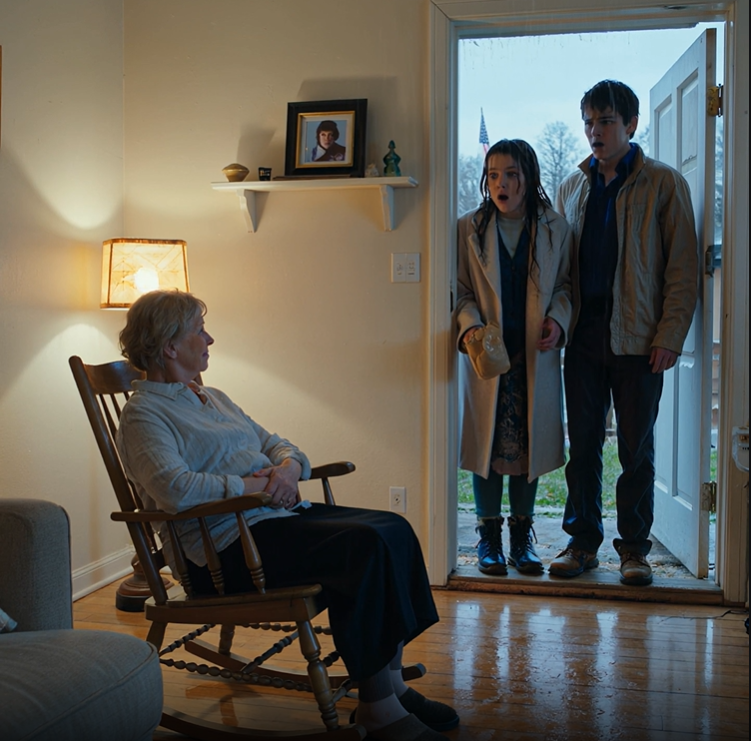
“From now on, your paycheck goes into my account. You don’t need it anyway,” my son said.
I just nodded calmly.
That night, he and his wife came over for their usual free dinner, but the moment they stepped inside, their screams echoed through the empty house—because everything they thought they owned in my life was already gone.
“From now on, I think it’ll be easier if your paycheck just goes directly into my account,” my son said, stirring his coffee as if he were commenting on the weather.
It was a gray Thursday afternoon in late October, the kind of Wisconsin day when the sky looked like brushed steel and the air smelled faintly of burning leaves.
I sat across from him in my kitchen, my hands wrapped around a mug that had gone cold long ago.
Daniel didn’t look nervous.
If anything, he looked confident—too confident for a man asking his mother to hand over her financial life. He said it with that professional calm he’d perfected since becoming a financial consultant in Milwaukee, as if what he was suggesting was standard procedure.
“It’s just practical,” he continued. “You know how complicated online banking can be these days. I could handle everything for you—bills, taxes, transfers. You wouldn’t have to worry about a thing.”
He smiled as he said it. A smile that didn’t quite reach his eyes.
For a few seconds, I couldn’t speak. I just watched him, searching his face for some sign of the boy I had raised alone after his father died in that factory accident thirty years ago. I wanted to find warmth in his expression, but all I saw was a certain distance, a faint impatience—like a man trying to close a business deal with a difficult client.
Finally, I asked softly, “And you’d have access to all my accounts.”
“Of course,” he said, as if that were obvious. “It’ll make things smoother for both of us. You can trust me, Mom.”
I took a slow breath. The word trust settled heavily in the air between us.
Once upon a time, I would have signed anything he handed me without a second thought. But now, something in his tone—too rehearsed, too formal—sent a cold ripple through me.
“I see,” I said quietly, forcing a small smile. “That sounds reasonable.”
His expression brightened. He leaned forward and gave me one of those quick, mechanical kisses on the forehead he’d learned from his wife, Kayla. Gestures that looked affectionate but felt like performance.
“You’ll see, Mom,” he said, rising from the chair. “It’s for your own good.”
That phrase—for your own good—hung in the air long after he left, echoing through the empty kitchen like the ticking of the wall clock.
Outside, the wind picked up, rattling the dry corn stalks in the field beyond my window. I stared at the half-empty mug in front of me and realized I hadn’t actually agreed.
I’d simply gone quiet.
But silence, I reminded myself, was sometimes more powerful than words.
That night, I lay awake listening to the creaking of the old farmhouse, thinking about how easily Daniel had spoken, how confident he’d been, and how little hesitation he’d shown in asking for control over my life.
Something in me shifted that night.
Something old and instinctive. The part of me that had once survived widowhood, debt, and exhaustion woke up again.
If Daniel wanted control, he’d soon learn that I had my own plans—and that I was far from done.
Friday came cold and windy, the kind of evening when the trees around my farmhouse leaned under the weight of November.
I spent the whole day quietly moving things around—packing, cleaning, rearranging.
By the time the sun disappeared behind the barn, half the house looked bare. The living room had no sofa, no TV, not even curtains—just my old rocking chair and the scent of lemon oil on the wooden floor.
I wasn’t losing my mind.
I was running a test.
For the past three years, Daniel and his wife Kayla had shown up every Friday evening without fail. They never called ahead. They never asked if I had plans. They’d simply arrive around six, expecting dinner to be ready, their table set, their wine glasses clean, their comfort guaranteed.
It had started as something sweet.
“We just want to keep you company,” Kayla would say, handing me her empty plate after dinner.
But the truth was simpler.
They came to eat, not to visit.
That night, when I heard Daniel’s car crunch over the gravel driveway, I wiped my hands on a towel and sat down in the chair. My heart beat so loudly it seemed to echo through the empty room.
“Mom,” Daniel called as the front door opened. His voice was cheerful, full of that false warmth he reserved for other people’s mothers. “We’re here.”
Then came the pause.
The silence.
A moment later, Kayla’s voice cut through the house—high, sharp, full of shock.
“Daniel, what on earth happened in here?”
Their footsteps thundered down the hall. Daniel appeared first, his eyes wide, scanning the stripped room like a man surveying the scene of a crime. Kayla followed, clutching her purse as though thieves might still be lurking.
“Mom,” Daniel said, his tone shifting instantly from confusion to alarm. “Where’s everything? The couch, the TV, the dining table?”
I looked up at him calmly.
“I sold some things,” I said softly. “I thought I should have a little cash on hand before transferring my money into your account.”
For a second, there was only silence.
Then Daniel’s face reddened, his jaw tightening.
“You what?”
Kayla’s eyes narrowed.
“You sold your furniture? Why would you do that?”
I smiled faintly.
“Because I wanted to see what mattered more to you. The things in this house—or me.”
Daniel’s nostrils flared.
“You’re being ridiculous. How are we supposed to watch TV when we come over now? How are we supposed to be comfortable?”
The words landed like knives.
We. Comfortable.
Not once did he say you.
I rose from my chair slowly, the wooden floor creaking beneath my feet.
“Daniel,” I said quietly. “If you were worried about my comfort, you wouldn’t be standing here shouting about furniture.”
He took a step closer, eyes blazing.
“You’re acting crazy. Maybe you really do need someone to handle things for you.”
Kayla crossed her arms.
“We only come here to make sure you’re okay, and this is how you repay us? Selling everything? It’s selfish.”
Selfish.
The same word his father had used years ago when I refused to lend him my savings.
Something cold and clean settled inside me.
“Dinner’s not ready,” I said. “And it won’t be. If you’re hungry, you can find somewhere else to eat.”
For a heartbeat, the only sound was the wind outside, pushing at the windows.
Daniel stared at me as though he’d just seen a stranger.
Then, with a voice stripped of emotion, he said, “Be careful, Mom. A woman alone without family—it’s easy for things to go wrong.”
The warning lingered long after they slammed the door and their car disappeared down the gravel road.
I stood in the empty house, the silence humming with something fierce and final.
It wasn’t fear.
It wasn’t grief.
It was the beginning of clarity.
And deep down, I knew this wasn’t the end of Daniel’s plan.
It was only the start of mine.
That night, I couldn’t sleep.
The wind howled through the old maple trees, brushing against the windows like restless hands, and I lay there listening to every sound of the house I had built with decades of labor and quiet sacrifice.
It’s strange how a single evening can make you revisit an entire lifetime.
When Daniel called me crazy, it was like an echo from the past—a voice that dragged me back to where everything began.
I was twenty-nine when Tom, my husband, died in that mill accident.
It was February 1992, and the snow outside the hospital window looked almost blue under the fluorescent lights. They handed me his wedding ring in a paper envelope.
Daniel was only three.
I remember going home that night, holding him in my arms, promising him—promising myself—that no matter what, I would give him a good life.
For years, that promise became the axis around which my world turned.
I worked days at the local library in Baraboo, then cleaned offices at the courthouse at night. I came home after midnight, hands raw from bleach, often too tired to eat.
But Daniel never went without.
When he was ten, he wanted new sneakers. Nike, blue and silver. They cost nearly as much as a week’s groceries.
I bought them anyway.
He wore them to school the next day, beaming.
That smile made every aching muscle worth it.
Later, when he wanted to join the summer robotics camp, I sold my mother’s old jewelry to pay the fee.
He never knew that.
At eighteen, Daniel got accepted to a private business college in Chicago. I didn’t have the tuition money, but I refused to let him settle for less. I mortgaged the house—the very same farmhouse we lived in now—to cover his education.
I told him it was an investment in his future.
He promised he’d pay it back someday.
He graduated at twenty-three, standing tall in his navy gown, shaking hands with the dean. I remember crying through the ceremony, not because I was proud—though I was—but because I was so relieved I could finally stop fighting so hard.
I thought the hardest years were behind us.
But when he came home, something had changed.
He moved back in for “a little while,” he said, to save money before finding his own place.
That little while turned into five years.
I paid the bills. I cooked. I even let him use my car because his wasn’t reliable.
He worked for a financial firm downtown and saved every penny.
When he finally moved out, he bought a modern condo in Milwaukee.
Paid in cash.
I remember helping him pack, folding his shirts while he checked his emails. He hugged me quickly and said, “Don’t worry, Mom. You’ll always be taken care of.”
At the time, I thought he meant he’d look after me.
Now I realize he meant he’d take control of me.
And as I lay in bed that night, listening to the whisper of the wind against the windows, a thought surfaced that chilled me more than the cold Wisconsin air.
Maybe my son had been preparing for this moment—not for weeks or months, but for years.
The following Monday, the air carried the bite of approaching winter.
Frost clung to the edges of my windows, and every breath inside the farmhouse felt heavier, sharper.
I made myself a cup of tea, but it tasted like dust.
I couldn’t stop thinking about Daniel’s face that night—the anger, the threat behind his smile.
I needed to know the truth.
So I took the early bus to town and walked straight into Summit Community Bank, the small local branch I’d used for nearly thirty years.
The teller, a young woman named Lindsay, recognized me.
“Good morning, Mrs. Morris,” she said kindly. “How can I help you today?”
“I’d like to review my account history,” I said. My voice trembled, but I kept it steady. “For the last six months, please. Every transaction.”
Lindsay printed the pages and handed them over.
I sat down in the waiting area and began reading.
It didn’t take long.
Halfway down the first page, my eyes stopped at a withdrawal—$1,200 taken out three months earlier.
The location: Milwaukee.
I hadn’t been to Milwaukee in years.
I felt my throat close.
“Excuse me,” I whispered, returning to the counter. “Can you tell me more about this withdrawal?”
Lindsay leaned closer, lowering her voice.
“It was made with your debit card in person at our Milwaukee branch. Do you still have that card?”
I opened my purse and pulled it out.
“It’s been with me the whole time.”
She frowned.
“That’s unusual. The system shows your PIN was entered correctly.”
And suddenly I remembered.
Three months ago, Daniel had shown up unexpectedly. I was in the shower when he arrived. I’d shouted for him to come in and he waited in the living room.
My purse, my card—had been right there.
I thanked Lindsay, folded the papers, and walked out into the cold.
My knees felt weak. The world seemed tilted, as if the ground beneath me had shifted.
Back home, I sat at my kitchen table, spreading out every old bank statement I could find. I looked through them one by one, marking every transaction I didn’t recognize.
Soon, the table was littered with yellow notes and highlighter marks.
There were more. $600. $900. Even a credit card payment to a company I didn’t remember signing up for.
The statement listed: HomePro Design Center, Milwaukee.
Daniel had renovated his condo last year. I had complimented him on how beautiful it looked—the granite counters, the oak cabinets. He’d smiled and said, “It’s all hard work, Mom.”
But the numbers on the page told a different story.
I pressed my hands to my face. The betrayal burned deep—not just because of the money, but because of how casually he had done it.
When I finally lifted my head, the daylight outside had faded to gray. The clock ticked loudly, filling the silence.
That’s when headlights swept across my window.
Slow.
Deliberate.
Daniel’s black SUV.
He didn’t knock. He just sat there for a minute before driving away.
It wasn’t a visit.
It was a warning.
And I understood then that my son wasn’t just greedy.
He was watching me.
I stayed awake the entire night, every sound amplified in the quiet house.
By morning, I’d made my decision.
If Daniel wanted a war over my life, then I would fight it my way—quietly, carefully, completely.
The next morning, the first snow of the season fell across the Wisconsin hills.
It dusted the fields like powdered sugar—soft and deceptive, just like Daniel’s charm.
I watched it from my kitchen window, holding a folder of papers so tightly my knuckles went white.
Inside that folder were the printouts from the bank, the suspicious transactions, and the receipts I’d dug up the night before.
Each page felt like a wound, but I wasn’t going to bleed quietly.
By ten a.m., I was standing in a small office on Jefferson Street in downtown Madison. The glass door read: A. Lee Law.
He wasn’t what I expected. No slick suit or expensive pen. Just a calm man in his fifties with warm eyes and a patient voice that carried the kind of stillness you only find in people who’ve seen too much.
He listened without interrupting as I told him everything—from Daniel’s proposal about handling my money, to the Friday night outburst, to the mysterious withdrawals.
When I finished, he sat back, his fingers steepled under his chin.
“Mrs. Morris,” he said gently, “what you’re describing isn’t confusion or a simple family disagreement. It’s financial fraud—and it’s considered a form of elder abuse under Wisconsin law.”
The words hit me harder than I expected.
Fraud.
Abuse.
I had spent a lifetime avoiding those words. They belonged to strangers on the news, not to my own son.
He continued, “Do not sign anything your son gives you. Not a form, not a note—nothing. We’ll start by securing your finances. I’ll help you open a new account, one he doesn’t know exists. Then we’ll document every single incident.”
I nodded, fighting the sting behind my eyes.
“I don’t want to ruin his life,” I said softly. “I just want mine back.”
Mr. Lee smiled sadly.
“Sometimes protecting yourself isn’t about revenge. It’s about survival.”
That afternoon, we opened a new savings account under legal confidentiality. I changed every password, every PIN, every email.
It felt like building a fortress brick by brick—one that had been missing my entire life.
That evening, as I brewed tea, my phone rang.
Daniel’s name flashed on the screen.
For a moment, I considered ignoring it.
Then I answered.
“Mom,” he said. His voice was unusually flat. “You went to the bank today.”
My heart stopped.
“How do you know that?”
He laughed—a low, joyless sound.
“You forget. I work with numbers. I get alerts when linked accounts move.”
“Linked accounts?” I whispered. “You shouldn’t have any linked accounts with me.”
He didn’t respond right away. Then, almost playfully:
“You should really trust me, Mom. You’re not as careful as you think.”
When the call ended, I stood frozen, the phone still pressed to my ear.
He knew.
He was watching.
But what he didn’t know was that I had already changed everything—the account, the passwords, even the locks on my doors.
That night, I sat at my kitchen table, staring at the snow swirling outside the window.
I wasn’t the woman he thought he could manipulate anymore.
I wasn’t just someone’s mother.
I was a woman who had survived poverty, widowhood, and decades of quiet battles.
And I was about to fight back—with patience, precision, and a truth he could never twist.
Three days later, the storm came.
The sky above Baraboo turned the color of bruised steel, and thunder rolled across the valley like a warning.
I had just finished locking the back door when I saw Daniel’s black SUV pull into the driveway, its headlights cutting through the curtain of rain.
Kayla was in the passenger seat, her hair perfect, even in the storm.
They didn’t call first. They never did.
The doorbell rang three times—sharp, demanding.
I took a breath, straightened my cardigan, and opened the door only halfway.
“Mom, what’s going on?” Daniel’s tone wasn’t concern.
It was command.
Rain streaked down his coat as he stared at me.
“Why are you doing this? Why did you move your accounts? Why are you talking to lawyers?”
So he knew.
Of course he did.
I met his gaze.
“You’ve been taking money from me for years, Daniel. And I have proof.”
His eyes flickered just for a second.
Then his face hardened.
“That’s ridiculous. You’re confused.”
Kayla stepped forward, her voice dripping with condescension.
“Helen, you’re under a lot of stress. Daniel told me you’ve been acting paranoid. He’s only trying to help.”
I didn’t move.
“Help? Is that what you call opening credit cards in my name? Taking out loans? Using my money for your renovations?”
Daniel’s jaw tightened.
“You don’t know what you’re talking about.”
I held up the folder.
The papers inside were neatly organized—every withdrawal, every unauthorized purchase, every false signature.
“I know exactly what I’m talking about.”
Lightning flashed behind him, lighting up his face like a photograph.
For the first time, I saw something raw there.
Fear.
“You can’t prove it was me,” he said, but his voice wavered.
“I don’t have to,” I replied. “The bank already did.”
Kayla scoffed, though her hand gripped her purse so tightly her knuckles whitened.
“You wouldn’t dare report your own son.”
“I already have.”
The words came out steady, cold, final.
Daniel took a step closer, towering over me.
“You think you can ruin my life after everything I’ve done for you?”
“Done for me?” My voice rose for the first time, cutting through the storm. “You stole from me, lied to me, used me like an ATM you could control. I gave you everything, Daniel—my youth, my health, my home. But I will not give you my dignity.”
For a long moment, the only sound was the rain hammering the porch roof.
Then Daniel laughed—a harsh, bitter sound.
“You’ll regret this. You’re old, alone, and no one’s going to believe your story.”
I looked him dead in the eyes.
“They will when they see the evidence. And when they hear the recordings.”
He froze.
“What recordings?”
I smiled faintly.
“You should have been more careful when you called me last week.”
Kayla’s expression cracked. For the first time, she looked afraid.
“Get out,” I said, opening the door wider. “Before I call the sheriff.”
They left, slamming the screen door so hard it rattled.
The sound of their car disappeared into the storm, leaving me in silence.
I stood there drenched in rain and relief, my hands trembling not from fear but from power.
Because for the first time in my life, I wasn’t the woman begging to be heard.
I was the one holding the truth.
And the storm outside suddenly felt like an ally.
The next few weeks unfolded like the slow thaw after a blizzard—quiet, unsettling, but full of change.
The storm that had rattled my windows that night had passed, but another kind was brewing, one that would tear through Daniel’s carefully built image of success.
Attorney Lee filed the official fraud report within days. The banks confirmed what we already knew—over $15,000 in unauthorized withdrawals, two fraudulent credit cards, and a personal loan opened with my forged signature.
I signed every document without hesitation. Each pen stroke felt like reclaiming a piece of myself.
Then came the silence.
Daniel didn’t call, didn’t show up, didn’t try to apologize.
But I wasn’t naive enough to think he’d given up.
I didn’t have to wait long.
One morning, while I was sweeping snow off the porch, my neighbor, old Mrs. Caldwell, shuffled across the road, holding her phone.
“Helen, honey,” she said, her voice trembling. “You should see what your boy’s posted online.”
I took the phone, and there it was—a long Facebook post with Daniel’s name above it.
The photo was of him and Kayla, smiling in their polished living room. The caption read:
Sometimes family turns against you when all you tried to do was help them. Protect your peace, even if it means walking away.
The comments were full of sympathy.
You’re such a good son.
Stay strong, Daniel.
Toxic parents can be the worst.
I stared at the screen until the letters blurred.
The betrayal didn’t even surprise me anymore. It just confirmed what I already knew.
My son wasn’t just trying to steal my money.
He wanted to steal my story.
That afternoon, Attorney Lee called.
“Helen,” he said calmly, “Daniel’s lawyer has reached out. They want to discuss a settlement.”
It turned out Daniel’s company had found out about the investigation. As a financial consultant, fraud under his name—family or not—was career suicide.
His reputation was cracking faster than ice on the lake in spring.
When we met in Lee’s office, Daniel looked nothing like the polished man I once knew. His suit hung loose on him, his face pale and sleepless.
Kayla didn’t come.
“Mom,” he said quietly. “Let’s fix this privately. We don’t need courts or police. I’ll repay you.”
I didn’t answer.
I looked at him the way I used to look at overdue bills—something that needed handling, not pity.
Lee slid the agreement across the desk.
Daniel would repay every cent plus damages and legal fees.
But that wasn’t the part that made him flinch.
The last clause was mine.
He would post a public statement acknowledging that he had committed financial misconduct against me. No excuses, no lies—just truth.
Daniel’s eyes filled with panic.
“You can’t ask me to do that,” he whispered. “Everyone will see it.”
“That’s the point,” I said softly. “You made the lie public. Now the truth deserves the same stage.”
Three days later, the post went up.
The words were brief but heavy.
I wrongfully accessed my mother’s accounts without permission. I deeply regret my actions and take full responsibility.
The comments changed overnight.
The same people who once praised him now recoiled.
His silence after that was absolute.
When the first repayment hit my account, I didn’t smile. I just sat by the window with a cup of tea, watching the snow melt along the fence line.
Justice didn’t feel like triumph.
It felt like breathing after years underwater.
And for the first time in decades, I realized I no longer needed Daniel’s approval—only my own peace.
Spring came slowly that year, as if Wisconsin itself was cautious about trusting warmth again.
The last of the snow melted into the soil. The fields turned soft and green, and for the first time in years, I felt my chest open with something close to peace.
The final payment from Daniel arrived in April.
$22,000— including restitution, damages, and legal fees.
I didn’t even check the balance.
I already knew what I wanted to do with it.
A month later, I stood on the porch of a small cottage overlooking Lake Mod, the water rippling in the sunlight.
The house wasn’t big, but it was perfect—two bedrooms, wide windows, and a narrow path that led down to the dock.
The realtor handed me the keys, and for a long moment, I just stared at them.
They felt heavier than I expected—not because of metal, but meaning.
This was the first home I had ever bought entirely for myself.
Not for Daniel.
Not for survival.
Not for anyone else’s comfort.
Just me.
The first morning there, I brewed coffee and sat by the window as dawn painted the lake gold. My dog, Jasper—a golden retriever I’d adopted from the shelter—rested his head on my knee.
I could still smell the faint scent of fresh paint mixed with lake air. The sound of gentle waves against the shore replaced the silence that used to haunt me back at the farmhouse.
Sometimes I still thought about Daniel.
I wondered if he slept at night or if guilt had finally found him.
I didn’t hate him anymore.
Hate takes too much energy.
But I no longer wanted him near me either.
He called once a few weeks after the last payment cleared. His voice sounded small, almost like a boy again.
“Mom,” he said, “maybe we can start over someday.”
I let the silence hang.
Then I said, “I wish you peace, Daniel. But peace doesn’t live where lies do.”
He didn’t answer.
He just breathed quietly before hanging up.
That was the last time I heard his voice.
Now my days belong entirely to me.
I tend to a small garden by the porch—rows of tulips and lavender that sway with the wind. I take morning walks into town, greet the bakery owner by name, and spend afternoons reading novels by the water.
In the evenings, I sit on the dock with Jasper, throwing pebbles into the lake, watching the ripples fade into the horizon.
It’s not loneliness that fills my house now.
It’s stillness—the kind that comes when you stop living to please people who feed on your guilt.
And every night before bed, I whisper a small prayer of gratitude.
Not for what I gained, but for what I finally let go.
I used to believe being a good mother meant giving endlessly, forgiving endlessly.
But love without limits becomes a leash, and I had worn that leash for far too long.
Now, I know love can still be fierce without surrender.
Boundaries are not walls. They’re doors we choose to keep closed when peace lives on the other side.
For the first time in my sixty-two years, I wake up to silence—and call it freedom.
And that, I’ve learned, is the truest form of love there is.
The kind you finally give to yourself.
