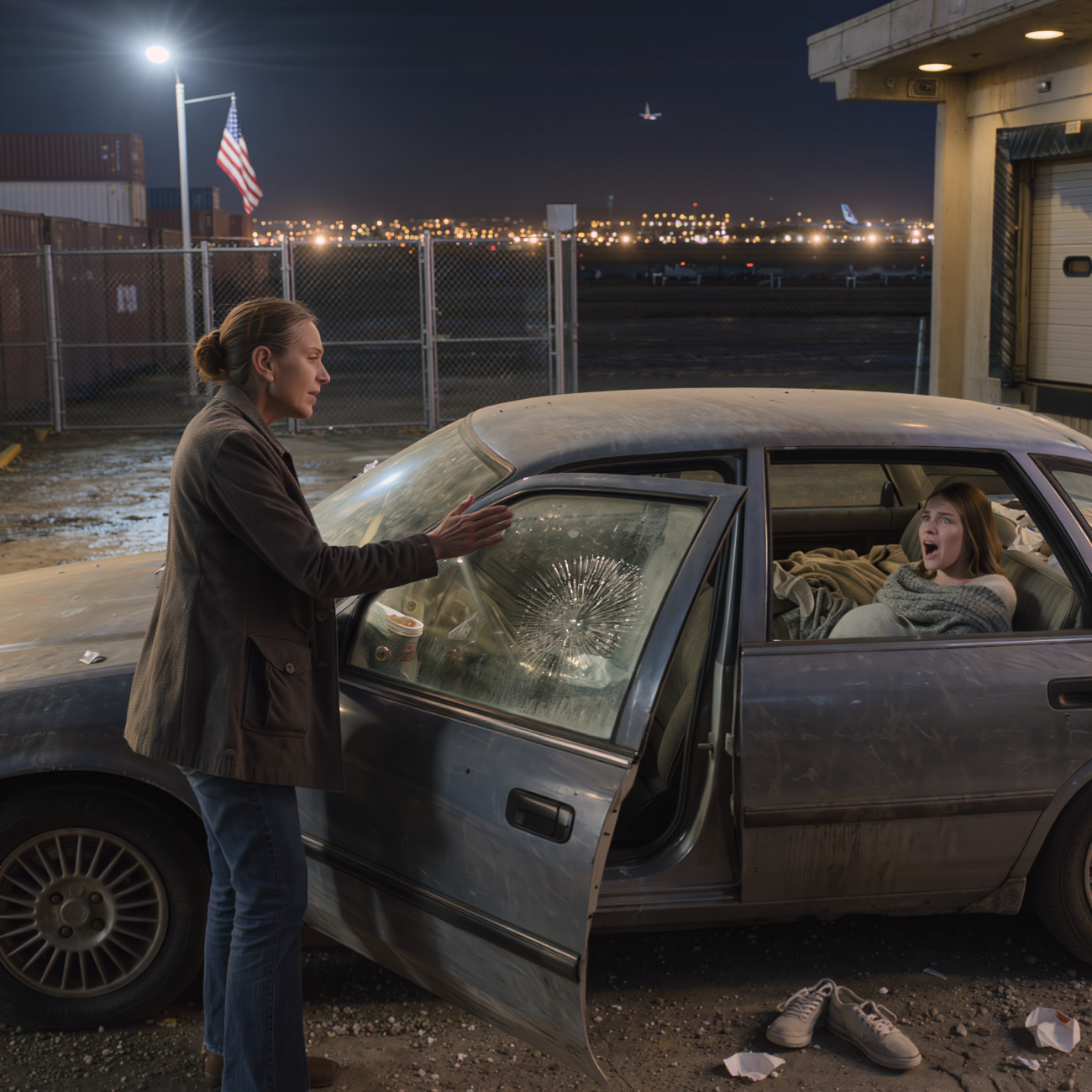
I found my adopted daughter living in her car, pregnant at 19, sleeping under a pile of old coats in an abandoned parking lot. When she saw me through the window, her face didn’t show relief. It showed pure terror. She screamed at me, told me to leave, said I was never her real family anyway.
The same words my other daughter had quoted to me over the phone three days earlier. The call that told me this girl I raised had stolen from our family business and disappeared.
But something was wrong.
If she’d stolen all that money, why was she living in a car? Why was she screaming at me with tears running down her face? And why did she look more terrified than angry?
Someone was lying to me. The question was who. And I wasn’t going to stop until I knew the truth.
My name is Sarah, and this is my story.
Before we continue, please leave a comment telling us where you’re watching from and subscribe to the Never Too Old channel. We’re creating a community of people who know that our best chapters can happen at any age.
Now, back to the story.
I was drinking coffee on the terrace of my villa in Tuscany when my daughter called to tell me the girl I raised was a thief. The phone buzzed against the iron table. Video call. Amelia’s name on the screen.
I tapped the green button. Her face filled the frame. Red eyes, mascara smudged, hair hanging loose instead of pulled back the way she wore it to work. She was alone.
“Mom.”
Her voice cracked.
I set my cup down.
“What happened?”
“It’s Clara.” She pressed her hand to her mouth, then pulled it away. “She’s been stealing from the company. A lot of money. We caught her.”
The word hung there between us like something physical. Stealing.
“Jason found the proof. Bank transfers. Fake invoices. She’s been doing it for months.” Amelia’s face twisted. “She left a note. Mom, she said we were never her real family anyway.”
My chest went tight.
Nineteen years old. I’d raised her since she was ten, when my best friend died and made me promise to take her in. The girl who labeled her notebooks by color, who asked before borrowing anything even after nine years in our house.
“That doesn’t sound like her.”
“I didn’t want to believe it either.” Amelia’s voice went sharp. “I knew we couldn’t trust her, Mom. You always saw the best in her, but I saw this coming.”
I opened my mouth. Nothing came out.
“Jason showed me everything. The company leadership voted to fire her immediately. We had no choice.” Amelia wiped her face with the back of her hand. “She cleaned out her apartment and disappeared.”
Jason. My son-in-law. The man my husband had trained from nothing. The CFO who ran the financial side of our textile mill.
“Where is she now?”
“I don’t know. Gone.” Amelia leaned closer to the camera. “I’m sorry, Mom. I know you loved her, but she used that. She used all of us.”
The sun was warm on my shoulders. A church bell rang somewhere in the valley below. Everything looked the same as it had five minutes ago, but nothing was.
“I need time to think.”
“Of course. Stay in Italy. Take your time. Jason and I will handle everything here.”
The screen went dark.
I sat there holding the phone, staring at the olive groves stretching out below the terrace. My coffee had gone cold.
“Never her real family.”
No. Those words didn’t belong in that girl’s mouth.
They triggered something in my head. A memory sharp enough to cut.
The hospital room had smelled like disinfectant and something sweet trying to cover it up. Helen was dying. My best friend of thirty years, the woman who’d been maid of honor at my wedding, who’d held my hand through my father’s funeral, who knew every secret I’d ever kept.
Six months of cancer treatments that stopped working. Her face was gray against the white pillow. Machines beeped in that steady rhythm that makes you want to scream.
She gripped my wrist. Her nails dug into my skin.
“Clara doesn’t have anyone else. My sister’s been dead ten years. No cousins, no grandparents.” Her voice was barely a whisper. “They’ll put her in the system, Sarah. Foster care. She’s ten years old and she’ll disappear into the system. I know. Promise me. Raise her like she’s yours.”
I looked at the girl standing in the corner. Ten years old with her backpack still on because she’d come straight from school. Her face was blank the way children’s faces go when they’re trying not to understand what’s happening.
“I promise.”
Helen died three days later.
The girl moved into our house the following week. She stood in the doorway of the guest room holding a garbage bag with her clothes inside and asked if she was allowed to put her things in the dresser.
“This is your room now,” I told her. “You can put your things wherever you want.”
She nodded, set the bag down, then sat on the edge of the bed and cried without making a sound.
That was her. Quiet, careful, grateful to the point of breaking. Nine years in our family. She called me Mom. She worked at the mill in the finance department, learning the business from the ground up. She sent me photos of new fabric samples, asking which colors I liked best.
And now Amelia was telling me she’d stolen money and left a note saying we were never her real family.
The coffee cup sat on the table in front of me, the handle chipped from years of use. I picked it up and poured what was left into the terracotta pot beside my chair.
Something was wrong.
Not wrong with Amelia. She’d sounded genuinely devastated. Angry, yes, but also hurt in that specific way that comes from feeling betrayed by someone you trusted.
But the story itself didn’t fit. Theft and cruelty weren’t in that girl’s nature. She’d spent nine years trying to earn her place at our table. She wouldn’t throw it away like that unless something had changed. Unless something had pushed her to a breaking point I hadn’t seen from 3,000 miles away.
I thought about why I was in Italy in the first place.
My husband had been sick for years before he died. Parkinson’s that got worse every month until he couldn’t feed himself, couldn’t walk, couldn’t remember who I was half the time. I’d been his caregiver through all of it. Bathing him, turning him in bed so his skin wouldn’t break down, watching him fade piece by piece.
When he finally died, I didn’t have anything left.
This villa, this whole Italian dream—it had been ours. Something we’d planned for retirement. Sunday mornings in bed talking about terracotta roofs and vineyards and coffee on a terrace overlooking hills that went gold in the morning light.
He never made it.
I came anyway because not coming felt like another promise broken. But I’d also come because I was exhausted down to my bones. I’d handed the mill over to Amelia and Jason. I’d told myself they were capable, that they’d take care of the girl, that I could finally rest.
I’d left them in charge of everything.
And now she was gone.
I stood up. The iron chair scraped against the tile.
Inside the villa, I walked through the cool stone hallway to the bedroom where I’d left my laptop on the desk. I opened it and typed in a name I hadn’t used in five years. A private investigator. Discreet, expensive, the kind who didn’t ask questions.
I sent an email.
Find Clara Mitchell. Do not let Amelia or Jason know you are looking.
I hit send. Then I opened a new tab and searched for flights.
The earliest one left tomorrow morning. One layover. I booked it with the credit card I kept separate from the business accounts, the one Amelia didn’t have access to.
Done.
I closed the laptop and walked back through the house to my bedroom. In the closet, I pulled out the suitcase I hadn’t touched since I’d arrived two years ago. I packed without thinking. Underwear, shirts, the black pants I’d worn to my husband’s funeral because they still fit.
On the desk was a photograph in a silver frame. My husband on the left, his arm around my shoulders, Helen on the right, laughing at something I’d said while taking the picture. Between us, ten-year-old Clara smiling, that careful smile she’d had back then, the smile that said she wasn’t sure if she was allowed to be happy yet.
I wrapped the frame in a sweater and tucked it into the suitcase.
My phone buzzed. A text from the investigator.
On it. We’ll have preliminary info within 24 hours.
I typed back, “Thank you.”
Outside the bedroom window, the Tuscan hills were still gold. The church bells rang again. Everything looked peaceful, but I knew something was wrong.
Amelia had always resented the girl. I’d seen it for years. The tight jaw when she got an award at school. The small comments at dinner that weren’t quite jokes. Things like, “Must be nice to be the favorite.” Or, “Mom has so much more time for you than she ever had for me.”
It wasn’t entirely wrong.
When Amelia was young, I’d been building the mill with my husband. Fourteen-hour days, weekends at trade shows. I’d missed recitals, forgotten lunches, come home too tired to ask about her day.
By the time Helen’s daughter arrived, we’d hired managers. We had systems. I had time. And the girl had needed me in a way Amelia never seemed to. Or maybe Amelia had needed me just as much, and I’d been too busy to see it.
Either way, Amelia had grown up jealous. I’d known that. I’d tried to manage it, but I’d also been tired. And managing other people’s feelings is exhausting when you’re seventy years old and you’ve just buried your husband.
So, I’d left. I’d gone to Italy. I’d trusted my daughters to figure it out.
I zipped the suitcase closed.
My instincts were screaming. The girl I knew wouldn’t steal. She wouldn’t run. And she definitely wouldn’t leave a note saying we were never her real family. She’d spent nine years terrified of being sent away. She would never walk away on her own, which meant something else was happening. Something I couldn’t see from Italy.
I didn’t know what yet. I didn’t know who was at fault, but I was going to find out.
I picked up the photograph one more time. Helen’s face looked back at me from behind the glass, her hand on her daughter’s shoulder, that smile she’d had before the cancer took everything.
“Promise me.”
“I’m coming,” I said to the empty room, to Helen, to the girl I’d sworn to raise as my own.
I set the frame down and carried my suitcase to the front door. Tomorrow morning, I’d be on a plane. By tomorrow night, I’d be back in the States and I was going to find her.
The flight took thirteen hours with a layover in Frankfurt. I didn’t sleep. I sat in the window seat with my phone in my lap, watching the screen for updates from the investigator.
Nothing until we landed.
I turned my phone off airplane mode while everyone else was still gathering their bags from the overhead bins. The message came through immediately.
Found her. Sending location now.
A pin dropped on a map. Industrial area on the east side of town, twenty minutes from the airport. A place where textile suppliers used to have warehouses before everything moved overseas. I knew the neighborhood. Empty lots, chain-link fences, nothing there anymore except concrete and weeds.
I texted back, “Thank you. Send the bill to my personal account.” Then I deleted the messages.
I didn’t go to the family estate. I checked into a hotel downtown. A small place that didn’t ask questions when I paid cash. The room was clean but generic. Beige walls, polyester bedspread, a painting of a lighthouse that could have been anywhere.
I set my suitcase on the floor and sat on the edge of the bed, staring at the map on my phone, the blue dot marking where she was. My hands were shaking.
I left the hotel and got into the rental car I’d picked up at the airport. I plugged the address into the GPS. Twenty-three minutes.
The roads got emptier the farther I drove. Strip malls gave way to closed storefronts. Then vacant lots with FOR LEASE signs that had been there so long the ink had faded.
The GPS told me to turn left into an industrial park that looked like it had been abandoned for years. Cracked pavement, rusted dumpsters, a chain-link fence with a gate hanging off one hinge. And in the back corner of the lot, under a tree that had pushed through the asphalt, a car.
I pulled in slowly. My tires crunched over broken glass. The car was a sedan with some rust along the bottom of the doors and a back bumper that didn’t quite match the paint. The windows were fogged from the inside.
I parked twenty feet away and turned off the engine. For a moment, I just sat there. My heart was pounding so hard I could hear it in my ears.
Then I opened the door and got out. The air smelled like oil and wet concrete. Somewhere in the distance, a dog was barking.
I walked toward the sedan, my shoes loud against the pavement. As I got closer, I could see movement inside, someone shifting under a pile of fabric.
I stepped up to the driver’s side window and knocked gently.
The pile moved. A face appeared.
It was her. Dark circles under her eyes, hair pulled back in a messy ponytail, wearing a sweatshirt that looked three sizes too big—and pregnant. The curve of her belly was visible even under the loose fabric.
My breath stopped in my chest.
She blinked at me through the glass. For one second, her face went soft. Relief. Recognition.
Then it twisted into something else. Terror.
She scrambled back against the passenger door, shaking her head.
I knocked again, softer this time.
“Clara, it’s me. Open the door.”
“No.” Her voice was muffled through the glass. “Go away, please.”
“I just want to talk.”
“I don’t want to talk to you.” She was crying now. Tears running down her face. “Just leave me alone.”
“I’m not going anywhere until you tell me what’s happening.”
She pressed her hands against the window like she was trying to push me away through the glass.
“You don’t understand. You can’t be here.”
“Then help me understand.”
“I can’t.” Her voice broke. “Just go, please.”
I reached for the door handle. Locked.
“Clara—”
“You were never my real family anyway.”
The words came out like something she’d been holding in her mouth too long. Sharp, painful.
“Okay, is that what you wanted to hear? You were never my real family. I don’t need you. I don’t want your help.”
She was shaking. Her whole body was shaking.
“I don’t believe you,” I said.
“I don’t care what you believe.” She turned away from me, curling up against the passenger door. “Leave me alone.”
I stood there for a long moment, my hand still on the door handle, the window between us fogging up from her breath.
“I’m not giving up on you,” I said quietly.
She didn’t answer.
I walked back to my car. My legs felt weak. I got in and sat there with my hands on the steering wheel, staring at her through the windshield.
She was nineteen, pregnant, living in a car, and she’d just screamed at me using the exact same words Amelia had quoted on the phone.
For a moment, everything Amelia had said felt possible. Maybe she really had stolen the money. Maybe she really did resent us. Maybe I’d been wrong about everything.
But then I thought about the way her face had looked before the terror set in. That one second of relief when she saw me.
And I thought about something else.
If she’d stolen money, why was she living in a car? A thief doesn’t end up homeless. A thief runs with the money, disappears to another state, buys a plane ticket. A thief doesn’t sleep in a parking lot in November, pregnant, wearing a sweatshirt with holes in the sleeves.
I started the car and drove out of the lot. In my rearview mirror, I could see her sedan getting smaller, the fogged windows, the mismatched bumper.
My daughter was living in a car, and she was too terrified to let me help her. Not angry. Terrified.
The drive back blurred together. I wasn’t paying attention to the road. I was thinking about Amelia, about the bitterness in her voice when she’d called me in Italy.
“I knew we couldn’t trust her, Mom.”
I’d always known Amelia resented the girl. I’d seen it for years, but told myself it would fade with time.
I was remembering a night about a year after the adoption. We’d had a small celebration dinner for Clara’s college acceptance letter. Nothing fancy, just the four of us at the kitchen table.
Amelia had barely said two words through the whole meal. When I’d asked her to pass the salt, she’d done it without looking up.
Later, I’d heard voices from my husband’s study. The door was cracked open.
“You have all this time for her now.” Amelia’s voice, quiet but sharp. “Where was that when I was growing up?”
My husband had said something I couldn’t hear.
“I’m happy for you, Dad. Really, it’s wonderful that you finally get to be the parent you always wanted to be. Better late than never, right?”
The sarcasm in her voice had been thick enough to cut.
I’d walked away before I heard the rest. I hadn’t known what to say, how to fix it. So I’d done nothing.
And now, nine years later, I was wondering if that nothing had grown into something I couldn’t see.
I pulled into the hotel parking lot and turned off the car.
But it didn’t make sense. If she’d stolen money, why was she living in a car? That question kept circling back.
I sat there for a long time trying to make the pieces fit. They wouldn’t.
Finally, I pulled out my phone and called Amelia.
She answered on the second ring.
“Mom, are you okay?”
“I’m back in the States.”
Silence. Then, “You’re here? When did you get in?”
“This morning. I couldn’t stay away.”
“Oh, Mom.” Her voice softened. “I’m so sorry. I know this is hard.”
“I want to come home.”
“Of course. Yes. Come to the house. Jason and I are both here.”
I closed my eyes.
“I’ll be there in an hour.”
“Drive safe. I love you.”
“I love you, too.”
I hung up and drove north toward the estate, the house where I’d raised both my daughters, where my husband had died in the downstairs bedroom because he couldn’t make it up the stairs anymore.
The gates were open when I arrived. I drove up the long driveway. The house looked the same. Big gray stone. Ivy growing up the east wall.
I parked and got out. The front door opened. Amelia stood there in jeans and a sweater. She looked tired.
“Mom.”
She came down the steps and hugged me. I hugged her back.
Behind her, Jason appeared in the doorway, tall, graying at the temples, wearing a button-down shirt.
“Sarah.”
He shook my hand. “I’m so sorry you’re dealing with this.” His grip was firm. His eyes were steady. He looked exactly like the man my husband had trusted.
“Come inside,” Amelia said.
I followed them into the house. The entry hall was exactly the same. Hardwood floors, the grandfather clock in the corner, the smell of lemon polish and old wood.
I sat at the kitchen table while Amelia made tea. Jason excused himself to take a work call.
“How are you holding up?” Amelia asked.
“I don’t know yet.”
The kettle whistled. She poured the water. I sat there, my hands folded in front of me, and thought about the girl in the car, about the terror in her eyes.
Something was very wrong.
I just didn’t know what yet, or who was lying. But I was going to find out.
That night, I unpacked in the guest room—my own house, but I was staying in the guest room because Amelia and Jason had moved into the master bedroom after I left for Italy. It made sense. They’d been living here, managing the business, taking care of the property.
But it still felt strange, like I was a visitor.
The room was exactly how I’d left it. Blue wallpaper, white curtains, a dresser with brass handles that stuck when you pulled them.
I put my clothes away slowly, listening to the sounds of the house. Amelia’s voice downstairs talking on the phone. Water running in the kitchen. The creak of floorboards in the hallway.
I sat on the edge of the bed and looked at the photograph I’d unpacked. My husband, Helen, young Clara. The faces stared back at me.
I set it on the nightstand and lay down without changing clothes. I was exhausted, but I couldn’t sleep. Every time I closed my eyes, I saw her face through the car window. The terror in her eyes.
The next morning, Amelia made breakfast. Scrambled eggs, toast, coffee that was too weak, but I drank it anyway.
Jason had already left for the office.
“Early meeting with suppliers,” Amelia said.
We sat across from each other at the kitchen table, the same table where we’d eaten thousands of meals as a family.
“I’m glad you’re here,” Amelia said. “I didn’t want to go through this alone.”
“I’m glad I came.”
She pushed her eggs around her plate.
“I keep thinking about all the signs I missed. She was always so quiet, so careful. I thought she was just shy.” She looked up at me. “But maybe she was hiding things the whole time. Maybe you gave her everything, Mom. A home, a family, a job at the company, and this is how she repays you.”
I nodded and took another sip of coffee.
“She’s always been ungrateful,” Amelia continued. “I know that’s hard to hear, but it’s true. She never appreciated what she had.”
I wanted to argue, to defend her, but I was supposed to be the heartbroken mother who believed the story, so I stayed quiet.
Over the next few days, I fell into a routine. Breakfast with Amelia. Long stretches of time alone while she and Jason went to the office. Dinners where Jason was polite and helpful and mostly silent. He asked how I was holding up. He offered to handle anything I needed. He talked about the business in that calm, competent way my husband had always admired.
One night at dinner, while Amelia was getting dessert from the kitchen, Jason leaned forward.
“I’m sorry you have to deal with this, Sarah. Your husband would have hated seeing you hurt like this.”
The mention of my husband caught me off guard.
“He trusted you,” I said.
“I know. I tried to live up to that.” Jason’s voice was steady, sincere. “He gave me everything, taught me the business from the ground up. I wouldn’t be where I am without him.”
I remembered my husband saying almost the same thing years ago. We’d been in his study going over the books. He’d just promoted Jason to CFO.
“Don’t worry, Sarah. If anything ever happens to me, Jason will take care of everything. He’s the son I never had.”
My husband had smiled when he said it. Proud. I’d believed him then. Jason had been the perfect protégé. Smart, hard-working, loyal.
Now I looked across the table at him and wondered if my husband had been wrong. Or if I was wrong for doubting him.
Amelia came back with coffee and the moment passed.
On the fourth day, I told Amelia I was going for a walk. I needed air, time to think. She nodded and said to take my time.
I walked upstairs instead, down the hallway to the room that used to be Clara’s. The door was closed. I opened it slowly.
The room looked exactly like she’d left it. The bed was made. Books were stacked on the desk. A sweater was draped over the back of the chair.
It didn’t look like the room of someone who’d run away. It looked like someone had just stepped out for a moment and would be back soon.
I walked to the desk, opened the drawers one by one. Pens, notebooks, a stapler. In the bottom drawer, textbooks: Corporate Finance, Accounting Principles, Business Management.
She’d been studying, learning, building a future.
I closed the drawer and moved to the closet. Most of her clothes were still there—a winter coat, jeans folded on the shelf, shoes lined up on the floor.
If she’d really run away, why hadn’t she taken more?
I knelt down and looked under the bed. Dust, a box of old magazines, and something else. A small book with a blue cover.
I pulled it out. Learn to Draw: A Beginner’s Guide. The cover was worn at the edges.
I opened it. The pages were filled with pencil sketches, not the exercises from the book. Personal drawings. A crib, simple lines but careful, like she’d drawn it over and over until she got it right. Baby clothes, tiny shirts with buttons, little pants with elastic waistbands. A mobile with stars hanging from strings. Booties so small they could fit in the palm of my hand.
I sat back on my heels, the book open in my lap.
These weren’t the drawings of someone planning to run away. These were the drawings of someone preparing, someone excited, someone making a life.
She’d been pregnant and happy about it. And now she was living in a car, too terrified to let me help her.
I closed the book and stood up. My hands were shaking.
Something was very, very wrong.
A thief doesn’t draw pictures of baby clothes. A thief doesn’t leave her winter coat behind. A thief doesn’t study corporate finance textbooks and plan a future at the family business.
Someone had driven her out. Someone had made her so afraid that she’d rather live in a car than come home.
I tucked the drawing book under my arm and left the room. Downstairs, I heard Amelia moving around in the kitchen. I went straight to the guest room and closed the door behind me.
That night, after Amelia and Jason went to bed, I sat in the guest room with my phone. I scrolled through my contacts until I found the name I was looking for.
Victor Ashford. Forensic accountant I’d worked with fifteen years ago when we had a supplier trying to inflate invoices. Retired now, but still consulting on complex cases.
I sent him a text.
Need your help. Confidential. Can you audit company financials? Possible irregularities.
The response came ten minutes later.
Of course. Send me access credentials. This stays between us.
I replied with the account information and passwords I still had from before I left for Italy.
Report only to me. No one else can know.
Done.
I set the phone down and picked up the drawing book again, flipping through the careful sketches, the tiny booties.
A girl planning for her baby doesn’t steal money and run. Something had happened. Something had pushed her out.
And I was going to find out what.
I was setting a trap. I just didn’t know yet who would be caught in it.
Victor sent the report four days later. I was sitting in the guest room when my phone buzzed. An email with a PDF attachment. The subject line was blank.
I opened it.
The first page was a summary. Short sentences. Numbers that didn’t make sense until I read them twice.
Systematic embezzlement over twenty-four months. Approximately $800,000 diverted through fake invoices and shell companies. Wire transfers to offshore accounts in the Cayman Islands. Additional transfers to personal account of junior executive named Rebecca Cole. Property purchase in Costa Rica registered under shell company controlled by Jason Cole. Value $450,000. Evidence of fabricated documentation implicating Clara Mitchell in theft of $42,000. Digital trail shows documents created on Jason Cole’s office computer. One-way airline tickets to San Jose, Costa Rica. Departure date, December 15th. Two passengers.
I set the phone down. My hands were shaking.
I read it again, then a third time.
Jason had stolen $800,000 from the family business. He’d bought property in another country. He’d booked one-way tickets for himself and someone else. And he’d framed Clara.
I picked up my phone and called the private investigator who’d found Clara in the parking lot.
“I need you to investigate someone. Rebecca Cole, junior executive at our textile mill. I need to know her relationship with my son-in-law. Everything you can find.”
“This will take a few days.”
“That’s fine. Be thorough.”
I hung up and sat there staring at the wall.
The next three days were the hardest of my life. I ate breakfast with Amelia, made small talk with Jason, smiled when I was supposed to smile, and the whole time I knew what he’d done.
On the third day, Jason mentioned he had an overnight trip to meet with fabric suppliers upstate. He’d be gone until the following evening.
“That’s fine,” Amelia said. “Mom and I can hold down the fort.”
He left early the next morning. I watched from the guest room window as his car pulled down the driveway.
An hour later, the investigator called.
“Rebecca Cole, twenty-eight years old, started at the mill three years ago, currently assistant controller.” He paused. “She’s been involved with Jason Cole for at least eighteen months. I have surveillance photos, hotel records, phone records showing frequent contact, credit card receipts from restaurants and weekend trips.”
“Send everything.”
“Already in your email.”
I opened my laptop. The photos loaded one by one. Jason and Rebecca leaving a hotel, his hand on her back. Jason and Rebecca at a restaurant two towns over, holding hands across the table. Jason and Rebecca in a parking lot, kissing.
I printed everything. The forensic report, the photos. I put them all in a folder.
Then I went downstairs and waited.
Amelia came home around six. I heard her car in the driveway, the front door opening, her footsteps in the hallway.
I met her in the kitchen.
“Is Jason here?” I asked.
“No, he’s still upstate. Why?”
“I need to talk to you alone. Upstairs.”
She looked at me. Something in my face must have warned her because her expression changed.
“What’s wrong?”
“Come with me.”
We went to my room. I closed the door and handed her the folder.
“What is this?”
“Just look.”
She opened it. The first thing she saw was the photo of Jason kissing Rebecca in the parking lot. Her face went white.
She flipped to the next photo, then the next. Her hands were shaking.
“Oh my God.” Her voice was barely a whisper. “Rebecca from accounting.”
“Yes.”
She sat down on the edge of the bed. She was still holding the folder, but she wasn’t looking at it anymore.
“How long?”
“At least eighteen months.”
She nodded slowly, like she was processing information that didn’t quite fit together yet.
“There’s more,” I said quietly.
She looked up at me.
“Keep reading.”
She turned to the next page. The forensic report. I watched her face as she read. Embezzlement. Shell companies. Offshore accounts. $800,000. Property in Costa Rica. One-way tickets. And then the last section: evidence Clara was framed.
Amelia read it twice. Then she set the folder down very carefully on the bed beside her.
“He framed her.”
“Yes.”
“Clara didn’t steal anything.”
“No.”
Amelia’s face crumpled. She pressed her hands over her mouth and started crying.
I sat down next to her, put my arm around her shoulders. She cried for a long time. I didn’t say anything. There was nothing to say.
Finally, she wiped her face with her hands.
“I believed him.” Her voice was raw. “He told me Clara stole from us and I believed him. I said terrible things about her. I told you she was ungrateful and dishonest and I believed every word.”
“He’s very good at lying.”
“I wanted to believe it.” She looked at me. “That’s the worst part. Some part of me wanted her to be guilty because it meant I was right. All those years of feeling like she didn’t deserve what she had. And when he told me she’d stolen from us, it felt like proof.”
“You didn’t know.”
“I should have known.”
She picked up the folder again, stared at the ticket information.
“He was going to leave me. Take all that money and just disappear with her.”
“Yes.”
Amelia stood up.
“Where is she? Clara. Where is she?”
“Still in the car. The industrial lot.”
“Take me to her. Right now.”
“Amelia—”
“I need to see her. I need to tell her I’m sorry.”
I looked at my daughter, at the devastation in her eyes, the guilt.
“Okay.”
We left through the back door, got in my car, and drove across town without speaking.
The lot looked the same. Gray concrete, rusted dumpsters, her car parked in the back corner under the tree. I pulled up next to it and turned off the engine.
Clara was awake this time, sitting in the driver’s seat with a book open on her lap. She saw us and her face went tight with fear.
Amelia got out. I stayed back. This needed to be between them.
Amelia walked to the driver’s side window and knocked gently.
Clara didn’t move.
“Please,” Amelia said. Her voice cracked. “I know you’re scared, but I need you to hear me.”
Clara stared at her through the glass.
“I’m so sorry.” Amelia was crying again. “I said terrible things to you. I believed lies about you, and I was cruel to you for years before that because I was jealous and bitter, and I made you feel like you didn’t belong.”
Clara’s hand moved toward the door lock. Stopped.
“Jason framed you. We know everything. The embezzlement, the affair, the fake evidence.”
Amelia pressed her hand against the window.
“You didn’t do anything wrong. And I’m so, so sorry I didn’t believe you.”
The lock clicked.
Clara opened the door slowly. She got out, standing there in the parking lot, pregnant and thin and exhausted.
Amelia reached for her and Clara collapsed into her arms. They both cried.
I stayed by my car, giving them space.
After a few minutes, I walked over. Clara looked at me over Amelia’s shoulder, her face streaked with tears.
“He said if I told anyone, he’d have me arrested.” Her voice was barely a whisper. “He said I’d go to prison and they’d take my baby away. I didn’t know what to do.”
“You’re safe now,” I said.
“I’m sorry I pushed you away. I’m sorry I said those things.”
“I know you didn’t mean them.”
She pulled back from Amelia and looked at both of us.
“I always felt like I owed you everything. When he told me I’d ruined everything by getting pregnant and discovering what he was doing, I believed him because I’d spent nine years being afraid I’d do something wrong and you’d send me away.”
Amelia’s face crumpled again.
“That’s my fault. I made you feel that way.”
“Not just you.” Clara wiped her eyes. “It’s what happens when someone takes you in. You spend the rest of your life trying to earn your place.”
“You never had to earn it,” I said. “I said your mother was my best friend. I loved you because you were hers and because you became mine.”
Clara nodded, but I could see she didn’t quite believe it yet.
“We’re going to fix this,” Amelia said. “All of it. Jason is going to pay for what he did.”
“How?”
“We’re going to trap him,” I said. “And then we’re going to have him arrested.”
Clara looked between us.
“What do you need me to do?”
“First, you’re not staying in this car another night,” Amelia said. “We’re taking you somewhere safe.”
“Where? A hotel? Somewhere Jason doesn’t know about. You’ll stay there until we have him arrested.”
Clara hesitated.
“Okay.”
We got her things from the car. It wasn’t much. Some clothes, a blanket, the book she’d been reading. She got in the back seat. Amelia sat next to her.
I drove to a hotel on the other side of town, a nice place, clean, safe. We checked Clara in under my name and paid cash, got her a room on the third floor with a view of the parking lot.
“Order room service,” I told her. “Get some rest. We’ll call you tomorrow when we have a plan.”
She nodded. Amelia hugged her one more time before we left.
In the car on the way back, Amelia stared out the window.
“We need a lawyer,” I said.
“Martin. He’s handled everything for the company for twenty years. Call him.”
Amelia pulled out her phone. It was almost nine at night, but she dialed anyway.
“Martin?”
“Amelia, everything okay?”
“No. We need your help. It’s urgent.”
“What happened?”
“Jason’s been embezzling from the company. We have proof. We need to have him arrested.”
Silence. Then, “Can you come to my office first thing tomorrow morning? Bring everything you have.”
“We’ll be there at eight.”
“I’ll see you then.”
She hung up.
We sat in the driveway for a moment before going inside. The house was dark, empty.
“What happens now?” Amelia asked.
“Now we set the trap.”
Martin’s office was on the third floor of a brick building downtown. We arrived at eight the next morning. Amelia and I. Clara stayed at the hotel.
The receptionist showed us into a conference room. Martin was already there. Sixty-something, gray suit, reading glasses hanging from a chain around his neck.
“Sit down,” he said. “Show me what you have.”
Amelia handed him the folder.
He read through everything slowly. The forensic report, the photos, the offshore account details, the plane tickets.
When he finished, he set it down and looked at us over his glasses.
“This is solid. Very solid. Have you contacted the police?”
“Not yet,” I said. “We wanted to talk to you first.”
“Good.”
He pulled out a legal pad and started writing.
“Here’s what we’re going to do. We’ll coordinate with the district attorney’s office. They’ll assign detectives. We’ll arrange a meeting. Get Jason into a room where he thinks he’s safe. Then we spring the trap.”
“How long will that take?” Amelia asked.
“I can have detectives here this afternoon. We’ll need Clara to give a formal statement about the threats. Then we set up the meeting for tomorrow evening.”
“Tomorrow?” Amelia’s voice was tight.
“The faster we move, the less chance he has to run.” Martin looked at her. “Can you act normal around him for one more day?”
She nodded.
“Yes.”
“Good. Don’t let him suspect anything. If he gets spooked, this all falls apart.”
We left the office an hour later. Martin was already on the phone with the DA.
In the car, Amelia sat with her hands in her lap, staring straight ahead.
“Are you okay?” I asked.
“He came home last night from his trip.” Her voice was flat. “I was in bed pretending to be asleep when he got in. He kissed my forehead, told me he loved me.”
She turned to look at me.
“I wanted to scream.”
“One more day.”
“I know.”
I drove her back to the house. Jason’s car was in the driveway.
“Call me if you need anything,” I said.
She nodded and got out. I watched her walk up to the front door. She straightened her shoulders before going inside. Playing the part.
That afternoon, I picked Clara up from the hotel. We drove to the police station where two detectives were waiting. A man and a woman, both in plain clothes.
They took us to a small room with a table and recording equipment.
“We need you to tell us everything,” the woman said. Her name was Detective Price. “Start from the beginning.”
Clara looked at me. I reached across the table and took her hand.
“It’s okay,” I said. “Tell them.”
She took a breath.
“I work in the finance department. About two months ago, I noticed some irregularities in the accounts. Invoices that didn’t match up, payments to suppliers I’d never heard of.” Her voice was quiet but steady. “I started digging. I found wire transfers, fake companies, money disappearing.”
“What did you do?” Detective Price asked.
“I went to Jason. He’s the CFO. I thought maybe there was an explanation. Maybe I was missing something.” She paused. “He told me I was right to come to him. He said he’d been investigating it, too. He asked me not to tell anyone else until he figured out who was responsible.”
“And then?”
“A week later, I found out I was pregnant. I told Amelia, my sister. I was excited and scared.” Her voice cracked. “She must have told Jason. The next day, everything changed. He pulled me into his office and closed the door. He said I’d ruined everything. That I was irresponsible and stupid. Then he showed me documents, bank records, transfers with my name on them. He said I’d been stealing from the company and he had proof.”
I squeezed her hand.
“He said if I told anyone he’d have me arrested, that I’d go to prison and they’d take my baby away. He said no one would believe me over him. That I was just the adopted daughter who’d never really belonged.”
She wiped her eyes with her free hand.
“He sent me text messages repeating the threats. I saved them. I was too scared to delete them.” She paused. “So I left. I didn’t know what else to do.”
The detectives asked more questions. Clara answered all of them. It took two hours.
When we were done, Detective Price shut off the recorder.
“You did the right thing,” she said. “We have everything we need.”
Back in the car, Clara leaned her head against the window.
“What happens now?” she asked.
“Now we trap him.”
“How?”
“Tomorrow evening, Martin will call Jason, tell him I want to meet about the business. Financial concerns. Jason will think everything is fine. He’ll show up and we’ll be waiting.”
“All three of us?”
“Yes.”
She was quiet for a moment.
“I’m scared.”
“I know. But you’re not alone this time.”
I took her back to the hotel, made sure she ate something, then I drove home.
That night, I called Amelia.
“How are you holding up?”
“He’s downstairs watching television like nothing’s wrong.” Her voice was strained. “I keep thinking about how many times he’s lied to my face, how many times I believed him.”
“Just until tomorrow night. We need him to feel safe.”
“I know.”
“Can you do it?”
“Yes.” She sounded more certain this time. “I can do it.”
The next morning, Martin called Jason at his office. I was standing next to Martin when he made the call. We had it on speaker.
“Jason, it’s Martin. I need to schedule a meeting with you and Sarah tonight at six in the boardroom at the mill.”
“Tonight?” Jason sounded surprised but not suspicious. “What’s this about?”
“Sarah wants to discuss the company’s future. Some financial concerns she has. She specifically asked for your professional opinion on how to proceed.”
“Of course. I’ll be there. Six o’clock.”
Martin hung up and looked at me.
“He took the bait. Now we wait.”
That afternoon, Clara and I met the detectives at the mill. They set up in the conference room next to the boardroom. Close enough to hear everything. Close enough to move fast.
Detective Price went over the plan one more time.
“We wait until he’s confronted with the evidence. Let him talk. Let him try to lie his way out. Then we make the arrest.”
“What if he runs?” I asked.
“He won’t get far. We’ll have two officers outside.”
At 5:30, Amelia arrived. She looked pale but composed.
At 5:45, Clara came in through the side entrance and slipped into the conference room next door with the detectives.
At six exactly, we heard footsteps in the hallway.
The door opened. Jason walked in, briefcase in hand, confident smile. Then he saw Clara. He froze. His smile disappeared.
“What is this?”
He looked at me, then at Amelia, then back at Clara.
“What is she doing here?”
“Sit down, Jason,” I said.
His face was changing—confusion shifting to calculation.
“Sarah, I don’t know what she’s told you, but—”
“Sit down.”
He stayed standing.
“She’s a thief. She stole from this company, from your family. Why is she even here?”
“Because she didn’t steal anything,” Amelia said. Her voice was steady. “You did.”
The color drained from his face.
The door behind him opened.
Detective Price and her partner walked in.
“Jason Cole,” Detective Price said.
He spun around.
“It’s over, Jason,” I said.
Detective Price moved to the table. She laid out the forensic report, then the bank statements, the offshore account records, the property deed in Costa Rica, the plane tickets.
“Systematic embezzlement over two years,” she said. “Eight hundred thousand dollars. Wire transfers to Rebecca Cole and to offshore accounts. Fabricated evidence framing Clara Mitchell.”
She looked at him.
“We have everything.”
Jason stared at the documents. Then he looked at me.
“This is a misunderstanding. Sarah, you know me. Your husband trusted me. I would never—”
“You told me if I said anything, you’d make sure I lost my baby.” Clara’s voice cut through his lies. Quiet but clear.
He turned to her, his face twisted.
“You have no proof of that.”
“Actually,” Detective Price said, “we have the text messages you sent her. Ms. Mitchell saved them, and we have her detailed testimony about your threats.”
His jaw clenched.
Amelia stood up. She walked around the table until she was standing right in front of him.
“You didn’t just steal money,” she said. Her voice shook, but she kept going. “You used me. You knew I was jealous of her. You knew I resented her, and you used that. You made me believe my sister was a criminal. You turned me into a weapon against my own family.”
He reached for her.
“Amelia, please. I did this for us, for our future.”
She stepped back.
“Don’t you dare. There is no ‘us’ anymore. There never was. You were already planning your future with her.”
His hand dropped.
The other detective stepped forward with handcuffs.
“Jason Cole, you’re under arrest for embezzlement, fraud, and witness intimidation.”
Jason’s face went from white to red.
“This is insane. You can’t prove any of this. I’ll fight this. I’ll—”
The detective pulled his arms behind his back and snapped the cuffs on.
“You have the right to remain silent—”
Jason looked at the three of us standing there together, his face filled with rage and something else. Fear.
“You’ll regret this,” he said. “All of you.”
“I don’t think so,” I said.
They led him out, his footsteps echoing down the hallway, the elevator doors opening, then silence.
The three of us stood there, not moving, not speaking. Outside the windows, the city lights were starting to come on, the sky fading from blue to purple.
I reached for both my daughters’ hands. Clara on my right, Amelia on my left. They held on.
We stood there together in the boardroom where my husband and I had built this company, where we’d made decisions and signed contracts and planned for a future we thought we understood.
The future looked different now, but we were still standing. And we were standing together.
We left the boardroom together that night. Walked out to the parking lot under streetlights that made everything look softer than it was.
Clara came home with us. Not to a hotel—home.
She moved back into her old bedroom, the one with the books still stacked on the desk and the winter coat still hanging in the closet like she’d never left. But everything felt different now. Lighter.
The house didn’t hold its breath anymore.
Over the next few weeks, we settled into a new rhythm. Breakfast together. Amelia and I taking turns driving Clara to doctor’s appointments. Long evenings in the living room where we didn’t talk much but sat together anyway.
Amelia started therapy. Twice a week at first, then once. She came home from those sessions quiet. Sometimes her eyes were red.
One night she knocked on Clara’s door. I was walking past and heard her voice through the wood.
“I’m sorry. I know I’ve said it before, but I need to say it again. I was cruel to you for years, and I’m sorry.”
Clara’s voice was softer.
“I know. I’m trying to be better.”
I could hear the pause.
“I can see that.”
It wasn’t perfect, but it was honest.
The baby came in March, a cold Tuesday morning when the sun was just starting to come up. Amelia and I were both in the delivery room, standing on either side of Clara while she gripped our hands hard enough to bruise.
When they placed the baby on her chest, she cried. We all did.
He was small, pink, perfect.
“You’re his family,” Clara said, looking between us, tears running down her face. “Both of you. You saved us.”
“What are you going to name him?” Amelia asked.
Clara looked down at the baby, then at me.
“Paul. After your husband. The man who started all of this.”
My throat closed. I couldn’t speak for a moment.
“He would have loved that,” I finally managed.
“I know.”
Over the months that followed, the house filled with new sounds. A baby crying at two in the morning. Cooing from the nursery. Laughter when Amelia made faces to get him to smile.
I taught Clara how to read balance sheets the way Paul had taught me. We sat at the kitchen table with spreadsheets spread out between us while the baby slept in his carrier on the floor.
Amelia showed her how to present to the board, how to hold the room, how to answer questions without sounding defensive. They worked well together. Better than I’d expected.
The company didn’t just survive. It grew. New contracts, new markets, the kind of growth that comes when people care about what they’re building.
Amelia started a charitable foundation using some of the recovered funds from Jason’s accounts. She focused on helping women in crisis—single mothers, women fleeing bad situations. She threw herself into it with the same intensity she’d once thrown into her jealousy.
“I can’t fix what I did to Clara,” she told me one day. “But maybe I can help someone else’s sister.”
Five years passed.
It’s Tuesday afternoon now. I’m sitting in my office at the mill going through quarterly reports. The numbers are good. Better than good.
I’m seventy-five years old now, but my mind is still sharp. Sharp enough to know when to step back.
Through the glass wall of my office, I can see into the conference room. The board meeting is in session. Amelia and Clara are presenting together. They’re talking about expansion plans, a new line of organic cotton bedding.
They move around each other easily. Clara pulls up a slide. Amelia explains the market research. They finish each other’s sentences.
One of the board members says something. They both laugh.
The meeting wraps up. Papers shuffle, chairs push back.
In the corner of the conference room, Paul is sitting on the floor with a coloring book. Four years old now. Dark hair like his mother, curious eyes like his grandmother, Helen.
He sees Clara and scrambles to his feet, runs to her. Amelia scoops him up first, spins him around. He giggles, that high, bright sound that children make when they’re purely happy.
Clara joins them, puts her arms around both of them. They stand there together, a little family within the bigger one.
And I watch from my office with tears in my eyes.
On my desk is the photograph. Paul, Helen, young Clara. I pick it up and run my thumb along the edge of the frame.
Paul and I built this company from nothing. Poured everything we had into creating something that would last beyond us. I always assumed the legacy would pass through blood, that Amelia would inherit it because she was ours. That family meant DNA and birth certificates and legal ties.
But I was wrong.
True legacy isn’t written in bloodlines. It’s not about who gave birth to whom or whose name is on what document. It’s forged in the fires of forgiveness. It’s built through second chances and hard conversations that you’d rather not have.
It’s passed on through the kind of love that chooses to stay when leaving would be easier.
My daughters are teaching me that every single day. Clara, who I promised to love as my own and discovered I already did. Amelia, who I thought I’d lost to bitterness but found again on the other side of her anger. Little Paul, who carries his grandfather’s name and his great-grandmother’s eyes and belongs to all of us.
Through the glass, Clara looks up and sees me watching. She smiles, waves. I wave back.
The company will be theirs soon. Amelia running the foundation. Clara running operations. Me stepping back into the role of adviser, grandmother, the one who built it but knows when to let go.
I set the photograph back on my desk.
Paul would be proud—not just of the company or the numbers or the legacy we built. He’d be proud of this, of the family we chose.
And I couldn’t be prouder either.
So that’s my story.
I’d love to hear what you think. If you were Clara, would you have forgiven Amelia after everything she did? Let me know in the comments and subscribe for more stories like mine.
