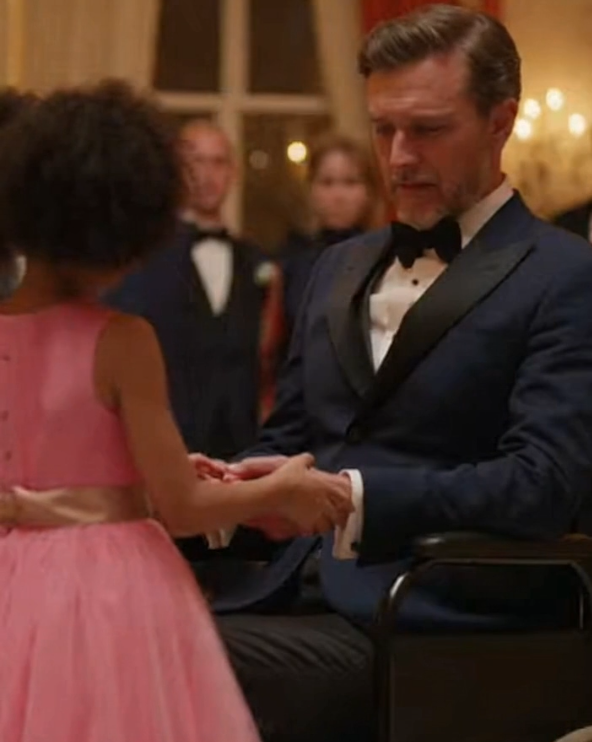
A billionaire sat alone at his own charity gala while hundreds walked past him… But a 2-year-old in a pink dress did what no one else would.
Robert Harrison had built an empire with his hands. Skyscrapers, neighborhoods, entire city blocks — all stamped with his name and his drive. At 57, none of that felt real anymore.
Eight months ago, a distracted driver ran a red light. The crash lasted less than two seconds. The aftermath would last the rest of his life.
Now he sat in a wheelchair in the center of his own ballroom, wearing a tailored navy suit, watching people he’d known for thirty years pretend not to see him.
The gala was his idea, like every year. The children’s hospital needed funds. So Robert had made the calls, signed the checks, approved the catering. He’d done everything except convince himself it still mattered.
Crystal chandeliers threw warm light across the polished floor. A string quartet played in the corner. Waiters circled with champagne.
It looked exactly like every gala he’d ever thrown. Except before, he’d been at the center of it. Now he was furniture.
Margaret Chen, one of his oldest friends, had touched his shoulder briefly before dinner.
“Robert, you know I care about you,” she said. “But seeing you like this — it’s just so hard.”
Then she’d walked away. Her heels clicked across the marble until the sound disappeared into the crowd.
He’d stopped counting after that.
His son David had come. That was something, he supposed. David had stayed exactly twenty minutes, kissed his father on the cheek, and explained about a flight.
Always a flight. Always California.
Robert wheeled himself toward the far edge of the ballroom, away from the noise. He found the tall windows overlooking the garden — Catherine’s garden, really. The rose bushes she’d planted the spring before she died. Five years ago now.
He stared at them and wondered what she’d say if she could see this.
Something wise, probably. Something that would make him laugh despite himself. Catherine had always known how to do that.
“Excuse me, Mr. Harrison.”
The voice was soft, uncertain.
He turned. Maria Santos stood a few feet away, his housekeeper of six years. She was in her early thirties, steady eyes, the kind of quiet competence that made a household run without anyone noticing. She’d added a pressed look to her uniform for the evening.
In her arms she held Emma. Not quite two years old. Pink dress, puffed at the hem, dark curls framing a round face full of alert, serious attention.
“Maria,” Robert said. “You didn’t have to stay for this. You should be home.”
“I wanted to make sure everything ran smoothly.” She looked around the ballroom, then back at him, and her expression held something he hadn’t seen all evening. Not pity. Just simple human warmth. “You’ve been good to us, Mr. Harrison. When Emma was born, you gave me paid leave. Not many employers would do that.”
“You earned it. You’re a hard worker.”
There was a pause. The quartet shifted into a waltz. Couples drifted onto the floor.
Robert watched them. A tightness settled in his chest, familiar and unwelcome. He and Catherine had danced badly for years before they got good at it. He missed the bad dancing almost as much as the good.
Emma squirmed.
“Down, Mama. Down.”
Maria set her on the floor, keeping hold of one hand. Emma immediately assessed the room — the lights, the colors, the movement — with that total, unfiltered focus that belongs only to toddlers and scientists.
Then her gaze landed on Robert.
She didn’t look away. She didn’t look through him. She looked at him, head slightly tilted, processing.
And then she smiled.
It was not a polite smile. It was the real thing — unplanned, unselfconscious, lit from somewhere inside.
She pulled her hand from her mother’s grip and walked toward him. Her legs were still working out the mechanics of the whole enterprise. She made it anyway.
She reached his wheelchair. Put both small hands flat on his knee. Looked up.
“Dance,” she announced. “Dance with Emma.”
Robert felt his throat close.
“Sweetheart,” he said carefully. “I can’t dance anymore. My legs — I can’t walk.”
Emma looked at the wheelchair. Looked back at his face.
She reached up and took both his hands in hers. Her fingers were very small. She began to sway.
“Dance,” she said again, as though he simply hadn’t understood her the first time.
Something shifted.
Not a big thing — not a revelation or a breakthrough. More like a single frozen gear turning loose. Something that had seized up months ago and had not moved since.
Robert began to sway. Just his upper body, just his arms. Following her rhythm.
Emma giggled. She spun in a slow, wobbling circle, still clutching his fingers. She bounced in place. She turned again.
The wheelchair didn’t register for her. The fact that his legs didn’t move didn’t seem to require explanation or apology. She had found a person willing to dance, and that was enough information.
The waltz carried them.
Her laughter was a specific sound. High and surprised, like she kept delighting herself. It cut through the string quartet, through the murmur of a hundred polished conversations.
Robert felt his eyes go wet. He didn’t try to stop it.
He was smiling. Genuinely smiling, in a way he had not managed since before the accident. Maybe before Catherine. He couldn’t quite remember.
Maria stood a few feet back, one hand pressed over her mouth, tears moving quietly down her face.
Around them, the ballroom changed texture. Conversations dropped. Heads turned. The crowd that had spent all evening carefully not looking at Robert Harrison found themselves unable to look away.
A little girl in a pink dress dancing with a man in a wheelchair. Both of them completely, entirely present.
When the song ended, Emma threw her arms straight up.
“More! More dance!”
Robert laughed. The sound surprised him. It came out louder than he expected, more real, and he didn’t try to contain it.
“Let’s rest a minute, little one.”
Emma considered this reasonable. She climbed directly onto his lap — no hesitation, no request for permission — and settled in like his wheelchair was a perfectly ordinary chair that happened to have wheels.
She patted his cheek once with her open palm.
“You nice,” she said.
Robert put his arms around her. This small, certain person who had simply walked across a ballroom and handed him something he didn’t know he still needed.
He held on.
“Thank you, Emma,” he said quietly. “Thank you for dancing with me.”
Maria came forward, wiping her face. “I’m sorry, Mr. Harrison. She’s usually shy around people she doesn’t know.”
“Don’t apologize.” His voice was unsteady and he didn’t care. “This is the best thing that’s happened to me in a very long time.”
After that night, things changed.
Not dramatically — not all at once. But steadily, the way a house warms when someone starts lighting fires in it again.
Emma and Maria began visiting the main house beyond their working hours. Not because Robert asked, though he did, eventually — but because Emma had decided she lived there, in spirit if not on paper, and toddlers have a way of making their preferences structurally binding.
She would appear in his study with picture books, sliding them across his desk with the authority of someone submitting a business proposal. She demanded stories in funny voices. She brought him small objects of obscure significance — a smooth rock, a bottle cap, a drawing that was either a horse or the sun — and watched his face while he received them.
He learned to match the gravity of these offerings.
Maria would make lunch and the three of them would eat together in the kitchen or out in the garden when the weather allowed. They talked about small things. Emma’s new words. The roses. Maria’s village back home, where her mother still kept a lemon tree older than the road.
Robert found himself looking forward to these hours more than anything on his calendar.
In April, as they sat in the garden — Emma dozing in his lap, her curls warm against his chest — Maria said quietly: “I almost didn’t take this job. After my husband died, I was so scared. Scared I couldn’t do it alone.”
Robert watched Emma breathe.
“Maria. You and Emma have given me more than I’ve given you.” He paused, choosing words carefully. “Before that night at the gala, I thought my life was finished. I thought I’d lost everything that mattered.” He looked at the roses, Catherine’s roses. “But your daughter taught me that love doesn’t need anything except an open heart.”
Maria smiled, her eyes bright.
“She’s always been like that,” she said softly. “Even as a baby. She could always tell who needed her.”
Robert didn’t let the lesson sit unused.
He restructured his foundation. Not just donations to the children’s hospital — though that continued — but a new initiative specifically for single parents navigating impossible math: childcare, housing support, emergency funds, job placement. He named it quietly and without fanfare, because fanfare wasn’t the point.
He called old friends, too. But on different terms now. He didn’t need their careful smiles. He needed people willing to sit in a room and be honest. Some surprised him. Margaret Chen called three weeks later and asked if she could come by. She brought wine and stayed four hours and cried when she apologized.
He told her it was all right, and he meant it.
David flew in from California in June. No charity event, no excuse required. He just came.
He sat across from his father at the kitchen table while Emma arranged crackers on a plate between them with intense spatial focus.
Father and son didn’t say much for a while. They didn’t have to.
Eventually David said, “I didn’t know how to be around you after the accident.”
“I know,” Robert said.
“That’s not an excuse.”
“No. But it’s a start.”
Emma pushed crackers toward both of them impartially and announced: “Eat.”
They both ate.
Every Thursday evening, Robert wheeled into the ballroom.
And every Thursday, Emma came running from wherever she’d been in the house — the kitchen, the garden, the hallway outside his study — arms already open, face already laughing, utterly certain of her welcome.
The music would start. They would move together.
Years later, when Emma was old enough to ask questions, she asked her mother: “Why did I go up to Mr. Harrison that night at the party? I don’t even remember it.”
Maria was quiet for a moment, remembering the way the ballroom had gone still around them. The chandeliers. The quartet. A little girl climbing onto a man’s lap like she’d always belonged there.
“Because you saw what no one else could see,” she said finally. “You saw a man who thought he’d become invisible. And you walked right up to him and showed him he wasn’t.”
Emma thought about this.
“That doesn’t sound that hard.”
Maria smiled.
“It wasn’t,” she said. “That was the whole point.”
Robert Harrison died at seventy-four, in the house he’d built and then learned, finally, to actually live in. He died on a Thursday.
Emma, twenty-two years old, was there. She held his hand and told him something that made him laugh — a real laugh, the surprised kind — and then he was gone.
He left the foundation fully funded. He left the rose garden tended. He left a letter for Emma that began: You don’t remember this, but when you were almost two, you climbed onto a dying man’s lap and told him he was nice. He believed you. It saved his life.
Thank you for dancing with me.
