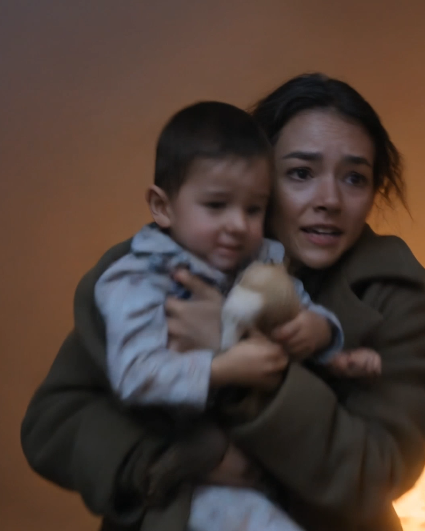
A homeless woman ran into a burning building to save a stranger’s child… But when the billionaire CEO hunted her down, what he found in her past destroyed everything he thought he knew about himself.
The morning Beacon Hill burned, Clare Dawson had seventeen dollars, a broken lighter, and a tarp she’d duct-taped to a chain-link fence. She hadn’t slept more than three hours. Her hands were still numb from the cold when the screaming started.
She heard the child before she saw the smoke.
It wasn’t a loud cry. That’s what stopped her — it was quiet, like someone had already given up. Everyone else on the sidewalk was filming, shouting, backing away from the heat. Clare dropped her blanket and ran toward it.
A security guard lunged for her arm. She ducked under the tape without slowing.
Inside, the lobby was already unrecognizable. Ceiling tiles melting. Alarms shrieking. Smoke so thick she could only see two feet in front of her face. She pressed her sleeve to her mouth and followed the sound — down a corridor to the left, to a door hanging open at the far end, fire eating the frame on both sides.
He was standing in the middle of the room. Four years old. Cartoon dinosaur pajamas. One fist clutching a small plastic T-Rex. His cheeks were streaked with soot and he was staring at the wall like he’d already gone somewhere else in his mind.
“Hey.” She dropped to her knees so she wouldn’t scare him. “My name’s Clare. I’m going to get you out.” He didn’t move. “Okay? We’re going home.”
He blinked once. Then reached out his hand.
She wrapped him in her coat and turned back toward the hall — and the way she’d come was gone. Smoke had closed over it completely. She got down on her stomach and crawled, one arm around the boy, the other feeling for the baseboard. Her lungs burned. Her eyes streamed. The sound of cracking wood grew close and then closer, a groan from somewhere above her like the building itself was deciding whether to hold.
Then cold air. The burst of it against her face was so sudden she gasped.
She stumbled forward and collapsed on the pavement outside. People shouted. Paramedics converged. Someone said, “She’s got a kid.” She lowered the boy into the waiting arms and stood back up on legs that didn’t feel like hers anymore.
“Ma’am, your hands are burned—”
“He’s safe,” she said. And before they could move, she turned and walked away.
She didn’t look back. Not even when she heard the ambulance doors close. Not even when the cameras started flashing.
Five minutes later, a black SUV screeched to the curb and Daniel Reeves hit the pavement running.
He was forty-one years old, CEO of Reeves Architects, the kind of man who managed crises before breakfast and felt nothing — not grief, not fear — until he saw the small shape wrapped in a silver blanket and heard his son whisper, “Daddy.”
He held Eli for a long time before he could form words.
“A woman,” the paramedic said. “Blonde, late twenties, heavy coat. She went in before we arrived and brought him out herself. Refused treatment and left before we could get her name.”
Daniel looked out across the crowd. “Where is she?”
“She’s gone, sir.”
He turned back to his son. Eli’s eyes were half-closed, but he reached up and touched Daniel’s face.
“The angel made the fire go away,” he murmured.
Something cracked open inside Daniel’s chest. He hadn’t felt it in years — not since his wife died, not since he’d learned to seal everything behind glass and manage it from a distance. But standing there on the smoke-stained sidewalk, holding his son, the crack ran all the way through.
“Then I’ll find her,” he said quietly.
He meant it.
By noon, Daniel had surveillance footage from four city blocks. By evening, he had her face.
She appeared in the corner of a gas station camera — grainy, ash-streaked, her jaw set at an angle that wasn’t fear. She looked straight at the lens for less than two seconds before disappearing into the shadows behind the old car wash on Water Street.
He drove there himself the next morning.
The waterfront district smelled of diesel and brine. Tents lined the chain-link fences. A man in a beanie looked up from a barrel fire as Daniel and Eli crossed the lot.
“Looking for someone,” Daniel said. “Blonde woman. Saved a kid from the Beacon Hill fire.”
The man’s expression shifted. He glanced toward the back of the lot. “Tent by the tire stack. She keeps to herself.”
Eli spotted her before Daniel did.
“It’s her!” He broke free and sprinted.
Daniel turned in time to see his son crash into her arms, her whole body going rigid with surprise. Then, slowly, one trembling hand moved to rest on the boy’s back.
“You’re my angel,” Eli said breathlessly. “You made the fire go away.”
Clare looked up over his head. Her eyes met Daniel’s — clear, blue, cautious. The exhaustion in her face was the kind that didn’t come from one bad night. It came from years.
Daniel stepped closer, voice low. “You’re Clare?”
“How do you know my name?”
“I didn’t,” he admitted. “I just needed to call you something.”
She shifted, pulling her coat tighter despite the morning sun. “You shouldn’t have come here.”
“You saved my son.”
“You don’t owe me anything.”
“That,” he said quietly, “is where you’re wrong.”
He came back. That was what surprised her most.
Not with cameras, not with a check, not with the performance of gratitude she’d learned to distrust. Just coffee. Just showing up. Every few days, same barrel fire, same quiet.
Clare tested him by ignoring him. He passed.
She tested him by being difficult — short answers, turned shoulders, pointed silences. He passed that too.
On the fifth visit, as the sun dropped behind the overpass and the shadows stretched long across the concrete, she spoke.
“You ever wonder,” she said, eyes on the fire, “how people end up like this?”
“Sometimes,” he said. “But I figure there’s always a story.”
Her fingers tightened around her cup.
She told him about her mother — cancer, nine years old, gone before Clare understood what dying meant. Her father and the drinking. The closet she used to sleep in to stay out of his way.
She told him about the jobs she’d worked at seventeen — waitressing, cleaning, babysitting. The man who said she mattered and then disappeared when she got pregnant. The baby she lost at seven months. The apartment she couldn’t hold. The invisibility that followed when you fell below a certain line — how people looked through you, past you, like you were a gap in the air.
“I used to dream about building something,” she said. “A place for mothers with no one. Safe. With childcare, food, job training. Build something good from everything I came from.”
She laughed once — a sound with no humor in it. “Funny, right? Someone like me dreaming about building anything.”
“It’s not funny,” Daniel said. “It’s extraordinary.”
She looked at him sharply, waiting for the pity. She didn’t find it. That unsettled her more than pity would have.
The weeks that followed moved the way seasons do — too slowly to notice and then suddenly, irrevocably changed.
Daniel started bringing Eli on visits. The boy threw himself at her every time like gravity. She taught him to build towers from cardboard, chalk-draw dragons on the sidewalk, whistle through a blade of grass.
One afternoon, Daniel showed up flustered, Eli on his hip. “I have back-to-back meetings. He keeps asking for you anyway. Would you mind—”
“Are you sure?” she said.
He looked at her. “You ran into a fire for him.”
When he came back that evening, Eli was asleep against her shoulder, his mouth slightly open, one hand still holding a crayon he’d forgotten to put down. Clare was sitting very still, like she was afraid to breathe and break something.
Daniel stood in the doorway for a long moment before she noticed him.
She looked almost at peace.
The media found them on a Wednesday.
By noon, the photo had been everywhere: CEO Daniel Reeves, mystery woman from the Beacon Hill fire, the little boy between them — all three of them mid-laugh outside a food truck, the kind of ordinary moment that looks extraordinary when strangers decide to make it mean something.
She’s homeless. He’s doing this for publicity. She’s playing him.
The comments multiplied. Clare heard about it through the women at the shelter — women who’d called her sister, who now looked at her sideways.
“Is it true? You and him?”
“Must be nice,” another one murmured, “going from the streets to a millionaire’s arm.”
Clare didn’t sleep that night.
Daniel’s mother called the following evening. He stepped away to take it, his voice low and strained. Through the wind, Clare caught fragments — risking everything, tent, you don’t know what you’re doing — and she didn’t move, didn’t pretend she hadn’t heard.
That night, he told her himself. “She’s worried. She thinks you’re using me.”
“And what do you think?”
A pause. One beat too long.
“I just want to give you a better life,” he said finally.
The silence that followed felt like a door swinging shut.
“A better life,” Clare repeated. The words tasted wrong. “You think I’m broken, Daniel. You think you’re rescuing me.”
“That’s not—”
“You see someone you pulled from a fire. Not someone you could actually love.” Her voice was steady but her eyes were bright. “I thought you saw me. I thought that was what was different about you.”
“Clare—”
“No.” She stepped back. “Don’t.”
She was gone before he could find words.
She left a note on the coffee table. One page. Addressed only to Eli.
You are the brightest light I’ve ever known. You made me believe I could be something more than my mistakes. But I can’t stay. You deserve someone whole, someone who belongs. Thank you for loving me anyway. — Clare.
Daniel read it four times. Then he sat down on the floor next to the coffee table because his legs had stopped working.
Upstairs, Eli murmured in his sleep: Mama Clare.
He built the lighthouse anyway.
Not because it was a grand gesture. Not to win her back. He built it because she had described it once — the place for mothers with nowhere to go, with childcare and food and job training, built from everything she’d come from — and the description had never left him. He could hear it in her voice every time he reviewed the blueprints. The reading nooks. The mural wall in the children’s room. The quiet room where a woman could sit down and breathe.
The foundation bore both their names: Clare Bennett and Daniel Reeves.
The night of the unveiling, Daniel stood at the podium in a downtown gallery and looked out at city officials and philanthropists and reporters and ordinary people who’d read the story and shown up anyway.
“This project,” he said, his voice steady, “is about people who are seen only when they’re lost — and reminding them they’re worth saving.” He paused. “She didn’t need saving. I did. She reminded me what real courage looks like.”
Outside, across the street, Clare stood in the dark.
She hadn’t planned to come. She’d told herself a dozen times she wouldn’t. But she’d seen the posters and something had pulled her here like a current — not to walk in, just to stand outside and look through the glass.
She watched him speak. Watched Eli in the front row, clutching a bouquet of paper flowers he’d made himself. Watched the crowd rise to its feet.
For the first time in months, she didn’t feel invisible.
When the crowd began to filter out, she turned to leave.
“Clare.”
She stopped. Turned.
Daniel was standing at the edge of the sidewalk, still in his jacket, his face open in a way she hadn’t seen before — no management, no distance, just him, afraid she’d disappear again.
She didn’t.
Neither of them moved for a long moment.
Then he crossed the street.
“You came,” he said.
“I wasn’t sure I should.”
“You built this.” His voice was rough. “You belong here more than anyone.”
Her eyes moved up to the glowing sign above the entrance — The Lighthouse Center — and something inside her chest gave way, quietly, like a knot finally releasing.
“I’m sorry,” he said. “What I said — a better life — I wasn’t saying you were broken. I was saying I was scared I wasn’t enough for you. That you’d realize you didn’t need me.” He exhaled. “I said it backward.”
Clare looked at him for a long time. “You did.”
“I know.”
A beat of silence. Then she almost laughed — a real one, rising from somewhere she’d thought had been sealed over.
He reached out his hand. Tentative. Uncertain.
She took it.
“I missed you every day,” he said.
“So did he.” She tilted her head toward the door, where Eli had appeared at the top of the steps, scanning the sidewalk with the intensity of a search-and-rescue operation.
“MAMA CLARE.” He spotted her and launched himself down the steps.
She was already kneeling when he hit her, arms around her neck, laughing into her shoulder.
“You came back,” he said.
“I did.” She held him tight. “I think I finally found home.”
Later, Daniel led her through the finished halls — the reading nooks, the mural wall, the quiet room with its deep chairs and soft lighting.
At the entrance, a polished brass plaque read:
Founded by Clare Bennett and Daniel Reeves — for those who light the world, even when theirs has gone dark.
She ran her fingers across the letters.
Daniel reached into his coat.
“There’s one more thing.”
He held out a small velvet box. His hand wasn’t entirely steady.
“You once told me you wanted to build something good from everything you came from,” he said. “I can’t think of anything worth building more than the rest of our lives together.”
She looked at the box. Then at him.
“Clare Bennett.” He opened it. Simple, plain, perfect. “Marry me. Not because you saved us. Because you’re my home.”
She looked at him for a long moment — and then she smiled. A real one. The kind that reached all the way up.
“Yes,” she said. “A thousand times, yes.”
Behind them, Eli let out a whoop that echoed down the corridor and flung both arms in the air.
“WE’RE A FAMILY AGAIN.”
Laughter filled the lighthouse hall — and outside, the city lights shimmered on the water like something finally, permanently lit.
