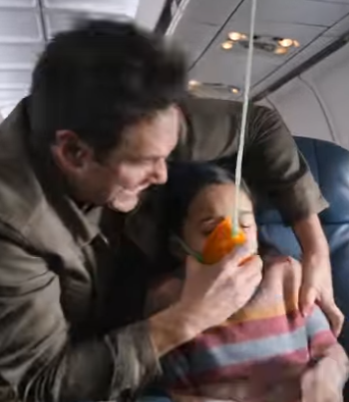
The first shudder came like God had grabbed the plane and squeezed. Marcus Hale gripped his armrest, the paperback novel in his lap sliding to the floor as Flight 1147 lurched sideways with a sound like cracking bone. Outside his window, the cloud cover was gone — replaced by nothing but black sky and the furious blinking of a wing strobe. He told himself: turbulence. He had told himself that twice before. Turbulence didn’t last four minutes. Turbulence didn’t make grown men weep.
Then the alarms started.
Not one — a wall of them, layered and mechanical, screaming through the cabin like something had torn open in the cockpit. The overhead panels above every row dropped their yellow oxygen masks in a single, unified cascade, dangling on their thin tubes like strange fruit. The cabin lights flickered. Half of them died. The other half pulsed in sick, amber emergency mode, throwing every face into shadow and orange.
Someone at the back of the plane screamed — a raw, animal sound — and then everyone was screaming.
“We’re going down!” The voice belonged to a man three rows behind Marcus, a heavyset man in a business suit who was now standing in the aisle with his oxygen mask clutched in his fist instead of on his face. “We are going down, somebody do something—”
A flight attendant’s cart broke free from its mooring and clattered down the aisle. Luggage rained from an overhead bin. The plane tilted — maybe twenty degrees, maybe thirty — and Marcus grabbed his mask and pulled the tube the way the safety card said. He breathed. Plastic and rubber and the metallic taste of recycled air. His hands were shaking. His whole body was shaking.
That’s when he saw the girl.
◆ ◆ ◆
II. The Girl in 14F
She was across the aisle and one row forward. Maybe eight years old. Nine at the most. She sat perfectly still amid the chaos, which was the most terrifying thing Marcus had ever seen — because it wasn’t calm, it was the stillness of someone so frightened they had simply left their body. Her oxygen mask hung unused beside her cheek. Her hands were flat on her thighs. Her eyes were fixed on the seat back in front of her, and tears poured silently down her face in two clean rivers.
There was nobody in the seat next to her. Nobody in front, nobody behind on that side.
Alone.
The plane bucked again — hard enough that Marcus’s teeth clacked together and the overhead storage door swung open. A carry-on bag fell and struck the man in 12C, who swore in a language Marcus didn’t recognize. The nose pitched downward. There was no question now about turbulence. The angle was wrong. The sound was wrong. That low, grinding moan beneath the engines was deeply, catastrophically wrong.
Marcus stood up.
Later, he would not be able to explain exactly why. He wasn’t a brave man by any particular measure. He sold insurance in Cincinnati. He was afraid of spiders. He had cried twice during Toy Story 3. But there was a child alone on a dying plane, and his body simply decided, without consulting him, that he was going to her.
He fought the aisle like fighting a current. The tilt of the floor was fighting him, and a woman came through the opposite direction, half-crawling, half-running toward the back lavatory for reasons he couldn’t fathom. He got his hand on seat 14E and dropped to his knees in front of the girl.
“Hey. Hey, look at me.” He had to shout over the alarms, over the roar of everyone else’s terror. “What’s your name?”
Her eyes moved to his face. Slowly, the way eyes move when the mind is barely present.
“Lily,” she said. Just barely. Just a breath.
“Lily. I’m Marcus. Listen to me very carefully, okay? I need you to put this on.” He grabbed the mask and held it out. She didn’t take it. Her hands still hadn’t moved from her thighs. He reached forward gently and placed it over her nose and mouth, pulling the elastic band around the back of her small head. She let him. “Good. That’s really good. Where’s your mom, Lily? Your dad?”
Her lip trembled. “My grandma’s in the back. She had to use the bathroom and then—”
The plane dropped. Not dipped. Dropped. Like someone had cut a cable. Marcus caught himself on the headrest, arm over Lily’s shoulders, and for a long, airless moment, everything in the cabin that wasn’t strapped down floated — cups, magazines, a blue cardigan, somebody’s reading glasses — and then gravity came back like a fist and everything crashed.
A man was praying. A woman up front was shouting someone’s name over and over. The plane groaned as if it were in pain.
“Lily, I need you to get into my seat. 14D, right there. Can you do that? Can you move for me?”
She looked at him. For a moment he thought she was going to say no. Then she nodded — a single, decisive dip of her chin — and she unbuckled and slid sideways and he guided her into 14D and buckled her so tight the belt dug into her small waist.
“Is it going to be okay?” she asked.
Marcus looked at her face. She deserved the truth. She also deserved not to die terrified.
“I’m going to be right here,” he said. “Right next to you. I’m not going anywhere.”
◆ ◆ ◆
III. Impact
He had no idea how long it lasted. Fifteen seconds. Fifteen minutes. Time had become unreliable. The cockpit made an announcement — something flat and controlled from the pilot, the kind of voice trained to stay steady on the way to the end of the world — but Marcus couldn’t make out the words above the chaos. He wedged himself into the seat beside Lily and grabbed her hand and she squeezed so hard her small knuckles went white.
“Don’t let go,” she said.
“I won’t.”
The trees came up through the window first. Marcus registered them dimly — dark shapes rushing upward through the smoke-grey dawn outside. Then the world became pure sensation: a roar so total it stopped being sound and became pressure, a physical force pressing against him from every direction. The plane shook itself apart around them — he heard the fuselage tearing, he felt it in his spine — and he threw himself over Lily and locked his arms around the seat and her and shut his eyes.
He thought about his daughter back in Cincinnati, asleep in her room right now. He thought: I should have called her yesterday. He thought: I should have called her every day.
The impact was not the thunderclap he expected. It came in three distinct, shattering jolts — each one worse than the last — and then the longest, most grotesque scraping sound he had ever heard as the fuselage tore open a groove through two hundred feet of forest floor. Metal screamed. Glass became powder. Something struck his shoulder hard enough to blank his vision white.
And then: silence.
Not peace. Not safety. Just the sudden, terrible absence of catastrophic sound, filled in slowly by the hiss of something venting under pressure, the creak and settle of wreckage, and the impossibly normal sound of birds — birds somewhere in the forest outside, singing as if nothing had happened, as if the sky were simply sky.
◆ ◆ ◆
IV. After
Marcus opened his eyes to grey morning light coming through a gash in the fuselage the size of a doorway. Smoke — thin, white, acrid — drifted through the cabin in lazy curls. He was on his side. The seat had collapsed sideways during the slide, pinning his left arm beneath him. He couldn’t feel it.
He turned his head.
Lily was looking back at him. Her oxygen mask had come off at some point. There was a small cut above her left eyebrow, already dried dark, and her hair was wild, and her face was covered in a fine grey dust — but she was looking at him with those enormous eyes, and she was breathing.
“You didn’t let go,” she said.
He couldn’t answer for a moment. His throat wouldn’t cooperate. He pulled his numb arm free and sat up slowly, checking himself — shoulder pain, a cut on his forehead, ribs that screamed when he breathed too deep. He was alive. He catalogued this fact carefully, as if it might be revoked.
Around them, other passengers were beginning to stir. Moans. Someone coughing. Someone else calling out a name — then, faint and miraculous, an answering voice. Through the torn wall of the plane, Marcus could see the edge of a forest, the silver glimmer of a highway maybe half a mile distant, and the sky turning from grey to the pale, stunned pink of early morning.
He looked back at Lily. She was still holding his hand. She hadn’t let go either.
“My grandma,” she said, her voice unsteady.
“We’ll find her.” He said it firmly, the way you say things you have decided to make true. “Come on. Can you stand?”
She could. They both could.
Marcus Hale, who sold insurance in Cincinnati, who was afraid of spiders, who had not done a single extraordinary thing in forty-one years of living — lifted an eight-year-old girl over a section of collapsed ceiling and stepped with her out through the gash in the fuselage and into the cool morning air of a forest in southern Kentucky, where seventeen other survivors were already gathering, already calling out, already reaching for each other across the wreckage.
From the far side of the debris field, a voice broke through the others.
“Lily! Lily, baby, where are you—”
Lily’s hand tore free from his and she ran — barefoot across the mud and the bent metal and the scattered luggage of a broken plane — toward an old woman in a torn cardigan who was hobbling forward from the smoke, arms wide open, face crumpled with a grief that was turning, right in front of Marcus’s eyes, into something else entirely.
He watched them collide. He watched the old woman fold the girl into her chest and squeeze her the way you squeeze someone you almost lost, the kind of hold that says: I will not let the world take you. Not today. Not ever.
In the distance, the first siren rose over the trees.
Marcus sat down on the wing of a destroyed plane in a Kentucky forest and pressed his hands to his face, and he cried — not from grief, not quite, but from the overwhelming, bewildering weight of being alive when the math said otherwise. From the fact that he had stood up. From the fact that it had mattered.
When he finally lowered his hands, Lily was standing in front of him. She had broken free from her grandmother just long enough. She reached out and put one small, dirty hand on his arm.
“You said you wouldn’t go anywhere,” she told him.
He looked at her — this small, impossible person who was alive because of a decision his body had made before his mind could talk it out of it.
“I didn’t,” he said.
Above them, through a gap in the smoke and the trees,
a pale winter sun was rising —
indifferent, ancient, and absolutely beautiful.
