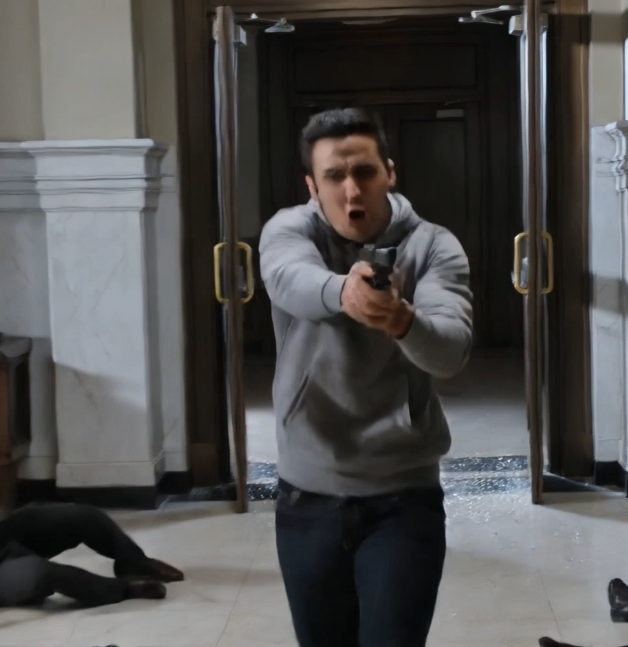
The doors of First National Bank exploded inward at 11:47 on a Tuesday morning, and Marcus Webb came through them like a verdict.
He wore a grey hoodie pulled low, a ski mask bunched at his chin — not yet over his face, not yet, because he needed them to see his eyes when he shouted. He needed them to believe he meant it. The gun was a Glock 19, and he raised it above his head the way he’d rehearsed in his bathroom mirror for three nights straight.
“Nobody moves! Nobody reaches for anything! Get down — everybody get DOWN!”
The bank erupted. A woman near the deposit slips let out a scream that seemed to peel the paint off the ceiling. A man in a suit dropped to his knees and covered his head with a briefcase. A security guard — old, heavyset, bad knee Marcus had already clocked when he walked past the building twice that morning — froze beside the velvet rope, one hand half-reaching for a holster he’d never clear in time.
“Don’t,” Marcus said. Just one word. The guard’s hand went still.
Eight seconds in. He was still on script.
Marcus moved toward the teller windows, gun leveled, scanning the row of faces behind the glass. Three tellers. He needed the middle window — always the middle window, his contact had said, that’s where they kept access to the main drawer. He looked left. He looked right. Then he looked center, and the entire architecture of the moment collapsed.
Her name was Claire Denton.
Or it had been, once. He didn’t know if she’d changed it. He didn’t know much of anything about her life anymore, because she had walked out of his apartment on a cold February night four years ago with one bag and a silence so complete it had its own weight, its own gravity. He still felt it sometimes, that silence. In the 3 a.m. hours when everything was honest.
She was staring at him.
He was staring at her.
The gun was still raised. The bank was still half-screaming, half-holding its breath. And between Marcus Webb and Claire Denton, four years of wreckage compressed itself into a single electric second.
· · ·
II.
Her hair was shorter. That was the first thing his brain decided to notice, as if it were cataloguing her for a future conversation rather than a federal crime. Shorter, darker. She wore a navy cardigan with a small gold name tag. Her hands, he could see, were pressed flat on the counter — the bank’s protocol for a robbery, probably — and they were trembling.
But her eyes. Her eyes were doing something he hadn’t expected. They weren’t wide with the random terror of a stranger. They were wide with a very specific, very personal recognition. And underneath that — he saw it, he knew her face too well not to see it — was something that might have been fury.
“Marcus.” She didn’t say it out loud. She mouthed it. Just his name, shaped by lips he’d once known the geography of.
He moved to her window.
He couldn’t help it. His feet just went.
“Open the drawer,” he said quietly, pressing close to the glass. Behind him, the guard was still frozen. The other customers were on the floor now, faces down. For thirty seconds they were almost alone. “Claire. Open the drawer and put it in the bag. Don’t hit the dye pack, don’t press anything, just—”
“You have got to be kidding me.”
Her voice was barely above a whisper, but it hit him like a slap. She hadn’t moved her hands. She was staring at him with an expression he recognized: the one she wore when she was deciding whether to cry or to demolish someone.
“This isn’t the time—”
“You’re robbing my bank.”
“Claire—”
“You are standing in front of me, with a gun, robbing the bank where I work, four years after you—” She stopped. Swallowed. “Four years, Marcus.”
“I know how long it’s been.”
“Do you? Because you also apparently know where I work now, which means you’ve been—”
“I didn’t know,” he said. And that was the truth, and it was so absurd that for a moment neither of them could do anything with it. “I swear to God I didn’t know. I just — the guy said this branch, this window, and I didn’t—”
“Who told you this branch?”
He hesitated.
“Marcus. Who told you this branch?”
· · ·
III.
The third character in this story had been sitting in the corner of the bank for eleven minutes before Marcus walked through the door.
His name was Danny Roark, and he was Marcus’s oldest friend — or had been, once, back when they were both young enough that friendship was just proximity and loyalty was just habit. Danny had done four years in Rikers for a robbery that went wrong in 2019. Marcus had not been involved. Marcus had, in fact, warned Danny not to do it. Danny had done it anyway.
Danny was sitting in one of the leather chairs near the loan officer’s desk, waiting, with the patience of a man who understood that timing was everything. He had a backpack at his feet. He had not hit the floor with the other customers. He had his phone out, and he appeared to be a man calmly checking his messages in the middle of a crisis, which was exactly what he wanted to appear to be.
He was watching Marcus at the teller window with very great interest.
Because Danny Roark had known Claire Denton too. He had known her rather better than Marcus was aware. He had met her, in fact, at a bar six months after she walked out on Marcus, and he had thought — he had honestly thought — that enough time had passed. That it wouldn’t matter. That Marcus would understand.
Marcus had not understood, when he found out. That was the real end of things. Not Claire leaving. What came after.
Danny stood up now, and unzipped his backpack, and Claire saw him first.
Her face changed in a way Marcus couldn’t parse — couldn’t, until he turned and saw who it was. Then everything in the room rearranged itself. Every object, every relationship, every motive reshuffled like a deck of cards thrown into the air.
“Hey, brother,” Danny said. He had a gun too. Of course he did. “Wasn’t expecting this reunion. But I think it works out for everyone.”
“You set me up,” Marcus said. His voice was very calm. That was new. He hadn’t felt calm in years.
“I pointed you at a score. What you do with it is on you.”
“You knew she worked here.”
Danny shrugged with one shoulder. “I knew a lot of things.”
Claire had not moved from behind her window. But she was looking at Danny now, and her expression was different from the one she’d given Marcus. It was colder. More prepared. Like she’d been expecting this, or something like it, for a long time.
“You told him,” she said to Danny. “You told him about the vault rotation schedule.”
Danny’s smile flickered for just a moment.
“What vault rotation schedule?” Marcus said.
“The one that means there’s four times the usual cash in this branch today,” Claire said. She reached beneath the counter. Not for a dye pack. Not for an alarm. She came up with a badge — a gold badge, a real one, with a federal seal that caught the overhead light and threw it across the ceiling in a clean cold arc. “FBI Financial Crimes. This branch has been under surveillance for eight months, Danny. The vault rotation you sold to Marcus was the bait. You’re both under arrest.”
· · ·
IV.
Afterward, outside, with Marcus in cuffs and Danny in cuffs and four agents filling the lobby and the street barricaded at both ends, Claire stood on the sidewalk and smoked a cigarette. She had quit, she told him, three years ago. She kept one for days like this.
Marcus sat on the hood of a federal vehicle and watched her. He wasn’t going anywhere.
“How long?” he finally asked.
“How long what?”
“How long have you been FBI.”
She exhaled. “I was FBI when we met, Marcus.”
He let that land. He let all the weight of it come down at once, and he sat very still beneath it.
“Were you—” He stopped. “Were we—”
“No,” she said. And there was something in her voice — not softness exactly, but the absence of hardness. “No. That part was real. That’s the part that made all of this—” She gestured vaguely at the badge, the guns, the handcuffed men, the whole improbable disaster of the morning. “Complicated.”
An agent approached her with a tablet. She took it. Signed something. Became official again.
Marcus watched her walk back through the bank doors, past the broken glass, back into the life she’d been living all along — the one he’d never seen, or never let himself see. The one that had been there every time she came home late, every time she took calls in the other room, every time she looked at him across a dinner table with something in her eyes that he’d mistaken for love, or at least for something adjacent to it.
Maybe it had been both. Maybe that was the tragedy of it.
A bird landed on the barricade tape and looked at him without judgment.
Marcus Webb, who had walked into a bank with a gun and walked out with nothing, closed his eyes and listened to the city go on without him.
— End —
