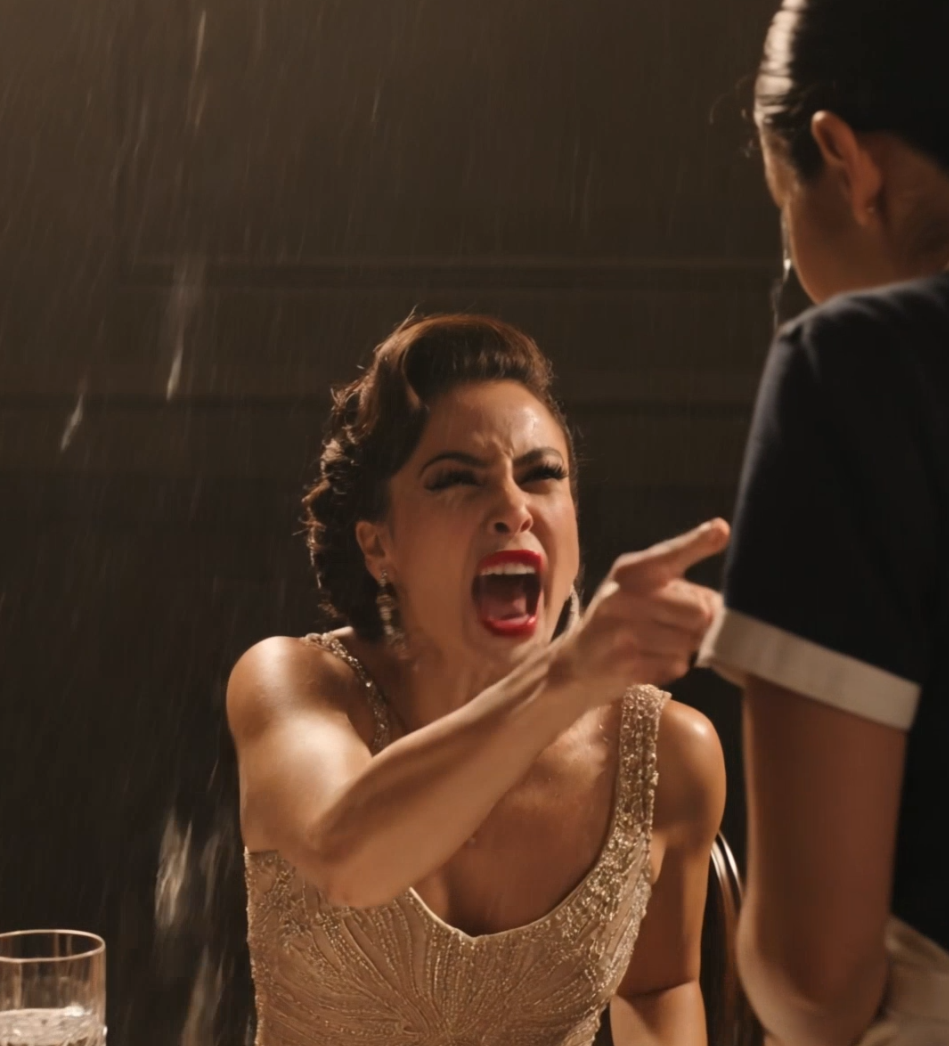
The restaurant was glowing with candlelight, crystal glasses, and the kind of luxury that made everyone pretend they were too refined for cruelty.
Then the very first second shattered everything.
The rich elegant woman hurled the glass of water straight into the waitress’s face and screamed for the whole restaurant to hear, “You think serving my husband gives you the right to stare at him?!”
Glass shattered.
Guests froze.
Phones rose instantly.
The poor waitress stood there soaked and trembling, humiliated under a hundred eyes, trying not to break apart in front of everyone.
But the woman pointed at her again with pure hatred and shouted, “Girls like you always destroy families!”
A silence spread across the restaurant.
The waitress’s lips trembled.
Her hands shook.
Then, with tears mixing into the water on her face, she slowly reached into her apron pocket and pulled out a tiny baby bracelet.
The entire room seemed to stop breathing.
In a voice so small it almost disappeared, she whispered, “My mother told me to show him this when he denied me.”
The rich woman went still. Completely still. Her face drained of color.
At the table, the husband slowly stood up.
The moment he saw the bracelet, his chair scraped backward. His hand began to shake. His lips parted. Because he knew it. He knew that bracelet. He had chosen it himself years ago. For a baby he was told never survived.
The waitress looked at him through tears. The whole restaurant stared. And just as he reached for the bracelet with trembling fingers and turned it over—he saw the engraving inside.
His knees nearly gave out.
For our Elena. May she find her way home.
Those were the words. His words. The ones he had whispered to a jeweler in a grief-fogged shop twenty-three years ago, three weeks after a woman named Mara told him through a hospital phone that their daughter had been stillborn, that there was nothing left to come home to, that he should never call again.
He had bought the bracelet anyway. Because he needed somewhere to put the love that had nowhere to go.
He had sent it to the hospital with a nurse he’d paid, begging her to leave it with whatever remained of his daughter, some small token against a loss too large to hold. He had never known if it arrived.
He had never known anything, because Mara had vanished, and he had been twenty-two years old and utterly destroyed, and eventually he had built a different life over the wreckage, the way people do, the way people must.
Now he stood in the candlelight of the most expensive restaurant in the city, holding the bracelet in both hands like something sacred, like something nuclear, while his wife of eighteen years stared at him with an expression that was rapidly shifting from rage into a kind of terrible understanding.
“Victor.” His wife’s voice had lost all its sharpness. It came out small. Almost frightened.
He couldn’t look at her. He could only look at the young woman in front of him, this soaking wet twenty-three-year-old waitress with his own eyes, his own jaw, his own stubborn way of standing with feet planted slightly too far apart, a thing he’d never noticed about himself until he saw it mirrored back at him in someone who had spent her whole life not knowing where she came from.
“What is your name?” he asked. His voice came out in pieces.
She swallowed. “Elena.”
The sound that escaped him then was not dignified. Several people at nearby tables looked away out of instinct, granting him the privacy that the rest of the room had already denied him. His wife pressed both hands flat against the tablecloth as though she needed the earth to hold still.
“Your mother,” he managed. “Mara Vasquez?”
Elena’s chin lifted, a trembling, courageous motion. “She died eight months ago. She left me a letter. And the bracelet.” Her voice broke on the last word but she pulled it back, straightened her spine, held herself together through what appeared to be sheer, inherited stubbornness. “She said you didn’t know I survived. She said the hospital told you I didn’t make it because she was afraid. She was very young and very afraid, and by the time she wasn’t afraid anymore, too many years had passed and she didn’t know how to find you without destroying your life.” She paused. “She said she was sorry. She told me to tell you that. She was sorry.”
Victor sat down.
Not gracefully. His legs simply made the decision without consulting the rest of him, and the chair caught him, and he sat there with the bracelet in his hands and tears running silently down the face of a man who had spent eighteen years being impeccably controlled in public, who had built an empire on the appearance of steadiness, who had never once in his adult life allowed himself to be undone in front of an audience.
He was undone.
The phones were still up. He was dimly aware of them, the way you are dimly aware of rain when something more important is happening. Let them record it. Let them put it everywhere. He didn’t care. He had stopped caring about the right things the moment he turned over that bracelet.
His wife, Claudette, had not moved. She sat with her hands flat on the table, her diamond rings catching the candlelight, her face passing through expressions like weather — fury, then shock, then something that was slowly, painfully, reorganizing itself into shame. Because Claudette was many things. She was imperious and territorial and capable of the specific cruelty that comes from a lifetime of never being challenged. But she was not, in the private architecture of herself, entirely without conscience.
She looked at Elena. At the water still dripping from the girl’s chin. At the bracelet in her husband’s hands. At the trembling that Elena was trying so hard to contain and failing, not from weakness, Claudette realized, but because the girl had been holding this weight alone for eight months, carrying a dead mother’s secret into a roomful of strangers, and had just been screamed at and publicly humiliated within the same minute she finally reached the end of that road.
Claudette stood up.
Every eye in the room swung to her.
She reached across the table and picked up the folded linen napkin beside her untouched plate. She walked around the table. She stopped in front of Elena.
And she held out the napkin.
It was not an apology. It was too small for an apology, and Claudette was not yet ready for the full weight of one, and everyone in the room understood this, including Elena. But it was a beginning. It was an acknowledgment that a human being was standing in front of her, soaked and shaking, and that she had put the water there.
Elena took the napkin. She pressed it to her face. Her shoulders heaved once, silently, and then steadied.
“I didn’t come here to cause trouble,” she said, from behind the napkin. “I wasn’t even going to say anything tonight. I’ve been working this section for three weeks trying to get the courage. I just — I kept looking at him. I know. I know how that looked.” She lowered the napkin. Her eyes were red but clear. “I just needed to know if it was true. What my mother wrote. I needed to know if he was real.”
Victor looked up at his daughter.
“I’m real,” he said.
The two words landed in the room like stones in still water, rippling outward until they touched every person present, every stranger who had come tonight for a quiet dinner and had instead received something they would describe differently for the rest of their lives — some of them honestly, some of them not, but none of them forgetting.
A woman at the bar quietly set down her phone.
Then another.
Then, one by one, like a small and unremarkable miracle, the phones came down across the room. Not all of them. But enough.
The maître d’, a small precise man named Fortunato who had managed this floor for nineteen years and had believed he had seen everything, stepped forward from the shadows near the kitchen door. He touched Elena lightly on the shoulder.
“Come,” he said, simply. “Let’s get you dry clothes. You can use my office.”
He looked at Victor. A long look, professional and human in equal measure.
“I’ll hold your table, Mr. Harmon. As long as you need.”
Later, much later, when the restaurant had emptied and the candles had burned low, three people sat at a corner table in the quiet. The remains of coffee no one had really drunk sat between them. The bracelet lay on the white tablecloth.
The conversation was not easy. It would not be easy for a long time, possibly forever. There were years of absence that no single evening could account for, grief that had calcified into the foundations of two separate lives, and between Victor and Claudette a fracture whose dimensions were still being measured in real time.
But Elena had eaten something warm, and her uniform had been replaced with Fortunato’s spare jacket worn over her shoulders like a cape, and she sat across from the father she had found by accident or by fate or by the specific courage of dead mothers who leave letters and bracelets behind them, and she was not alone.
That was the part she had not let herself hope for.
All those weeks of circling, of carrying the bracelet in her apron pocket like a secret heartbeat, she had rehearsed every version of this — denial, indifference, anger, even the cold politeness of a man protecting his reputation. She had not rehearsed this. She had not let herself.
Victor reached across the table and placed his hand over hers. Not claiming. Not performing. Just present.
“Your mother was right that I didn’t know,” he said. “I want you to know that. Whatever else you decide about me — I want you to know that.”
Elena looked at the bracelet. At the tiny engraved letters. May she find her way home.
“I know,” she said.
Outside, the city moved through its ordinary night. Somewhere a phone screen glowed with a video already gathering views, the moment a bracelet appeared in a shaking hand, the moment a man’s knees buckled under the weight of a name. People were already writing things about it, already deciding what it meant, already arguing in comment sections about rich women and poor girls and the stories we tell about both.
But inside the restaurant, in the last candlelight, none of that existed.
There was only a father and a daughter sitting across from each other for the first time, learning the specific, patient work of becoming real to each other — which is harder than finding someone, and longer, and in the end, the only thing that matters.
