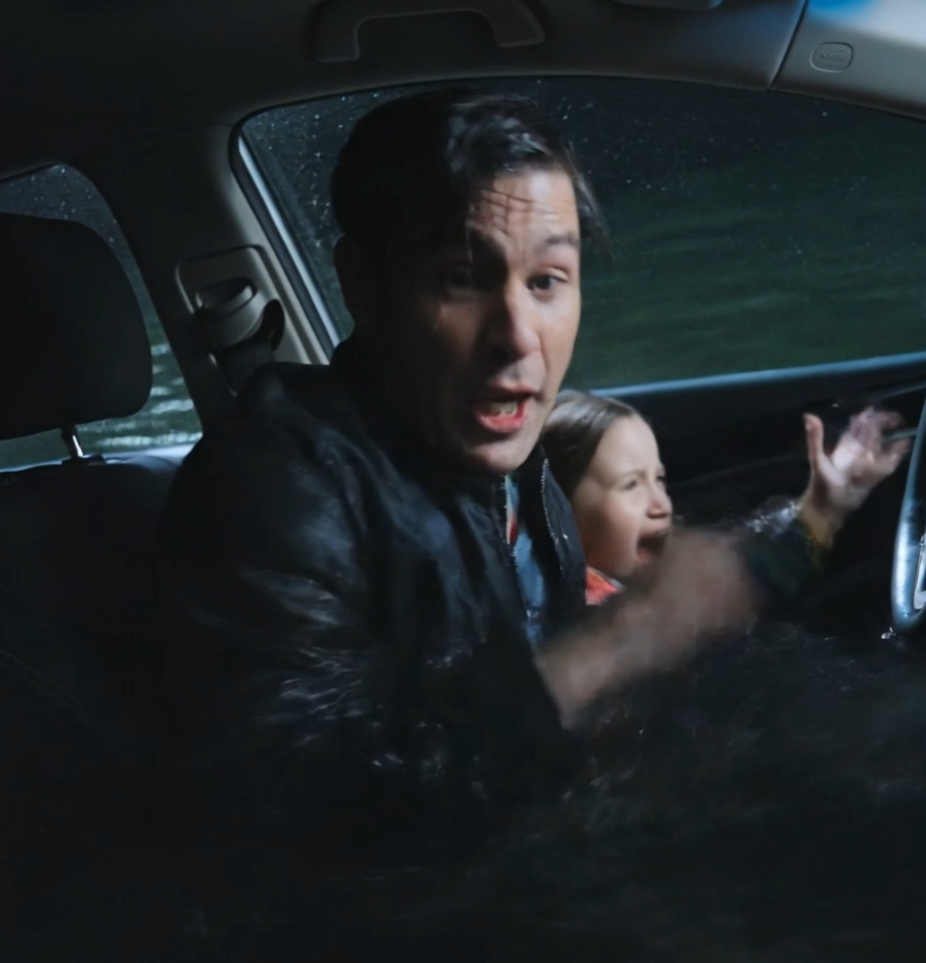
The guardrail disappeared in the headlights like a rumor, and then there was nothing — no road, no sound, only the terrible lurch of gravity reclaiming what it was owed. The Civic left the bridge at 11:47 p.m. on a Tuesday in November, and Marcus had exactly three seconds of freefall to understand that they were going to hit the water.
They hit it wrong.
Not flat — angled, nose-first, the windshield taking the impact like a fist. The airbags detonated. Marcus’s face snapped into white powder and chemical smoke. Beside him, his daughter Lily screamed — a high, pure note that cut through every other sound — and then the river came in.
I.
Cold. That was the first thing. Cold that was not a temperature but a presence — a living thing that poured over his ankles and up his shins and reached for his waist with both hands. The car was tilted forward, settling at the nose, and the current was already moving against them.
“Lily.” His voice was wrong. Too high. Not his voice at all. “Lily, look at me.”
She was still in her seatbelt. Eight years old and white-faced and clutching the stuffed rabbit she’d insisted on bringing. Her eyes were enormous in the dark. The headlights were still on, cutting pale green into the river ahead — into the river that was now in front of them, not below.
“Daddy.” Just that. One word. The most terrifying word he’d ever heard.
He hit the door handle. Nothing. He hit it again, shoulder into the panel, and the door didn’t move — the water pressure outside had already equalized against it, sealing them in as efficiently as a vault. He tried the window switch. The electrics were dead. He had seconds to think and his mind gave him nothing useful, only the image of his wife’s face that morning over coffee, the way she’d tilted her head when she laughed.
Diane had made him promise, once, years ago on the coast of Maine when they were young and still believed in the permanence of things, that if the car ever went into water, he’d know what to do. She’d read an article. She’d made him listen. Wait for pressure to equalize. Then the door will open. He’d nodded and kissed her temple and forgotten it within an hour. The way you forget things you’re certain will never matter.
The water was at his knees now. Lily was crying — not screaming anymore, just crying the way children cry when they don’t have words for what’s happening, a low, rhythmic sound that was worse than the screaming had been. Marcus unclipped his seatbelt and twisted toward her.
“Okay. Okay, listen to me. Are you hurt? Tell me if you’re hurt anywhere.”
“No.” She shook her head. Shook it again. The rabbit was pressed to her face.
“Good. That’s good.” His hand found the back of her neck — her pulse was there, fast and alive, and something in him steadied at the feeling of it. “We’re going to get out. I need you to be brave for me. Can you be brave?”“I’m scared, Daddy.”
“I know. So am I.” He’d never said that to her before. He had a rule about it — that fathers didn’t say that to eight-year-olds. The rule felt absurd now, three feet underwater in a sinking car. “Being scared is okay. We can be scared and still get out. Okay?”
II.
The water reached his chest and his body understood cold in a new language. His hands had started to shake — not from fear, or not only from fear, but from the nervous system beginning its calculations about survival, the old animal math that doesn’t care about feelings. He needed something to break the glass.
He patted the door pocket. Nothing. The cupholder: his thermos, useless. Then his hand closed around the car’s emergency kit in the seat pocket behind him — the one Diane had packed two years ago when they’d moved, the one he’d never opened. He tore it apart by feel in the dark water and found it: the spring-loaded window punch, small and red and miraculous.
He remembered buying that kit at a gas station outside of Portland. He’d been tired and slightly annoyed at the traffic, and Diane had insisted on the upgrade package, the one that included the cutter and punch. It’s ten dollars, Marcus. Just get it. He’d rolled his eyes. He could feel himself rolling his eyes across the years, across the impossible distance between that moment and this one.
The water was at his chin. Lily had her head tilted back to keep her face clear, her small hands white-knuckled on the headrest, rabbit floating forgotten at her side. The last air in the car moved in a small, shrinking pocket around their faces. Marcus pressed the window punch against the glass. He could feel the current outside — the river didn’t stop moving just because something had fallen into it.
“Take a big breath, Lily. The biggest breath you’ve ever taken. When I break the glass, we’re going to swim out. I’ll hold your hand the whole time. Don’t let go.”
“Don’t let go,” she repeated. Eyes locked on him. Absolute trust. The kind of trust that exists only in children and only in extremity, the kind that could destroy a person if they failed it.
He pressed the punch against the corner of the rear window — the side away from the current — and fired it.
III.
The glass went out in a sheet and the river came in like a living thing throwing its full weight through the gap. In the chaos of it Marcus grabbed Lily’s wrist — both hands, bone-grip — and kicked toward the window. The cold was a wall. The dark was total. There was no surface, no sky, no direction; only the faint, dying green of the headlights pointing wrong and his daughter’s wrist in his hands.
He kicked. He felt her kicking too — small legs against the current, the bravest thing he’d ever felt — and he followed the bubbles, because bubbles know which way is up even when fathers don’t. The current shoved them sideways. Something hard caught his shoulder — a pylon, a rock, the indifferent architecture of the riverbed. He held on. He always held on.
“The river gives you two things: the cold, and the dark. After that, you are on your own.”
They broke the surface forty feet downstream from the bridge. Marcus came up gasping, that first breath so raw and large it felt like something being torn open rather than taken in. Lily came up half a second later, coughing, the rabbit somehow still in her fist — she’d grabbed it in the dark, in the current, while swimming out of a sinking car, and had not let it go.
He pulled her to him. She was crying again. He was crying, though he didn’t know it yet; he thought it was just the river on his face.
The bank was close. He kicked toward it, one arm crooked around Lily’s chest, and found the mud and the reeds and the frozen November grass and they pulled themselves out of the water and onto the earth and lay there for a moment that had no length, listening to each other breathe.
IV.
A passing truck on the bridge had seen the headlights going down. By the time Marcus sat up and took inventory of what was intact — one daughter, breathing; two hands, shaking; one life, still in use — the first set of emergency lights was already painting the bridge red and blue above them.
Lily was pressed into his side. She smelled of river water and cold and the particular wool of her jacket that he knew without thinking, the way he knew his own name. He put his arm around her and she let out a long, ragged exhale that sounded very old for eight.
“The rabbit’s wet,” she said.
“Yeah,” he said.
“Is it going to be okay?”
He looked at the small gray rabbit, limp and river-soaked in her hand. He thought about Diane at home, who didn’t know yet, who was probably watching television or already asleep, who would wake tomorrow to a world that had been very close to being unrepairable. He thought about a gas station in Portland and ten extra dollars and an eye-roll he would spend the rest of his life being grateful for.
“Yeah,” he said. “It’s going to be okay.”
Above them on the bridge, someone was shouting their location into a radio. Below them, somewhere in the black and moving river, the Civic’s headlights dimmed once, and went out, and the water closed over them like a sentence ending — like something said and finished and released into the dark.
Marcus held his daughter and did not let go.
