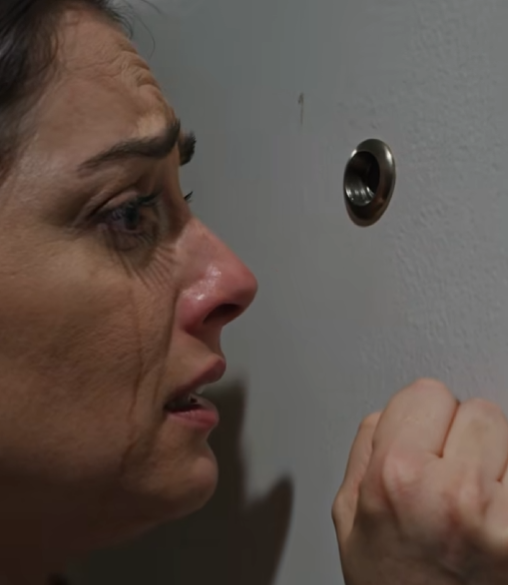
The hallway of the Marbel Arms smelled the way old buildings always do — carpet adhesive and someone else’s cooking and the particular staleness of air that hasn’t moved in years. At 11:47 PM, the fluorescent tube above apartment 314 buzzed with the persistence of something that wanted to die but hadn’t yet found the nerve.
Maya’s fist hit the door for the fourteenth time.
“Dani. Dani. Open the door.”
Nothing.
“I can hear you in there. I know you’re standing right there.” She pressed her ear to the painted wood. Her breathing was loud and ragged, the kind that comes after crying in a car for forty minutes. “Please. Please just open the door.”
From inside: the small, deliberate sound of a deadbolt turning. Not unlocking. Locking tighter.
“Are you serious right now?”
She hit the door again, palm flat this time, the smack of it loud enough to travel. Down the hall, a door cracked open two inches — Mrs. Okafor from 314, a woman in her sixties who wore the same pink housecoat every night and had heard most of the building’s business through walls thinner than anyone had been promised when they signed their leases. She said nothing. She simply watched with the steady attention of someone who had learned that silence was the most efficient way to gather information.
Across the hall, the Petrovs’ door opened. Husband and wife, both in their fifties, both in separate corners of whatever argument they’d been having before the noise started. They stood together now, unified by the spectacle of someone else’s crisis.
At the far end of the hallway, near the stairwell, a teenager in oversized headphones had stopped walking. He didn’t remove them. He just stood there with the detached calm of someone who had grown up in buildings like this and understood that sometimes you watched and sometimes you were watched and the line between was thinner than it seemed.
“Dani.” Maya’s voice dropped, the shrieking collapsing into something more naked and worse. “Our stuff is in there. My passport is in there. I have a flight at six in the morning. I have to be in Dublin by Thursday. I cannot—” She pressed both hands flat against the door, leaning her weight into it as though the wood might eventually relent out of exhaustion. “Please. Please just let me in so I can get my things and then you never have to see me again, I swear to God, I will disappear—”
“You’re already good at that.”
The voice from inside was quiet. That was the thing about it. Maya had been wailing loud enough to move through walls, and Dani’s voice came back barely above conversational, which somehow filled the hallway more completely than the shouting had.
Maya went still.
“What?”
“You heard me.”
“Dani, just—”
“Eleven times.” Still that quiet. Still that horrible steadiness. “November. December. January. February. Eleven hotel receipts. I found them in the pocket of your gray coat when I took it to the dry cleaner because I was doing something nice.”
Mrs. Okafor’s door drifted another inch.
Maya’s hands slid down the door. “It’s not—”
“Hotel Celeste. You always liked that place. We stayed there for our anniversary, do you remember? You said the pillows were the best you’d ever slept on.”
“Dani—”
“I kept trying to think of explanations.” The voice wavered, just for a moment, a single hairline fracture in the surface. Then it sealed back over. “I made a list. I’m not even joking, I sat down with a piece of paper and I wrote down every possible explanation that wasn’t what it obviously was. Work trip — but you don’t travel for work. Surprise for me — but our anniversary was in March. Family emergency—” A short pause. “But then I found the second receipt and the third and after the fifth I ran out of paper.”
Maya had both hands pressed over her mouth.
“I changed the locks this morning,” Dani said. “I called a locksmith at seven AM and I watched him do it and I tipped him forty dollars because I needed to give the money to someone and I didn’t know what else to do with my hands.”
“Dani, please just open the door so we can—”
“Your clothes are in a bag by the service elevator. The big duffel, the one we bought for the Portugal trip. I used that one because it holds the most.” Another pause. “I folded everything.”
Something in Maya broke open at that. A sound came out of her that wasn’t quite a word.
“I folded everything,” Dani said again, and now the quiet voice had something else running underneath it, a current of something that wasn’t anger exactly but was in the same family. “Your good blouse that has to be done a certain way. Your jeans. I folded them all and I put them in the bag and I didn’t throw anything out the window even though I thought about it. I thought about opening the window and throwing every single thing you own into the street and watching it land and I didn’t, and I need you to understand what it cost me to not do that.”
The teenager at the stairwell had taken his headphones off. He held them loosely at his side.
“The passport is in the front pocket of the duffel,” Dani continued. “Your mother’s photograph — the framed one from the side table — that’s in there too, wrapped in your sweater so it wouldn’t break. I almost didn’t wrap it. I want you to know that I almost didn’t, and then I did, because even now, even right now, I—”
The voice stopped.
In the hallway, no one moved.
“Dani.” Maya’s voice was barely audible. She had slid down the door slightly, not quite kneeling, one hand still pressed against it. “I know I don’t have the right to ask you to open this door. I know that. But I need you to know it wasn’t — he wasn’t — it didn’t mean anything, I know that sounds like the worst possible thing to say, I know it sounds like an excuse, but I need you to—”
“Don’t.”
“I need you to—”
“Don’t.” And now there was something in the voice that hadn’t been there before, something that had been held very carefully in place and was no longer being held. “Do not stand outside my door and tell me it didn’t mean anything. Do not tell me that. Do you understand what it would mean if it didn’t mean anything? If it meant nothing? Eleven times, Maya. You chose to go back eleven times to something that meant nothing. What does that make me? What was I, in that equation — the thing you came home to when nothing was done? Was I the nothing or was he?”
The fluorescent tube buzzed overhead.
Mrs. Okafor had her door fully open now. She wasn’t pretending otherwise.
“That’s not what I meant,” Maya whispered.
“I know what you meant.” The quiet was back, but it was a different quiet now, the kind that comes after something has been said that can’t be walked back. “You meant it was physical and not emotional. You meant it was small. And I’ve been standing on this side of this door for three hours trying to decide if that makes it better or worse and I cannot figure it out. I cannot figure out which version I would rather have.”
“The version where I’m still here,” Maya said. “That’s the version. That’s what I want.”
Silence.
“I want to come home,” Maya said. “I want to come inside and I want to sit down on our couch and I want you to scream at me if you need to because I deserve it and then I want us to—”
“To what.”
“To try to—”
“To what, Maya.” Not a question anymore. “What exactly is it you think is on the other side of this? What are you picturing? Because I’ve been picturing it too. I’ve been standing here picturing it and what I see is me, for the rest of my life, every time you’re twenty minutes late, every time your phone goes to voicemail, every time I pick up a coat to take it to the dry cleaner — I see myself doing that math forever. I see myself never stopping doing that math. And I don’t want to live like that. I don’t want to be that person.” Her voice cracked fully on the last word and did not recover. “I liked the person I was before today. I want her back. I don’t think you can give her back to me.”
Maya’s knees hit the floor.
The Petrovs’ door quietly closed. Not in dismissal — something more careful than that. A recognition that this was no longer a thing to be watched.
Mrs. Okafor remained. She had known Dani since the girl moved in, had accepted the occasional borrowed egg and the handwritten note left when the hall light went out for a week. She stood in her doorway and said nothing and made no move to go back inside.
“I’m sorry,” Maya said from the floor. “I know that isn’t enough. I know it doesn’t fix anything. But I need you to know that I’m sorry and that I love you and I know I don’t have the right to say that right now but I don’t know what else I have.”
The door didn’t open.
“Dani.”
Nothing.
“Okay,” Maya said. Very quietly. As though she were telling herself. “Okay.”
She stood. The motion was slow and precise, the movement of someone making sure their body still worked correctly. She smoothed her shirt. She pressed her fingers briefly to the door — not knocking, just touching — and then let her hand fall.
She walked to the service elevator without looking at Mrs. Okafor or the teenager or the closed door of the Petrovs’ apartment. The duffel bag was where Dani had said it would be. It was packed neatly. The zipper ran straight and unforced.
Maya crouched down and opened the front pocket. The passport was there. She held it for a moment without opening it, then tucked it into her jacket.
She stood, shouldered the bag, and pressed the elevator button.
The door to apartment 312 did not open.
The elevator came. The doors slid apart with a mechanical sigh. Maya stepped inside and turned around and for just a moment looked back down the hallway — at the buzzing light, at Mrs. Okafor still standing in her doorway, at the long stretch of carpet leading back to a door that had gone completely still.
The elevator doors closed.
In the hallway, the teenager put his headphones back on and went down the stairs. Mrs. Okafor stood a moment longer, then stepped back into her apartment and shut the door very gently, the way you shut a door when you know someone on the other side needs the quiet.
Behind the door of apartment 312, after a long time, there was the sound of someone sliding slowly down the inside of it until they reached the floor.
And then nothing. Just the light, still buzzing. Still not quite ready to go out.
