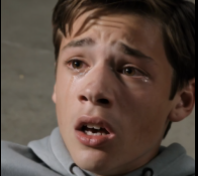
The lunch tray hit the concrete first.
Macaroni scattered like shrapnel. Chocolate milk exploded in a brown wave across the asphalt, and then Eli Marsh came down after it — knees, palms, chin — a full-body collapse that the entire courtyard witnessed in a single, suspended second of silence before the laughter broke.
It was Marcus Holt’s foot. Everyone knew it. No one would say it.
“Oh damn, Marsh can’t even walk.” Marcus’s voice carried the easy cruelty of someone who had never once been afraid of anything in this school. He stood above Eli with his arms wide, performing for the crowd, and the crowd — forty, fifty students — rewarded him with exactly what he wanted.
Eli pushed himself up on bleeding palms. The gravel had opened two red lines across his right hand. His chin burned. He could feel it — the hot prickling shame that was worse than any physical pain, that specific, suffocating humiliation of being down while everyone else was standing.
“Get up, get up,” he told himself quietly.
“What’s that?” Marcus leaned in. “You talking to yourself now? Does the freak talk to himself?“
Devon Reyes, Marcus’s shadow, two steps behind and always laughing. “He’s literally talking to the ground, bro.”
Eli got to one knee. The chocolate milk had soaked through his jeans. He could see it pooling around him, brown and spreading, and he thought absurdly of his mother ironing those jeans that morning, the particular careful way she folded the crease.
Don’t cry. Do not cry.
His eyes were already burning.
“Look at him,” Marcus said. “Look at him, he’s going to cry.“
And that was the thing about Marcus — he didn’t just want the fall. He wanted the after. He wanted the wet eyes and the shaking chin, the full humiliation documentary, proof of something Eli could never quite name but always felt, which was: you don’t belong here, you have never belonged here, and everyone agrees.
Eli got to his feet. His knee was bleeding through the denim now. He kept his eyes down, reached for the overturned tray.
“Leave it,” Marcus said.
Eli stopped.
“I said leave it.” Marcus put his sneaker on the edge of the tray, claiming it. “You’re gonna clean this mess up like a good little freak.”
The crowd had shifted, tightened. A loose horseshoe of bodies. Some with phones out now. Some just watching with that hollow look people wear when they’re glad the thing happening isn’t happening to them.
Eli’s hands were shaking. He could feel a tear break from his left eye — just one, a traitor — and he tilted his head forward so his hair might hide it.
It didn’t.
“There it is.” Marcus’s voice was triumphant, reverent almost. “There it is, everybody.”
The laughter came in a wave, and Eli felt it move through him the way cold water does — total, everywhere, inescapable.
The Interruption
“Hey.”
The word was flat. Not loud. But something in its flatness cut through the noise like a blade through paper, and the laughter stuttered.
Nadia Osei had been eating alone at the table nearest the wall — where she always ate, by choice, with a book open and earbuds in, a person who had constructed her entire school existence around maximum distance from exactly this kind of moment. She was standing now. The book was closed. The earbuds were out.
She was looking at Marcus.
Marcus blinked. He knew Nadia the way everyone knew Nadia — she was quiet, she was smart, she kept to herself. She had never once entered his orbit. This did not compute.
“The hell are you—”
“I’m talking to you.” She walked forward. Unhurried. She had the particular calm of someone who has already decided something, already crossed the line internally, and now the external part is just execution. “You tripped him.”
“I didn’t trip anybody.” Marcus’s voice found its footing again. “Mind your business.”
“You put your foot out. I was watching.”
“Then you need to get your eyes checked.”
Devon snorted. A few people in the crowd laughed, nervous, recalibrating.
Nadia stopped three feet from Marcus. She was shorter than him by four or five inches. She looked up at him with an expression Eli — still frozen, still bleeding — had never seen on another student’s face before. It wasn’t anger exactly. It was colder than anger.
“You’re a coward,” she said.
The courtyard went completely silent.
Marcus’s jaw moved. Whatever he had been expecting, it wasn’t that word, said that plainly, in front of that many people. The smile flickered.
“What did you—”
“You heard me.” She didn’t raise her voice. “You need an audience to feel like something. You need someone smaller to be on the ground. That’s a coward. That’s the whole definition.”
“You better watch your mouth.“
“Or what?” She tilted her head. Genuine question. “You’ll trip me too? Record it? What exactly is your move here, Marcus?”
Something shifted in him. Eli could see it — the way Marcus’s face reorganized itself, the performance dropping for just a moment to show what was underneath, which was a kind of furious confusion, the specific rage of a person unaccustomed to being read accurately in public.
“You think you’re brave?” Marcus stepped toward her. “You think you’re doing something right now?”
“I think you should walk away.”
“I should walk away.” He laughed — ugly, short. “You’re one strange girl, you know that?”
“Walk away, Marcus.”
Devon put a hand on Marcus’s arm — not restraining, just touching, the universal signal of this is getting weird, let’s go — and Marcus shrugged it off hard.
“Don’t,” he snapped at Devon. Then back to Nadia: “You don’t know what you’re starting.”
“I know exactly what I’m doing.” Her voice finally cracked, just slightly — not with fear but with something rawer, something genuine. “I’ve watched you do this for two years. I’ve sat right there and put my earbuds in and turned the page and I am done doing that. So say whatever you’re going to say.”
Silence.
Somewhere in the crowd, a girl whispered something. A boy coughed. The ordinary sounds of the world rushing back in to fill the vacuum.
Marcus stared at Nadia. Nadia stared at Marcus.
Then Devon said, quietly: “Bro. Let’s go.”
Something in Marcus collapsed — invisibly, internally, but Eli saw it. Saw the moment he decided that continuing was more dangerous than retreating. He pointed at Nadia — a long, lingering point, the gesture of someone who needs the last word but doesn’t have one — and then he turned, and Devon followed, and they walked away through the crowd, which parted for them and then closed behind them and then, slowly, began to disperse.
After
Eli hadn’t moved.
Nadia turned to him. Up close, he could see that her hands were shaking slightly — the adrenaline working through her now that it was over, the cost of the calm she’d projected.
“Your chin,” she said.
He touched it. His fingers came back with a small smear of blood.
“I have tissues.” She reached into her jacket pocket, produced a small folded packet, held it out.
He took it. Pressed it to his chin. They stood there in the emptying courtyard, Eli bleeding quietly and Nadia breathing slowly, both of them in the strange flat aftermath of something they couldn’t fully name yet.
“You didn’t have to do that,” he said finally.
“I know.”
“He’s going to make your life—”
“I know,” she said again. Her voice was steady but tired. “I know what he’ll do. I’ve watched him do it to other people.” A pause. “I’ve watched him do it to you. Since seventh grade.”
Eli looked at her. He had shared a school with Nadia Osei for three years and exchanged, at most, two dozen words with her. He knew her name, her table, her book-and-earbuds routine. He had never considered that she had been watching. That anyone had been watching.
“Why now?” he asked.
She looked at the place on the asphalt where his tray had landed, the spreading stain of chocolate milk already going tacky in the afternoon sun.
“Because you almost didn’t get up,” she said quietly. “And I thought — if he stays down, if he just stays down — and I realized I was the only person who was going to do anything about it.” She looked at him. “That felt like information I needed to act on.”
Eli’s throat tightened. He pressed the tissue harder against his chin. He thought about his mother and the ironed jeans and the way she always said have a good day, baby with such simple fierce hope every morning, and he thought about the two years of lunch trays and lockers and low laughter and the earbuds-in, page-turned world he had believed surrounded him.
He’d been wrong about the surrounding.
“Thank you,” he said. It came out rough.
Nadia nodded once. She bent down, picked up his overturned tray, set it on the nearest table. Then she went back to her own table, sat down, opened her book.
But she didn’t put her earbuds in.
Eli stood in the cooling afternoon, bleeding and milk-stained and still trembling faintly, and felt something shift in him — not healed, not fixed, not anything so clean or complete as that. Just shifted. The way a bone might shift in its setting. The way a room looks different when someone turns on a light you didn’t know existed.
He walked to the table nearest the wall.
“Can I sit here?” he asked.
Nadia looked up from her book. She studied him for a moment — genuinely, carefully, the way she’d looked at Marcus. Then she moved her bag off the bench.
“Yeah,” she said. “Sit down.”
He sat down.
Across the courtyard, life resumed — trays clattering, voices rising, the institution grinding forward on its ordinary gears. Marcus Holt was somewhere inside, recalibrating, planning or brooding or both. Tomorrow would come, and the day after that, and none of this would be simple.
But for now, in the long afternoon light, two people sat at a corner table, one of them bleeding and one of them still shaking, and neither of them was alone.
~ end ~
