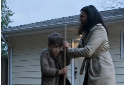
The rake handle had split two days ago, and no one had replaced it. The broken edge pressed into Eli’s palm with every stroke, and he’d learned to grip it higher, away from the splinter, which meant less control, which meant the leaves scattered instead of gathered, which meant he had to do it again.
He had been doing it again for the better part of an hour.
“You’re missing the corner.” Dana’s voice came from behind him, from the step where she stood with her arms crossed and her breath fogging in the November air. She wasn’t cold. She’d put on her coat. “The whole left corner, Eli. Are you blind?”
“I’ll get it,” he said.
“You said that about the right corner twenty minutes ago.”
He pulled the rake toward him. The leaves resisted, damp and heavy, clumping against the broken tine he’d been working around. His fingers had stopped hurting a while back. That felt like a bad sign, but he didn’t know what to do about it, so he kept moving.
“Faster.”
“I’m trying.”
“Trying.” She said it the way people say a word when they want you to hear how stupid it sounds. She came down the step, across the brown grass, and stopped close enough that he could hear her breathing. “You think this is a game? You think I ask you to do things for fun?”
“No.”
“Then why does this yard still look like this?”
He didn’t have an answer. The honest answer — because the rake is broken, because my hands stopped working, because I’ve been out here since three and it’s almost five — had never once helped anything, so he kept it behind his teeth where he kept most things.
“Do it again.” She pointed at the corner he’d already done. “Start over.”
Something moved in his face. He didn’t mean for it to, but it did, some small collapse around his eyes, and she saw it.
“Oh, don’t you dare,” she said. “Don’t you dare cry right now.”
He wasn’t, exactly. His eyes were wet but that might have been the wind. He dragged the rake back to the corner and started again and told himself to think about something else, the trick his teacher had shown him about multiplication, the ending of the book he’d been reading, anything with a shape to it that he could put between himself and right now.
The leaves moved. She watched.
“This is pathetic,” she said. Not loudly. Conversationally, almost, the way you’d say it might rain or dinner’s at six. “You know that, right? Nine years old and you can’t even handle a rake.”
He pressed his lips together.
“Your father thinks I’m too hard on you.” She laughed, a short, dry sound. “He should be out here watching this.”
The rake caught in a root and he stumbled forward, catching himself on one knee, and the leaves went everywhere. He heard her sharp intake of breath and scrambled to get up and his knee was bleeding a little through his jeans and he reached for the rake and she grabbed his arm.
Her fingers dug in above his elbow. Not a grip. A clench.
“I didn’t say stop,” she said.
“I didn’t — I fell, I’m sorry, I’m —”
“Pick it up.”
“I’m trying to —”
“Pick it up.“
The front door opened.
No — slammed. It opened the way doors open when someone has been watching through a window for longer than they should have had to watch, when someone has been building toward a decision the whole drive home. It hit the frame and bounced and the sound crossed the yard like a shot.
Her hand dropped from his arm.
His father was already moving, already off the porch, his jacket not fully on, one sleeve trailing. He was a tall man and he moved like someone taller. His eyes went to Eli’s arm first, then to Dana’s face, then back, doing the math.
“What are you doing to him.”
It wasn’t a question, quite.
Dana turned, and the shift in her was immediate and practiced — shoulders back, chin up, the version of herself she assembled for conflict. “He’s been out here for an hour and hasn’t finished a simple —”
“His hands are bleeding.”
“He’s fine, Marcus, I’m teaching him —”
“Teaching him.” He reached Eli, crouched down, looked at his knee, looked at his palm, the raised welt from the broken handle. His jaw worked. “Go inside, bud.”
And this was the moment. This was the moment that, later, people would expect to have felt like relief.
Eli didn’t move.
He stood between them, the rake still in his hand, and something in him went very quiet and very still, the way small animals go still when there are two large things moving nearby and they aren’t sure which one to watch.
“Eli.” His father’s voice was softer now, directed at him, careful. “Inside. Okay?”
“Okay,” he said. But his feet didn’t move.
Because the last time his father had come home like this — coat half on, voice like gravel, something burning behind his eyes — it had started with the stepmother, too. It had started with raised voices in the kitchen, with Dana’s sharp laugh and his father’s careful, building fury. It had moved through the house the way weather moves, and by the end of it, his father had been standing in the doorway of Eli’s room, and the conversation had turned, the way those conversations sometimes turned, toward your attitude, toward you think you can just, toward the specific, focused heat that Eli had learned to recognize by the particular set of his father’s shoulders.
The cold was the same cold. The gray sky was the same gray sky.
He knew what his father looked like when he was protecting him. He also knew what his father looked like ten minutes after that.
Dana had moved to the other side of him now, and the geometry of it was wrong, three points of a triangle with him at the bottom.
“This is exactly the problem,” Dana was saying. “You come in here like I’m some kind of monster —”
“I saw you grab him —”
“I was correcting him, Marcus, which is something you’ve apparently decided is my job —”
“Don’t.” His father stood up. He was taller than she was by almost a foot, and right now he wasn’t managing that, wasn’t trying to make it less. “Don’t make this about —”
“This is about the fact that you leave me here with him every day and then walk in and act like I’m the problem when all I’m —”
“You left a mark on his arm.”
The sentence stopped her.
Not for long. Her expression shifted, a complicated thing, not quite guilt, more like recalculation. “He struggles with everything. He fights me on everything. You don’t see what I deal with —”
“He’s eight —”
“Nine,” Eli said quietly.
Both of them looked at him.
“I’m nine,” he said. “Since October.”
He watched them remember, separately, that he was still there. His father’s face did something difficult. Dana looked away.
“Go inside, Eli,” his father said again.
“Dad —”
“Inside.”
The rake was still in his hands. He set it down against the tree because he didn’t want to just drop it, didn’t want to give her the satisfaction later, and he walked to the porch and opened the door and stepped into the warmth of the house.
He didn’t go far.
He stood just inside, door not quite closed, and listened.
Listened to his father’s voice drop low in the way it did before it got loud, the long controlled note before the break. Listened to Dana’s voice match it, not backing down, never backing down, the two of them moving through the same old architecture of this argument he had memorized. You coddle him. You undermine me. You’re never here. You don’t know what you’re asking me to do. The responses his father had memorized too. He is a child. He is my child. You knew what this was.
It went on.
And on.
And then the volume broke, and there was shouting, real shouting, and Eli sat down on the floor in the hallway with his back against the wall and his knees pulled up, and he pressed his bleeding palm flat against his jeans and breathed.
He heard his own name, twice, three times, used as evidence by both sides, and he thought about how strange it was to be evidence. To be the thing the argument was about while also being the person having to hear it.
He needs more. He needs less. He’s the reason. He was like this before.
The door opened.
He stood up fast.
His father came in first. Then Dana, stopping in the kitchen doorway, arms crossed, watching. His father moved down the hall toward him and crouched down again, and his eyes were too bright, that brightness that could go either way, that Eli had spent years learning to read.
He watched his father’s shoulders. Watched his hands. Ran the calculation he was always running.
“Eli.” His father’s voice was different now. Not soft, exactly — stripped. Like something had been taken off it. “I need you to tell me something.”
He waited.
“Has she —” His father stopped. Started again. “How long has it been like this? The way she talks to you. What I saw today.” He looked at the mark on Eli’s arm, the red pressure-lines Dana’s fingers had left. “Has it been like this for a while?”
Eli looked at his father. Then past him, to Dana in the doorway. Her expression was careful. Warning.
Then back.
He thought about the last time he’d told the truth about something in this house. How it had gone. The specific way the temperature had changed, his father’s protection curdling into something more complicated, more demanding, because the truth had made things harder and things being harder made his father a different person than the one who had come through the door today.
He thought about the version of the next hour where he said yes, it’s been bad, it’s been like this for a long time.
He thought about the version where he said nothing.
He thought about how he was nine years old and there was no version of this that was his to fix.
His father’s eyes were on him. Really on him. And they were, right now, the eyes of someone who wanted to know. Who was asking because he was afraid he’d gotten something wrong, and maybe ready to hear it.
Maybe.
“Tell me the truth,” his father said quietly.
Eli looked at Dana.
Looked at his father.
The house held its breath.
“Do you really want to know?” he whispered.
And for one long moment, nobody moved.
Because the question wasn’t about Dana, not entirely. The question was about all of it. The whole shape of the last three years. The things that had been said and the things that hadn’t. The nights Eli had learned to read footsteps, the particular weight of each pair, what they meant, which door to stay behind.
His father’s throat moved.
And Eli waited, the way he had learned to wait — patient, still, giving nothing away — to find out what kind of man his father was going to be tonight.
