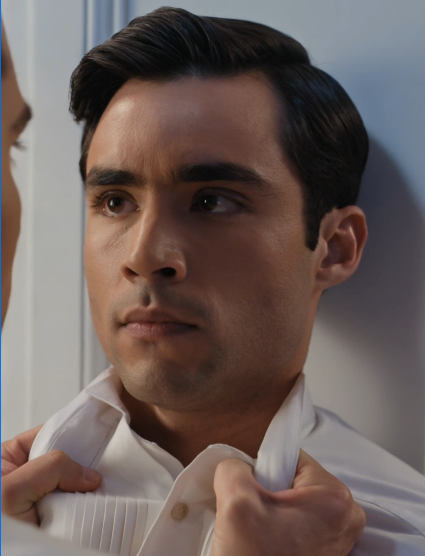
The ballroom of the Harborview Hotel smelled exactly the way Marcus Hale remembered high school: cheap cologne, desperation, and the faint chemical sweetness of someone trying too hard. Twenty years had a way of concentrating everything — the good memories compressed into a few glittering snapshots, the bad ones expanding to fill every corner of a room.
Marcus adjusted his cufflinks. Italian gold. The kind that caught the light just right.
He surveyed the room with the practiced ease of a man who had never once questioned his right to survey. At thirty-eight, he still had the jaw, still had the shoulders, still had the easy smile that had gotten him elected prom king of Ridgemont High’s Class of 2005 by a margin that his campaign manager — yes, he’d had a campaign manager at seventeen — called historic. His hair had thinned slightly at the temples, but he’d styled it in a way that suggested distinguished rather than diminished.
He needed tonight to go well.
The Harrington Group deal had collapsed in February. The Coastal Properties investment had cratered in March. His divorce had been finalized in April — Sandra taking the Malibu house, the good wine cellar, and what remained of his reputation in certain circles. Now it was June, and Marcus Hale, former golden boy, former VP of a mid-sized financial firm that had quietly asked him to “pursue other opportunities,” was hunting.
He’d heard through a prep school friend that Daniel Ashford was going to be at the reunion.
Daniel Ashford. He’d had to Google the name twice before he remembered the face. Quiet kid. Borderline invisible. Wore the same three sweaters in rotation and spent every lunch period in the computer lab. The kind of boy Marcus and his friends had treated the way a solar system treats an asteroid — barely noticing him except to occasionally knock him slightly off course.
But Daniel Ashford was now the founder and CEO of Luminary Technologies, a San Francisco-based AI infrastructure company valued at four point three billion dollars. They were reportedly expanding their East Coast operations and looking to build out a senior leadership team.
Marcus had spent two weeks crafting his approach.
The waitstaff moved through the room in white shirts and black vests, carrying trays of champagne flutes and miniature crab cakes. Marcus plucked a glass from a passing tray without looking at the person carrying it and resumed scanning the room for familiar faces — specifically, one familiar face.
He spotted his old teammate Grover Walsh near the photo display wall, fat and happy and laughing too loud. He saw Bethany Cruz, who’d been homecoming queen, now apparently a pediatric surgeon based on the LinkedIn stalking Marcus had done before driving here. He saw the old geometry teacher, Mr. Finch, who had apparently been invited for reasons Marcus couldn’t fathom.
He did not yet see Daniel Ashford.
“Excuse me.” Marcus raised his empty glass in the direction of a passing waiter. “Another.”
The waiter turned.
He was a slight man, perhaps an inch shorter than Marcus, with dark-framed glasses and close-cropped hair that had gone silver at the temples — prematurely, fashionably. He wore the same white shirt and black vest as the other staff, a small gold pin on the lapel that Marcus didn’t bother to read. He had the calm, unhurried face of someone who had simply stopped caring what certain rooms thought of him.
Marcus didn’t recognize him.
“Another champagne,” Marcus repeated, slower, with the particular enunciation people use when they are not actually concerned about being understood and are mostly concerned about performing impatience.
“Of course,” the man said pleasantly. He lifted a flute from his tray and held it out.
Marcus took it. Then frowned. Something about the man’s stillness was vaguely irritating — he hadn’t flinched, hadn’t rushed, hadn’t offered the small reflexive apology that Marcus had come to expect from people in service positions.
“You’re going to want to be quicker about it,” Marcus said. “These people are paying guests.”
“I understand.”
“Do you?” Marcus smiled the way that had always worked — the one that was somehow both charming and cutting, a smile that said I’m doing you a favor by speaking to you. “What’s your name?”
A brief pause. Not the pause of someone caught off guard. The pause of someone choosing.
“Daniel,” the man said.
Marcus’s networking instincts fired before his recognition did. “Daniel. Listen, Daniel, I’m looking for someone tonight — Daniel Ashford, you know him? He might be arriving late. Tech guy, probably looks like someone who was bad at gym class.” He chuckled at his own joke. “If you spot someone like that, you flag me down immediately. I have a meeting with him — well, nearly a meeting — and it’s quite important.”
Daniel Ashford looked at Marcus Hale with an expression of the mildest, most anthropological interest.
“Bad at gym class,” he repeated.
“You know the type.” Marcus waved a hand. “Probably nervous, probably overdressed to compensate. Just point him my way.” He reached into his jacket, produced a business card — the new ones, elegant matte finish, Marcus Hale | Strategic Partnerships & Executive Consulting — and held it out between two fingers. “There’s something in it for you if he and I connect tonight.”
Daniel took the card. He read it. His expression did not change.
“I’ll keep an eye out,” he said.
An hour passed. The reunion hummed and swelled. Marcus worked the room with professional fluency, laughing at the right moments, leaning in with the practiced body language of genuine interest he had long since stopped feeling. He collected two LinkedIn connections, one vague promise to “grab lunch sometime,” and zero sightings of Daniel Ashford.
He was growing frustrated.
He found the quiet waiter again near the bar, this time standing still, watching the room with his hands loosely clasped behind his back. There was something odd about the way he stood — not the posture of someone waiting for instruction, but of someone taking inventory.
“Still no sign of him?” Marcus said, appearing at his elbow.
“Of who?”
“Ashford. The tech billionaire I told you about.”
“Right.” Daniel tilted his head slightly. “No sign.”
Marcus exhaled and looked out across the room. The night was slipping from him. “You know what the worst thing about success is?” he said, with the confessional warmth of a man who has had two champagnes and wants to feel interesting. “It makes certain people inaccessible. I built a career — a real career, institutions, relationships — and now I have to chase down some kid who got lucky with software to get a foot in the door.” He shook his head. “It’s absurd.”
Daniel was quiet.
“He used to be a nobody,” Marcus continued, warming to the sound of his own voice. “I mean, genuinely — invisible. The kind of kid you don’t even bother to remember. And now because he wrote some code at the right moment—”
“Do you remember him?” Daniel asked.
Marcus frowned. “What?”
“From school. Do you actually remember him?”
“I—” Marcus paused. Honesty surfaced briefly before networking instinct submerged it again. “Sure. Vaguely. Quiet kid. Kept to himself.”
“Did you ever speak to him?”
Something in the question’s tone made Marcus stand slightly straighter. “I’m sure our paths crossed.”
“Your paths crossed,” Daniel said, “the day you and two of your friends cornered him in the hallway outside the computer lab and knocked his project out of his hands. It was a circuit board he’d built for the regional science fair. It took him four months.” He said it the way someone reads a historical marker — informative, declarative, utterly without heat. “It broke. He didn’t make it to the fair. The teacher who was mentoring him that year later wrote him a recommendation letter for MIT anyway, because she said he had responded to the setback with more maturity than anyone she had ever taught.”
The room seemed to tilt slightly.
Marcus stared at the waiter.
The waiter looked back at him.
“My name,” Daniel Ashford said, “is not actually a secret. It’s on my pin.” He glanced down at the small gold pin on his lapel. Marcus looked. D. Ashford — Luminary Technologies. “I co-sponsored this reunion. The hotel, the catering, the band. It felt like the right thing to do for the community.” A small pause. “I also own the catering company. I was helping carry trays because two of the staff called in sick tonight and I don’t believe in standing around watching other people scramble.”
The business card — his own business card — appeared in Daniel’s hand. He set it gently on the bar top between them.
“I’ve already reviewed forty-three applications for our East Coast leadership team,” Daniel continued. “We’re looking for people with specific qualities. Accountability. Intellectual honesty. The ability to admit when they’ve been wrong.” His voice remained even, almost kind — the most devastating possible register. “I have your card. I know how to reach you.”
He picked up his tray.
“It was good to see you, Marcus.”
Marcus stood at the bar for a long moment after Daniel Ashford walked away, disappearing into the easy movement of the room — pausing here to say something that made a cluster of people laugh warmly, stopping there to shake a hand with the unperformed comfort of someone who had long since made peace with who he was.
The crab cake in Marcus’s hand had gone cold.
He thought about the circuit board. He couldn’t picture it — not really — but he could picture the hallway, could picture himself at seventeen, loud and golden and utterly convinced that certain people were simply less: less interesting, less worthy of space, less real in some fundamental way that he had never bothered to examine.
He put the crab cake down.
Around him, Ridgemont High’s Class of 2005 celebrated twenty years of roads taken and not taken, of who they had meant to become and who they had quietly agreed to be instead. Bethany Cruz was showing someone photos of her kids — three of them, all enormous smiles. Grover Walsh was telling a story that required both arms and most of his torso. Mr. Finch was eating a crab cake with the serene contentment of a man who had watched hundreds of graduating classes and knew, with the certainty of long experience, that the ones who peaked at seventeen rarely understood what had happened to them.
Marcus Hale picked up his coat.
He did not network his way to the door. He did not collect any more cards. He walked out through the gold-lit lobby into the cool June night, and he stood on the sidewalk for a while, listening to the city, feeling the particular quality of silence that arrives not when everything goes wrong, but when everything becomes, at long last, perfectly clear.
His phone was in his hand before he’d consciously decided.
He opened his email. Navigated to the Luminary Technologies careers page. Found the application portal for the East Coast leadership team.
He stared at the first question for a long time.
In 500 words or fewer, describe a moment when you failed to meet your own standards — and what you did about it.
Marcus sat down on a bench outside the Harborview Hotel and began, for the first time in a long time, to tell the truth.
