The fluorescent light at the end of B-Wing had been flickering for three weeks.
Manny Reyes had put in the maintenance request on a Tuesday, same as always—filled out the little yellow form, slid it under Vice Principal Hartwell’s door, and watched it disappear into the same bureaucratic void that swallowed all his requests. The light kept flickering. Manny kept mopping. That was the arrangement.
He was wringing out his mop near the gymnasium entrance at 4:47 p.m. when he heard the sound.
Not a crash. Not a scream. Something worse—the low, collective murmur of a group that had already decided something.
Caleb Whitmore had made the mistake of staying late to finish a history project.
That was all it was. A project on the Industrial Revolution, due Thursday, and the library printer was the only one that didn’t smear the ink. He’d been at Crestwood Preparatory Academy for eight months on a full academic scholarship—eight months of navigating the invisible architecture of wealth that structured every hallway, every lunch table, every sidelong glance. He’d learned to read rooms the way sailors read weather. He knew when a sky was turning.
He knew the moment he turned into B-Wing.
There were four of them. Drew Callahan first, because there was always a Drew Callahan—lacrosse build, jaw like a architectural detail, the specific cruelty of someone who had never once been told no. Beside him: Jordan Fitch, whose father owned two car dealerships and a congressman. Then Marcus Webb and Tyler Prouse, satellites in Drew’s orbit, their courage entirely borrowed.
They were arranged across the hallway the way boys arrange themselves when they want to make sure there’s no way around.
“Scholarship boy,” Drew said. It wasn’t a greeting.
Caleb stopped walking. His project was rolled in a cardboard tube under his arm. He thought, abstractly, about how long it had taken to print. “I’m just heading out,” he said.
“You made me look stupid in Brennan’s class today.”
Caleb had answered a question about the Pullman Strike that Drew had answered wrong. He’d done it quietly, without theater, the way you correct someone when you’re trying not to humiliate them. It hadn’t mattered. The humiliation had happened anyway, in the private arithmetic of Drew’s ego.
“I wasn’t trying to—”
“You were, though.” Drew took a step forward. “You’re always doing that. Always trying to prove you belong here.”
The flickering light made shadows jump and stutter. It made everyone look like different, more dangerous versions of themselves.
“I don’t want any trouble,” Caleb said. The words felt thin in his mouth, tissue paper held against fire.
“Too late,” said Jordan Fitch, and stepped to the right to close the gap.
Manny heard the first impact from thirty feet away.
It had a particular sound—not like the movies, not a clean crack—more like a door being thrown open in wind, sudden and wrong. He left the mop bucket where it stood and moved toward B-Wing without deciding to.
He was sixty-one years old. His knees had opinions about stairs. He had a bad shoulder that predicted rain with more accuracy than the weather app on the phone his daughter had made him download. He wore a gray uniform with CRESTWOOD MAINTENANCE stitched above the breast pocket, and in eight years at this school, he could count on one hand the number of students who had learned his last name.
He came around the corner and took in the scene in less than a second—the way you learn to read rooms when rooms have historically been trying to kill you.
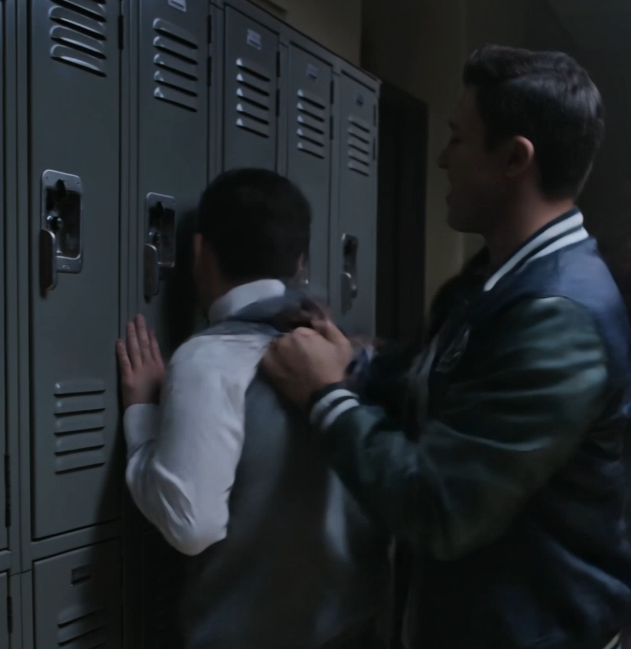
Caleb was against the lockers, a hand braced on the metal to stay upright. His lip was split. The cardboard tube was on the floor, his project scattered in a white fan across the linoleum. Drew Callahan was pulling back for something that was going to be worse than the first one, his friends forming a loose, watchful semicircle, the geometry of cowardice.
“Hey,” Manny said.
Nobody moved. Nobody even turned.
He had spent eight years being unhearable. He had learned, without bitterness, that the gray uniform made you a piece of furniture. He said it again—not louder, but differently.
“Hey.”
Drew Callahan turned around.
Later, if any of them had been asked to explain it, they would have struggled. Something had changed in the janitor’s posture. Something had reorganized. He was still the same short, thick, gray-haired man who mopped their hallways and replaced their light bulbs. But he was standing differently—weight low, hands relaxed at his sides in a way that was somehow more threatening than fists—and his eyes had gone somewhere else entirely, somewhere older and considerably less patient.
“Walk away,” Manny said.
Drew laughed. It was a nervous laugh, the kind that precedes a decision you’ll regret. “Mind your business, old man.”
Manny looked at him for a long moment.
“Last chance,” he said quietly.
Drew threw the punch.
What happened next lasted perhaps eleven seconds.
To Caleb, leaning against the lockers with blood on his chin, it looked like the hallway had suddenly rewritten the rules of cause and effect.
Manny didn’t step back. He stepped in—inside the arc of the punch, so close that the swing passed harmlessly over his shoulder—and he did something with his forearm and his hip that redirected Drew’s momentum so completely that Drew stumbled forward and met the lockers face-first with a resonant, shuddering clang. It was so smooth it looked like a demonstration.
Jordan Fitch made his move from the left. Manny turned with the kind of unhurried rotation that suggested he had already known this was coming, and his response—a short, horizontal movement that caught Jordan’s wrist and redirected his forward energy into the wall—deposited Jordan on the floor with an expression of profound confusion.
Marcus Webb took one step forward and stopped. He had seen enough.
Tyler Prouse had already taken two steps backward.
Manny stood in the center of the hallway. He wasn’t breathing hard. His expression hadn’t changed. Drew was peeling himself off the lockers, a red mark blooming across his cheekbone. Jordan was sitting on the floor, holding his wrist, which was not broken but would have a story to tell for a week.
The flickering light stuttered overhead.
“That’s enough,” Manny said. “All four of you. Sit down. On the floor. Right now.”
They sat. Drew Callahan, son of a hedge fund manager, sat on the linoleum floor of B-Wing and did not argue.
Manny crossed to Caleb and looked at his lip, the way you look at injuries when you’ve seen a great many of them. “You okay?”
“Yeah.” Caleb touched his face. “Yeah, I think so.” He looked at the man in the gray uniform with an expression that was trying to recalibrate something fundamental. “How did you—what was—”
“Let’s get your papers,” Manny said.
They gathered the scattered pages of Caleb’s history project together, squaring the edges, sliding them back into the tube. Behind them, four wealthy boys sat in silence on a linoleum floor, nursing bruises and a new understanding of the world.
Vice Principal Hartwell arrived six minutes later, by which point Manny had his mop back in his hands.
There were interviews. There were phone calls to parents who used their first names with Hartwell in the tone of people accustomed to using their first names with everyone. There were consequences that were not quite sufficient, as consequences at schools like Crestwood tended not to be when the last names on the incident report matched the names on the buildings.
But that is a different story.
Caleb found Manny the next morning before first bell. The janitor was replacing a ceiling tile in the A-Wing corridor, standing on the second step of a folding ladder with the patience of a man for whom patience had become structural.
“Mr. Reyes,” Caleb said.
Manny looked down. A tile was balanced in his hands.
“I wanted to say thank you. Properly.” Caleb paused. “And I wanted to ask—where did you learn to do that?”
Manny considered the ceiling tile. He set it into the grid with a soft, definitive click.
“Long time ago,” he said.
“Were you—were you trained? Like, formally?”
Manny stepped down from the ladder and folded it with the efficiency of long habit. He looked at Caleb for a moment—actually looked at him, the way adults at this school rarely did, without the overlay of category or assessment.
“Fourteen years professional,” he said. “Retired 2009. Welterweight.”
Caleb stared. “Professional—you mean fighting? Like, professionally?”
“Like professionally.” A faint, private amusement moved across Manny’s face and was gone. “Had a good run. Won some. Lost some. Shoulder went.” He lifted his chin slightly toward the bad shoulder, the one that predicted rain. “That’s usually how it ends.”
“Why didn’t you—” Caleb stopped himself. The question he’d been about to ask was why didn’t you tell anyone, but he heard how it sounded before it left his mouth. Tell anyone. As if Manny owed the population of Crestwood Preparatory Academy his biography. As if moving through a place quietly, doing your work without demanding recognition, was some kind of failure to disclose.
Manny read the unfinished question anyway. He had spent a lifetime reading rooms.
“People see what they want to see,” he said, without rancor. “I learned that early.” He picked up the ladder and tucked it under his arm. “You should get to class.”
Caleb didn’t move immediately. There was something else—the thing that had been sitting on him since last night, heavier than a bruised lip, heavier than scattered papers.
“Does it bother you?” he asked. “Being here, I mean. After everything you did. Being—” He gestured vaguely at the gray uniform, the maintenance cart, the long corridor.
Manny was quiet for a moment. Outside, through the high windows, the morning light was coming in pale and specific.
“I spent fourteen years trying to prove something in front of crowds,” he said finally. “Used to need that. The noise of it. The people watching.” He looked down the corridor—the long, empty hallway of a school not yet filled, quiet as a church. “I don’t need that anymore. I just do the work.”
He started down the hall.
Caleb stood there and watched him go—the gray uniform, the bad shoulder, the folded ladder under one arm—until he turned the corner and was gone.
In B-Wing, the fluorescent light had stopped flickering.
Manny had fixed it sometime in the early morning, before anyone arrived, because it was on his list and because a flickering light in a dark hallway was the kind of thing that made everything worse, and he had seen enough of everything worse to know that the small repairs matter.
He had put in no maintenance form. He had made no announcement.
He had simply fixed it, and moved on to the next thing, and the hallway was full of light.
