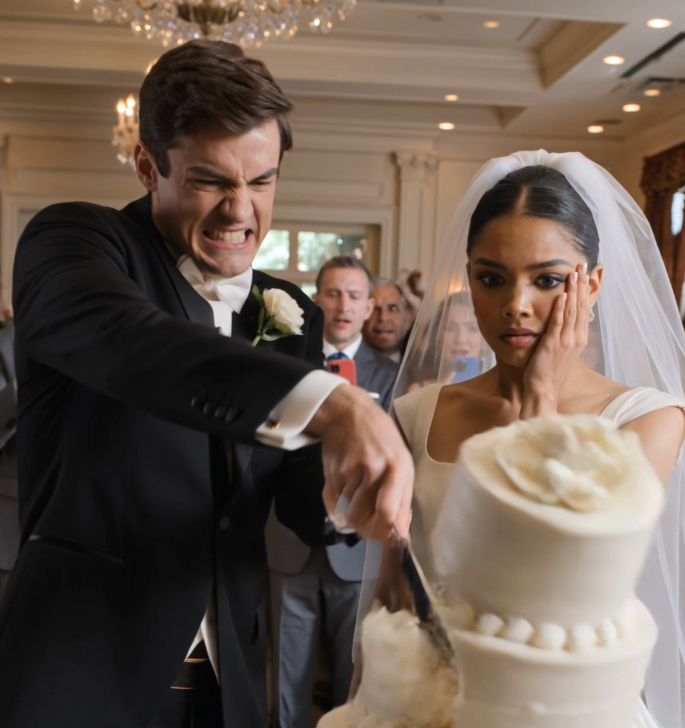
The Hargrove Estate had never looked more beautiful. String lights threaded through the magnolia trees like captured stars, and the scent of gardenias drifted across the manicured lawn where two hundred guests sat in gilded chairs, their champagne glasses catching the last gold of a late June evening. It was, by every measure, a perfect wedding.
Or it had been.
The ceremony itself had gone without incident. Natalie Beaumont, radiant in ivory lace, had walked down the flower-strewn aisle on the arm of her father, a broad-shouldered man with silver-streaked hair named Raymond Beaumont, who had smiled quietly at his daughter the entire way — the kind of smile that carried decades of bedtime stories and scraped knees and late-night homework sessions inside it.
And at the altar, Marcus Holt had stood waiting.
Marcus was what people in Clover Falls called a catch. Thirty-four, a real estate developer who drove a black Porsche and wore suits that cost more than most people’s car payments. He had charm the way some men have height — just naturally, effortlessly, as though he’d been born already knowing how to work a room. He could make anyone feel like the most important person alive. That was the trick of him.
That was also the danger.
Natalie had ignored the first sign — raised voices at a restaurant, early in their courtship, when a waiter brought the wrong wine. She’d told herself it was stress. She’d ignored the second sign, too, and the third, the way people in love sometimes choose to look at the painting instead of the cracks in the wall behind it.
But tonight, at the reception, with the whole town watching, Marcus Holt could not hold himself together for even one more hour.
It began at the cake table.
The five-tier confection stood in the center of the terrace — white fondant decorated with hand-pressed sugar flowers, a masterpiece that the baker, Dottie Marsh, had spent four days constructing. The guests had gathered in a warm, champagne-giddy semicircle, phones raised, ready to capture the moment.
The photographer, a young woman named Claire who was three weddings into her career, positioned herself to Natalie’s left. The videographer circled wide. Someone in the crowd laughed at a private joke. A child near the back asked her mother when they could eat.
Marcus took the silver cake knife first, placing Natalie’s hand over his with a practiced romantic gesture that earned a collective aww from the crowd.
“To us,” he said, lifting his champagne flute.
“To us,” Natalie echoed, and her smile was real — whatever her doubts, in this moment she wanted it to be real.
They pressed the knife together into the bottom tier, slicing cleanly through. Natalie lifted the small piece onto a dessert plate, white cake with raspberry filling, and as tradition demanded, she raised it toward Marcus’s mouth.
He bit into it.
And then something went wrong in his eyes.
It was the frosting — too sweet, he’d say later, though no one would care about his reasons by then. Or it was the champagne talking. Or it was the fact that his collar was too tight and the night had run thirty minutes long and he’d been smiling for five hours straight and something inside him had simply run out of patience for the performance of being good.
Whatever it was, when Natalie laughed and playfully smeared a small bit of frosting across his jaw — as couples do, as everyone does, as they had laughed about doing just the week before — Marcus’s face darkened like a cloud passing in front of a sun.
“Don’t,” he said.
The word was a door slamming.
Natalie blinked. “It’s just a little—”
“I said don’t.” He grabbed her wrist.
The nearby guests went quiet first, a ripple of silence spreading outward through the crowd.
Natalie tried to pull her hand back. “Marcus, you’re hurting—”
He struck her.
Not with a closed fist — as though that distinction meant anything. An open-handed blow, across her cheek, sharp and sudden and loud as a gunshot in the hush that had already fallen over the terrace. The dessert plate shattered on the flagstone. Natalie’s head snapped to the side. She stumbled, caught herself on the cake table, and sent the bottom tier sliding half off its stand.
For one long, terrible second, nobody moved.
Claire the photographer had stopped taking pictures. The child who had asked about eating was now perfectly silent. Two hundred people stood frozen in the amber of collective shock, the string lights still twinkling with grotesque cheerfulness overhead.
Then Natalie slowly turned back to face him. Her hand moved to her cheek. Her eyes — those brown eyes Marcus had written three embarrassing text messages about in the early months — were not filled with the tears he perhaps expected, or the cowering he had perhaps grown accustomed to behind closed doors. They were filled with something that looked, after a moment, almost like relief.
Like a door she had been leaning against had finally, irrevocably opened.
The crowd found its voice in a mess of gasps and urgent whispers. Someone near the back said did he just— and didn’t finish the sentence. A groomsman took a single step forward and then stopped, unsure of his role in something this big.
Marcus straightened his jacket. The charm came back to his face like a reflex, a man so accustomed to recovery that he reached for it without thinking. “It was an accident,” he said, to no one and everyone. “She knows I didn’t—Natalie, tell them. Tell them it was—”
“Marcus.”
The voice came from the left.
Raymond Beaumont walked through the parting crowd the way water moves around a stone — people stepped aside without being asked, something in his bearing requiring it. He was not a tall man, particularly, not physically imposing in any dramatic way. He was sixty-one years old, and he had iron in his hair and a stillness about him that came from spending thirty-seven years making decisions that mattered.
He stopped four feet from Marcus Holt.
In his eyes there was nothing hot or frantic. No explosion. He looked at Marcus the way a man looks at a math problem — studying it, understanding it, deciding what to do about it.
“I’d like you to step away from my daughter,” Raymond said.
Marcus exhaled, almost laughed. He recognized Raymond, of course. He’d shaken his hand a hundred times. He’d sat at his dinner table and eaten the man’s cooking and called him sir with easy, charming fluency. He thought he knew Raymond Beaumont.
He thought Raymond Beaumont was simply the father of the woman he was marrying.
“Raymond, I understand this looks—”
“It doesn’t look like anything,” Raymond said. “I watched it. So did two hundred other people.” He tilted his head very slightly. “Step away from my daughter.”
Marcus stepped back. One step, grudging, the step of a man who still believed he could manage this situation.
“Now.” Raymond reached into the breast pocket of his suit jacket and produced a badge. He held it up without theater, without flourish — the way you might show someone the time on your watch.
Chief Raymond Beaumont. Clover Falls Police Department.
The silence that followed was a different kind of silence than before. The first silence had been shock. This one was something else — the held breath before a verdict.
Someone in the crowd whispered it before Marcus could fully process what he was seeing: He’s the chief. Her father’s the chief of police.
Marcus blinked. His mouth opened.
“You struck a woman,” Raymond said, tucking the badge away with the same calm with which he’d produced it. “In front of two hundred witnesses, including a videographer who I sincerely hope kept rolling.” He glanced toward the videographer, who gave a single, rapid nod. “You struck my daughter. On her wedding day. At a table where she was trying to give you a piece of cake.”
Each sentence landed like a stone dropped into still water.
“Raymond, I—”
“Chief Beaumont.” It wasn’t said with anger. It was said the way you correct someone’s grammar in a legal document.
By now, two officers had materialized at the edge of the terrace — off-duty, attending as guests, and now standing with the particular posture of men who have received a silent instruction. They hadn’t been called. They hadn’t needed to be called. They knew their chief. They could read the room. They moved through the crowd and positioned themselves on either side of Marcus Holt with professional ease.
Marcus looked at them. He looked at Raymond. He looked at Natalie.
And whatever he saw in her face — not anger, not heartbreak, but that quiet, devastating relief — finally broke through something in him. The charm evaporated. His shoulders dropped. He suddenly looked, very much, like what he was: a man who had made an irreversible decision in front of everyone who would ever know his name.
“You have the right to remain silent,” Raymond began.
They walked Marcus Holt through the Hargrove Estate in his wedding suit, past the gilded chairs and the gaslit lanterns and the untouched dinner tables set with ivory linens and small cards bearing his name. Past the dance floor that would not be danced on tonight. Past the gift table. Past the bar where two bartenders stood holding their bottles and watching with wide eyes.
Nobody laughed. Nobody cheered. It was not that kind of moment.
It was quieter than that.
Afterward, Raymond came back to his daughter.
She was sitting on the low stone wall at the edge of the terrace, her heels off, the train of her dress gathered beside her, a glass of water in her hand that someone — Dottie Marsh, of all people — had pressed on her without a word. The string lights were still on. The magnolias were still fragrant. The caterers stood uncertainly near the kitchen, waiting for instruction that hadn’t come.
Raymond sat beside her. For a while, he said nothing at all.
“I should have listened,” Natalie said finally. Her voice was steady, but very quiet.
Raymond was quiet for a moment. “The listening starts now,” he said. “That’s the only place it ever starts.”
She leaned against him — her father, the chief of police, the man who had walked her toward a mistake and then, when it revealed itself completely, had walked her back out of it with a badge and a stillness she would remember the rest of her life.
Around them, slowly, the evening reassembled itself into something else. Not a wedding reception. Something harder to name. Guests set down their champagne and sat beside each other and talked in low, serious voices. Someone brought Natalie a plate of food she didn’t eat. Claire the photographer quietly packed her camera away, then unpacked it again, uncertain what photographs were appropriate now, and settled in the end for one: Natalie and her father on the stone wall, her head on his shoulder, the lights glowing soft behind them.
It was, everyone who saw it later agreed, the best photograph of the night.
The cake stood abandoned on the table, half-served, sugar flowers intact, the little ornamental bridge between the top-tier figurines leading from one side to nowhere in particular — which, if you thought about it, was not so different from how a lot of things ended.
The raspberry filling bled slowly onto the white fondant.
The night went on.
