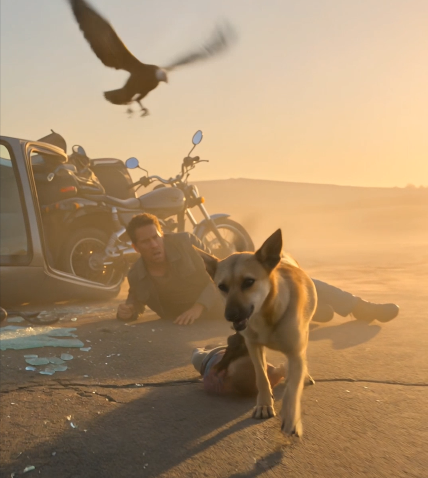
After a car wreck, a dying biker watches a stray dog drag a crying infant from the backseat. He realizes the dog is not attacking — it’s protecting the baby from vultures.
The sky above the Mojave was the color of an old bruise, purple bleeding into orange at the edges, and Raylan Cord had maybe twenty minutes left on this earth. He knew it the way a man who has spent thirty years riding knows weather — not from reading instruments, but from feeling it in his bones.
His Harley lay thirty feet behind him, a crumpled testament to the pickup truck that had blown the stop sign at Highway 62 and Old Mesa Road. The truck itself had veered into the desert brush and gone quiet. No movement from that direction. Raylan had checked once, then stopped checking.
He could not move his legs.
The pain had come in a great white wave at first, then receded to something duller and more permanent, the kind of pain that stops announcing itself because it has decided to simply live inside you. His left arm was broken in at least two places. He could tell by the wrong angle of his elbow when he’d tried to drag himself toward the road.
The road. Empty in both directions. It was four-seventeen on a Tuesday afternoon in the middle of October, and nobody drove Old Mesa Road on a Tuesday unless they were lost or local, and the locals all knew better.
He had his phone. That was something. The screen was cracked clean across, a spider web of fractured glass, but it still showed the emergency call option. He had pressed it three times, heard the operator’s voice each time, tried to speak his location. Whether the words had come out right, whether the GPS had grabbed hold — he didn’t know. His mouth tasted like copper and desert dust.
So he waited.
It was the sound that reached him first — thin and high and furious, the unmistakable register of an infant who has decided that the world is intolerable and intends to say so at full volume. Raylan turned his head slowly, grinding his teeth at the bolt of pain in his neck, and looked at the car he had not noticed until this moment.
A silver sedan, nose-down in the shallow drainage ditch on the far shoulder. It must have been clipped by the same truck, or perhaps it had swerved to avoid the chaos and gone in on its own. The driver’s door was pushed inward at a nauseating angle. The back passenger window was shattered.
The crying was coming from inside.
“Hey,” Raylan tried to call out. Nothing but a thin rasp. He swallowed blood and tried again. “Hey! Is anyone—”
But then the dog appeared.
It came from nowhere, the way desert animals do — out of brush and heat shimmer and shadow, as though the land had simply exhaled it. A big animal, some kind of shepherd mix, brindled gray and brown, ribs visible beneath a coat caked with dust. It had the lean, cautious movement of a creature that had been on its own for a long time and had learned to treat the world as a place full of teeth.
It circled the sedan twice, nose working, ears swiveling. Then it pushed its head through the shattered back window.
Raylan’s heart seized.
“No,” he gasped, struggling to lift himself on his good arm. “No — hey — get away—”
The dog ignored him. He heard the scrape and shuffle of movement inside the car, heard the crying intensify for a moment, then pitch downward into a strange, surprised silence. And then the dog was backing out of the window, and in its mouth — Raylan felt the world tilt sideways — in its mouth was the baby.
It was maybe eight months old. Still in a car seat harness that had released or broken, wrapped in a yellow blanket. The dog had it by the blanket, the fabric bunched in its jaws, moving backward with careful, deliberate steps, the way Raylan had once seen a mother wolf on a nature program carry a pup — tender and purposeful and absolutely certain.
It laid the baby in the dirt three feet from the car.
The infant had gone quiet, staring up at the enormous animal with enormous eyes. Then it found its voice again and began to wail, arms pinwheeling, face a furious red.
The dog sat down beside it.
Raylan watched, breathing in shallow sips that were all his body could manage now. He watched the dog lower its great head and sniff the baby from crown to foot, and then settle its chin on the ground beside the infant’s head, creating a wall of warm animal between the child and the road, and then he understood what the dog had seen that he had not.
He looked up.
They were already there. Four of them, maybe five, riding the thermals two hundred feet above the wreck with their broad black wings spread wide and their naked red heads tilted downward. Turkey vultures. The Mojave had no shortage of them. They had the infinite patience of creatures who had evolved to wait — who had made a specialty of waiting — and they were watching the silver sedan with the professional interest of those who know that stillness, in the end, comes for everything.
One had already landed. It sat on the roof of the sedan, not twenty feet from where the baby lay, its head cocked at that precise angle that spoke of calculation.
The dog raised its head and looked at the bird with flat yellow eyes.
The vulture considered its odds. It was a large bird, with a wingspan that suggested confidence. It took two hopping steps down the windshield toward the hood, closer to the baby by four feet.
The dog did not bark. It did not growl. It simply rose to its feet, and in the rising there was something that needed no translation. The vulture reassessed its odds and lifted off in an ungainly, reluctant flap, rejoining its companions on the hot air above.
The dog lay back down beside the child.
Raylan closed his eyes. He could feel the sun on his face, lower now, less brutal. The light behind his eyelids was orange. The baby had found a rhythm in its crying — a steady, indignant pulse that was actually, he realized, the most beautiful sound he had ever heard, because it meant the child’s lungs were full and strong and working.
He thought about his own daughter. Maggie, who was twenty-six now and lived in Portland and called him twice a year, Christmas and his birthday, and sometimes not even that. He had not been a good father. He had been a man who loved motorcycles and open roads more than he loved Saturday mornings and school plays and the particular patience that daughters require. He did not make excuses for this. It was simply the shape of the failure he had chosen.
He thought he might like to call her now. He thought her voice might be the right sound for the end of things.
But his phone had gone dark.
“Hey,” he said softly. The dog’s ears swiveled toward him. “You’re doing good. You keep doing that.”
The dog regarded him for a moment with those yellow eyes, then looked back up at the sky.
The vultures had grown to seven. They were patient. They were always patient. But the dog was patient too, in its way — the patience of the living rather than the patience of those who feed on the end of living, and Raylan understood, in some loose and pain-colored way, that this distinction was not nothing. This distinction might be everything.
He did not know how long he drifted. The pain had changed its nature again, become something distant and theoretical, and he recognized this change for what it was. The sky had gone from orange to violet to a deep, encyclopedic blue, and the first stars were making their arguments above the desert.
The dog was still there. The baby was still crying, softer now — a tired sound, a hungry sound — but alive. Furiously, insistently, magnificently alive.
Raylan found he was smiling, which surprised him.
He had not thought there was anything left in his particular story worth smiling about. He had ridden forty thousand miles across this country’s skin and had never found whatever it was he was looking for, and had mostly stopped believing he was looking for anything at all. He had been a man in motion, which was sometimes indistinguishable from a man in flight, and the destination had never been the point.
But here was a dog that had come from nowhere and dragged a baby from a wreck and planted itself between the child and the dark-winged things that circled. Nobody had asked it to. Nobody had trained it for this. It had simply arrived at a moment of chaos and done the one clear thing that needed doing and then stayed.
Raylan thought there was probably a sermon in that, if you were the kind of man who went to church. He was not that kind of man. But he thought the sentiment was sound all the same.
Stay, he thought. When everything in you wants to run — just stay.
He heard the sirens before he saw the lights — a distant, thin wailing from the direction of Twentynine Palms, growing. The baby heard them too and shifted its crying into a new register, something almost conversational, as though commenting on the development.
The dog lifted its head.
The lights crested the low rise half a mile north, red and white cutting through the darkening desert, and Raylan felt something release in his chest — not pain, exactly, but the particular tension of a man who has been holding something in place through sheer will and can now, finally, let it go.
“They’re coming,” he told the dog. “You did good. You can go now.”
But the dog didn’t go. It stayed beside the baby as the ambulance and the sheriff’s cruiser came skidding to the gravel shoulder, stayed as the paramedics came running with their bags and their voices full of urgent professionalism, stayed as one of the paramedics — a young woman with her hair pulled back tight — stopped dead at the sight of the infant on the ground with the dog curled around it and said, quietly, oh my god, before stepping forward to gather the child up.
The dog let her. It stood and watched as the baby was lifted and examined and pronounced, tearfully, unharmed. It watched the paramedics move toward Raylan, who was no longer smiling but was still conscious, still holding on to the thread of the orange light with both hands, metaphorically speaking, because one hand didn’t work and the other was busy.
He heard them talking above him. Spinal. Internal. We need to move now.
He heard the baby crying again somewhere nearby — that strong, furious sound — and he thought, yes, go on, keep making that noise, don’t stop making that noise.
He turned his head one last time, looking for the dog.
It was at the edge of the headlight beams, at the place where the desert took the light back and kept it. Standing still, watching him with those flat yellow eyes that held, if you were in the mood to read things into animal eyes, something that might have been acknowledgment.
Then the desert took it back entirely.
The young paramedic said, “Sir, stay with me, okay? Stay with me.”
Raylan Cord, who had spent thirty years running from everything that mattered, closed his eyes and decided, for the first time in longer than he could remember, to stay.
The infant, a girl named Cora, was treated for minor lacerations and released to her grandmother the following morning. Her mother survived the wreck after three surgeries. Raylan Cord spent eleven days in the ICU at Desert Regional Medical Center. He survived.
His daughter Maggie drove down from Portland. She stayed for two weeks.
Nobody ever found the dog.
