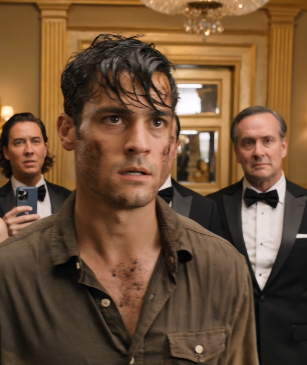
The chandeliers of the Hargrove Grand Ballroom held seven hundred candle-flame bulbs each, and tonight all fourteen of them blazed without mercy, flooding the marble floor with light so pure it seemed to erase shadow from the world entirely. Diamonds caught the glow and scattered it. Silk gowns shimmered. Laughter rose in practiced, musical waves — not the laughter of joy, but of performance, of people reminding one another how exquisitely well their lives were going. The Golden Gala was the pinnacle of the city’s social calendar, and every soul in attendance wore that fact like a second skin.
Among them moved a man who wore nothing of the kind.
He had no name tag. He had been given no uniform. When the catering manager, a thin, harried woman named Mrs. Pryce, had found him sleeping beneath the loading dock two hours before the event, she’d made a calculation born entirely of desperation — her third sous-waiter had called in sick, the hors d’oeuvres needed circulating, and the man, though filthy, was tall and quiet and had looked at her with eyes that were disconcertingly steady. She’d shoved a silver tray into his hands and whispered, fiercely, “Don’t speak. Don’t stop moving. There’s a full meal in it for you at the end of the night.”
He had nodded once. That was all.
And so he moved through the glittering room in clothes that had once been a grey woolen suit — now so worn, so deeply stained by months of open sky and city pavement, that the fabric had surrendered its original form and draped around him in shapeless, odorous folds. The sleeves swallowed his wrists. The shoulders sat wrong. He was a ghost dressed in what a suit remembered itself to be. The silver tray balanced perfectly in his left hand, tilted at exactly the right angle, and he moved with the practiced stillness of someone who had once known how not to be noticed — not from shame, but from discipline.
The guests recoiled slightly as he passed. Nostrils flared. Eyes slid away. One woman in a crimson gown pressed a manicured hand briefly to her nose and turned back to her conversation without missing a syllable. A man in a tuxedo took a miniature crab cake from the tray without looking at the hand that offered it, as though the food had materialized from the polished air itself.
The silent waiter said nothing. He kept moving.
✦
Desmond Harlow III did not so much enter a room as colonize it. At fifty-two, he was the sort of man whose wealth had calcified around him like a shell — visible, impenetrable, and slightly grotesque. He had made his fortune in technology investment, or so the official story ran, and he laughed louder than anyone, tipped extravagantly in public and not at all in private, and possessed the particular cruelty of men who have never once faced a consequence they could not purchase their way out of.
He had been drinking since four in the afternoon.
By nine, Harlow stood at the center of a loose constellation of admirers near the ice sculpture — a leaping marlin, already beginning to weep at the fins — with a bottle of Armand de Brignac in one hand and a loosening tie in the other. His face was flushed the deep, satisfied pink of a man who mistakes his happiness for the world’s approval.
The silent waiter drifted past.
Harlow smelled him before he saw him, or perhaps he simply needed something to aim at. He pivoted, and his eyes found the gray shambling figure with the silver tray, and something lit behind his gaze — not anger, exactly, but appetite.
“Good God,” he announced, loudly enough to turn heads within a ten-foot radius. “What in the hell have they dragged in off the street?”
The laughter began immediately, the reflexive laughter of people who fear being on the wrong side of a powerful man’s attention.
The silent waiter stopped. He did not turn. He stood very still, the tray balanced in his hand, and waited with the patience of deep water.
“Look at this.” Harlow stepped forward, circling slightly, performing for his audience. “They’ve got a genuine vagrant serving canapés. I can smell him from here — what is that? Dumpster? Seine River circa 1987?” More laughter, louder now, drawing a wider circle of onlookers. “Someone must be very desperate. Or very cruel. Either way—” He raised the gold bottle of champagne and, with a slow, deliberate tilt, began to pour.
The champagne cascaded over the man’s bowed head in a cold, fizzing curtain — soaking his matted hair, running down the back of his neck, darkening the grey rags further. Twenty thousand dollars a bottle, poured over a homeless man’s skull for laughs, in a room where no one moved to stop it. The orchestra, sensing the mood, faltered for just a moment before resuming. The ice marlin continued to weep.
“There,” Harlow said, stepping back and spreading his arms like a conductor receiving applause. “Now he smells like something worth standing near.” The laughter peaked. A few people looked away. Most did not.
And then the man looked up.
✦
It was not a dramatic gesture. He simply raised his head — slowly, as though he had been deciding whether to do it for a long time and had only just resolved the question. Champagne dripped from his jaw. His eyes, dark and entirely clear, found Desmond Harlow’s face with the precision of a compass needle finding north.
The silence that followed was not sudden. It spread.
It spread because something happened to Harlow’s face — a flicker, barely perceptible, the microexpression of a man who has just stepped on ground he did not know was hollow. His lips parted. The gold bottle lowered an inch.
The man on the receiving end of seven hundred thousand dollars worth of contempt said, quietly, in a voice that had not been used for formal speech in eleven months, “Hello, Desmond.”
Two words. The room heard them anyway.
The name he had not heard spoken aloud in nearly a year — his own name, from a face he had paid a great deal of money to ensure would never appear before him again — landed on Desmond Harlow like a physical blow.
Because the man standing before him, drenched in champagne and dressed in the ruins of what had once been a bespoke Savile Row suit, was Edmund Vayle. Former CEO of Vayle Technologies. The man whose name had been on every financial publication in the country eighteen months ago — first in celebration, then in accusation. The man who had been charged with securities fraud, insider trading, the systematic pillaging of his own company’s pension fund. The man who had watched his reputation, his fortune, his family, and eventually his housing, stripped away in the methodical fashion that only institutional destruction can achieve.
The man who had been framed.
Framed by the precise individual who now stood before him with a bottle of champagne and an expression that was curdling, in real time, from triumph into something closer to terror.
“You—” Harlow began.
“I’ve been living under your loading dock,” Edmund said pleasantly, “for six weeks.” He set the silver tray down on a passing table with great care — he had never once dropped it, not the entire evening. “I didn’t plan it. Though I suppose there’s a kind of poetry in it.”
The circle of onlookers had gone very quiet. Phones, inevitably, had begun to rise.
“Edmund Vayle,” said a woman near the back — a journalist, as it happened, who had covered the original trial and whose memory for faces was professionally honed. She said it once, then again, louder, her voice carrying that specific vibration of someone who recognizes they are standing inside a story.
The name moved through the crowd like a lit fuse.
“You need to leave,” Harlow said, quietly now, all performance extinguished. “Right now. You need to—”
“I have been leaving for a year,” Edmund said. “I left my office. I left my home. I left my daughter’s school play because I was being arraigned that afternoon. I left everything, Desmond, because you needed me to.” He looked down at the champagne still dripping from his wrist, and something in his expression — not rage, not grief, but a terrible, lucid calm — made several people in the front of the crowd step involuntarily back. “But here is the thing about leaving everything. Once there’s nothing left to take, a man has a great deal of time to think. To remember. To reconstruct.”
He reached into the inside pocket of the ruined jacket — fingers steady, eyes never leaving Harlow’s face — and produced a folded envelope, softened by months of being carried close to the body, but intact. He held it out.
“Copies,” he said simply. “The originals are with the attorney general’s office as of this morning. It took eleven months to locate the wire transfer documentation your lawyers buried in the Cayman subsidiary. It turns out,” and here, for the first time, Edmund Vayle almost smiled, “that when a man has nowhere to sleep and no reason to stop, he becomes remarkably persistent.”
✦
Desmond Harlow did not take the envelope. His hand reached for it once, reflexively, and then withdrew. The gold champagne bottle slipped from his other hand and shattered on the marble floor, and the sound of it — brilliant, final, irreversible — rang through the Hargrove Grand Ballroom like a bell struck at the end of something.
The orchestra stopped completely this time. The ice marlin had lost its tail.
Edmund Vayle picked up the silver tray from the table, tucked it neatly under his arm, and walked — without haste, without theater — toward the kitchen, where Mrs. Pryce stood in the doorway with both hands pressed over her mouth.
“I believe,” he said to her gently as he passed, “that you owe me a meal.”
Behind him, in the wreckage of the Golden Gala’s finest hour, surrounded by seven hundred candle-flame bulbs and the slowly dying music and the rising sound of a hundred conversations igniting at once, Desmond Harlow III stood alone in a pool of twenty-thousand-dollar champagne and understood, for the first time in his life, what it felt like to be at the center of a room with nowhere to hide.
The ice had been melting the whole time. No one had noticed until now.
