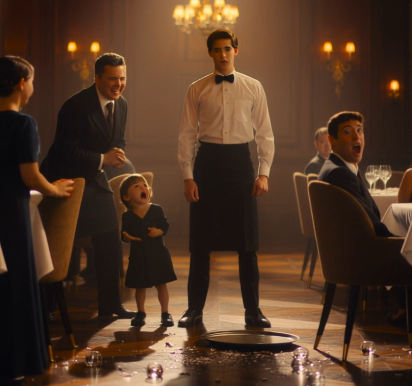
The restaurant was called Aurum. It occupied the forty-second floor of a tower of glass and steel, and on clear nights like this one, the city sprawled beneath it like a scattered constellation. The tablecloths were white as fresh snow. The candles burned low and amber. The sommelier moved between tables with the silence of a monk, and the guests—those who could afford the seven-course tasting menu—spoke in the practiced hush of people who had never needed to raise their voices to be heard.
Marco Bellini had worked at Aurum for eleven years.
He was fifty-three years old, with silver threading through dark hair and a small scar above his left eyebrow from a childhood fall. His uniform was pressed. His shoes were polished. He had opened a bottle of Petrus for a former prime minister once, without spilling a drop, and the man had gripped his hand afterward and called it a performance. Marco had smiled, bowed slightly, and returned to the kitchen. He never needed applause. The work was its own reward.
Tonight, he was assigned to Table Nine.
Table Nine held four guests: two men in their late forties and their wives, all of them lacquered in the specific sheen that money polishes into people over decades. The taller man—whom Marco had mentally catalogued as Mr. Cufflinks, for the ostentatious gold squares at his wrists—had already sent back the bread twice, claiming it was too warm the first time and not warm enough the second. His companion, a broad-shouldered man with a face like a thumb, had barely looked up from his phone.
There was also a child. A girl, perhaps nine years old, seated between Mr. Cufflinks and a woman Marco assumed was her mother. The girl was quiet, with large dark eyes and a braid that was already beginning to unravel on one side. She had ordered the pasta and was eating with careful concentration, as though the act of eating in this room required its own kind of precision.
Marco approached with the wine.
“The 2018 Burgundy you selected, sir—”
“You again,” Mr. Cufflinks said, not quite looking at him.
“Yes, sir.”
“What is that on your face?”
Marco paused. “Sir?”
“That.” He gestured vaguely at the scar. “It’s unsightly. Doesn’t the management have standards about that sort of thing? We’re trying to have a pleasant evening.”
The table went quiet. Even the broad-shouldered man lifted his gaze from his phone.
Marco felt the heat rise from his collar, not from shame—he had long since burned through that particular fuel—but from something older, something that lived in the chest cavity like a coal refusing to go entirely cold. He breathed once. “I apologize for any discomfort, sir. Shall I pour?”
Mr. Cufflinks laughed. It was the kind of laugh that comes when a man is certain the room belongs to him. His companion joined in, and the two wives exchanged a glance that was almost sympathy, almost nothing.
“He’s apologizing for his face,” Mr. Cufflinks said, still laughing. “Remarkable. Tell me—do you frighten the other guests as well, or just—”
“Stop.”
The word landed like something dropped from a great height. Small and sudden and irreversible.
The girl had risen from her chair.
She stood barely as tall as the table itself, but she stood straight, both hands clenched at her sides, her braid flopping at her shoulder. Her dark eyes were fixed on Mr. Cufflinks with an expression that did not belong on the face of a nine-year-old, or perhaps belonged there more than anywhere else—something raw and clarifying, not yet diluted by years of choosing battles.
“You don’t get to talk to him like that,” she said. Her voice was shaking—not with uncertainty, but with the effort of restraining something larger than herself. “You don’t get to talk to anyone like that.”
“Sofia—” her mother began.
“He has a name. He works here every night and you’re laughing at his face.” The word came out bitten, furious. Her chin trembled. “My dad says that people who laugh at things they didn’t cause are just scared. He says they do it to feel big because they don’t feel big anywhere it matters.”
The table was stone silent.
Mr. Cufflinks stared at the child with a look of pure, uncomprehending affront—the look of a man who had encountered a door he expected to open and found it did not move.
“Sofia, sit down, sweetheart—”
“I don’t want to sit down.” But even as she said it, her knees were going. She reached out and gripped the edge of the table, and Marco, instinctively, quietly, placed one hand near hers on the tablecloth—not touching, just present—the way one stands close to a person on a high ledge. She looked up at him. He gave her the smallest nod.
She sat down.
The silence that followed was the particular silence of a room that has witnessed something and doesn’t yet know what to do with it. Three tables over, forks hovered above plates. A couple who had been deep in conversation had stopped talking mid-sentence.
Then a woman stood up.
She was seated two tables away, alone with a glass of white wine and a leather notebook. She was in her sixties, with the kind of composed face that suggested she had spent years in rooms where composure was the price of admission. She wore no jewelry except a single ring, and her suit was the charcoal grey of a building that means to last centuries.
She walked to Table Nine.
Marco turned and felt the world rearrange itself.
“Marco,” she said.
He stared. “Minister Haraldsen.”
Astrid Haraldsen. Norway’s former Minister of Culture. Two-term. Recipient of the Nansen Prize. The woman who had, eleven years ago, written the foreword to a book—a small book, barely two hundred pages—by a man who had spent forty years cooking in restaurant kitchens across Europe, writing down everything he saw and felt and tasted and thought. A man who had observed the human condition from the angle of the service entrance and found it profound.
That book had sold, quietly and then thunderously, nearly two million copies.
That man was Marco Bellini.
Minister Haraldsen did not look at Mr. Cufflinks. She looked only at Marco, and in her expression was the warm recognition of one artist meeting another, or perhaps simply of one person meeting someone they consider significant.
“I didn’t realize you were still working the floor,” she said. “I thought you’d retired from service.”
“I came back,” Marco said. “I missed it.”
“Of course you did.” She smiled. “I re-read the chapter about the bread basket on the flight here. The passage about dignified repetition. I’ve thought about it a hundred times.”
Mr. Cufflinks was very still.
His companion put his phone away.
The broad-shouldered man leaned forward and said, quietly, to no one in particular, “The book—Between Courses? That book?”
His wife turned toward him with wide eyes.
Between Courses: Notes from a Life in Service had been translated into twenty-six languages. It had been taught in universities. A documentary had been made. And somewhere in the world right now, Marco knew without any particular feeling of pride, there were people reading his words about invisibility and grace, about the strange dignity of those who carry things so that others may be still.
Mr. Cufflinks looked at his cufflinks.
Marco poured the wine.
He poured it with the same hands, the same scar, the same steady breath he had brought to the table six minutes ago when the evening had been arranged differently. Nothing had changed about him. He was the same man. He would always have been the same man.
“Thank you, sir,” he said, when he finished pouring.
Mr. Cufflinks said nothing. His color had become a specific, telling shade of red.
Marco moved away from the table. As he passed the girl—Sofia, her name was Sofia—she was looking up at him, her braid fully unraveled now, a small half-smile on her face. He paused. Leaned down slightly.
“Your father sounds like a very wise man,” he said.
Sofia tucked a strand of hair behind her ear. “He reads a lot,” she said, with the quiet pride of a child reporting something true about someone they love.
Marco smiled—not the small, professional smile of service—but the real one, the one that used the scar.
Then he walked back toward the kitchen, carrying nothing, light as he had ever felt.
