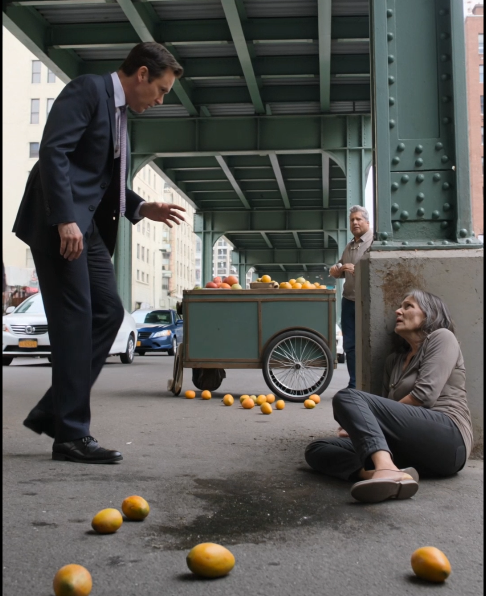
A billionaire stopped dead on Fifth Avenue when his daughter pointed at a beggar woman’s wrist… But the birthmark she was pointing at was identical to his own.
Alexander Miller hadn’t walked through this part of midtown in years. His driver usually took him straight from the tower to the helipad, straight to the next meeting, the next deal, the next controlled version of a life with no loose ends.
Brooklyn had insisted on walking. She was seventeen and stubborn in exactly the way he’d always secretly admired. She’d looped her arm through his and said she wanted a real afternoon, not a scheduled one.
He’d agreed. He almost wished he hadn’t.
They were passing under the overpass near Ninth when Brooklyn stopped moving.
He felt it before he saw it — her grip tightening on his arm, her whole body going still the way it did when something registered that she wasn’t ready to say out loud yet.
“Dad.”
He followed her gaze.
Near the concrete pillar, half-swallowed by shadow and foot traffic, an old woman sat on the ground. Her coat was too heavy for the weather. Her shoes didn’t match. She held one palm open, head slightly bowed, saying something in a voice so worn it barely carried.
Nobody stopped. People split around her like water around a stone.
“Brooklyn, we can—”
“Dad.” Her voice dropped. “Look at her wrist.”
He looked.
The birthmark was small. Dark. Shaped like a curved leaf, sitting right over the pulse point.
Alexander stopped breathing.
He had that mark. Had always had it. His left wrist, same location, same irregular edge that looked almost like a brushstroke.
His mother had one too — or so he’d been told. He’d been four when she disappeared. He didn’t remember her face. He didn’t remember her voice. The only thing the social workers had written in his file, the only physical detail anyone had thought to record, was: distinctive birthmark, left wrist, curved shape.
He had read that sentence so many times the paper had softened at the fold.
“That’s…” He couldn’t finish.
“You told me,” Brooklyn said quietly. “You told me when I was little. You said it was the only thing you knew about her. You said—”
“I know what I said.”
His voice came out harder than he meant it to. Brooklyn didn’t flinch. She just watched him with those steady eyes that had always seen more than he was comfortable with.
Three women nearby had noticed him now. One had her phone half-raised, whispering to the others. Isn’t that Miller? The one from the Forbes cover? He ignored them.
He took a step toward the old woman.
She didn’t look up immediately. She was still murmuring her quiet request to the stream of passing feet, most of which didn’t slow.
He stopped directly in front of her. His shadow fell over her.
She looked up.
Her eyes were pale — almost colorless — and clouded at the edges the way eyes get after decades of hard weather. She didn’t recognize him. To her he was just another well-dressed obstacle in an afternoon full of them.
He crouched down.
Behind him he could feel Brooklyn watching, and the three women watching, and two street vendors who had paused their carts, sensing something shifting in the air the way animals sense pressure before a storm.
“What is your name?” he asked.
His voice came out steadier than he expected. He was grateful for that.
The old woman blinked. Confused, maybe, that someone like him would want to know.
“Rose,” she said. The word came out rough, like it hadn’t been used much lately. “Rose Delaney.”
The name hit him like a physical thing.
He had that name too. Not Miller — that came from the group home, assigned because the file had been incomplete. His original file, the one a private investigator had dug up twelve years ago and handed to him in a sealed envelope he’d opened alone in his office at two in the morning, had listed one name under birth mother:
Rose Delaney. Last known location: Savannah, Georgia. Status: Unable to locate.
He had closed the envelope. Filed it. Told himself it was too late, that the trail was cold, that reopening it would only cost him something he couldn’t afford to lose.
He had been wrong about a lot of things in his life. That decision was near the top of the list.
His knees were on the pavement now. He didn’t remember deciding to kneel. He was just there, at eye level with a woman who didn’t know him, on a street that had kept moving around a grief he’d carried for over forty years.
“Did you live in Savannah,” he said, “more than thirty years ago?”
The change in her face was immediate. Something cracked open behind her eyes — not recognition of him, not yet, but recognition of something, a place, a time, a piece of her own history she hadn’t expected to hear named on a New York sidewalk.
Her hands began to tremble.
“You… you know about that…?”
“I was born there,” Alexander said. “In 1983. My mother’s name was on my file. They told me she was gone.”
The old woman stared at him. Her mouth opened. No sound came out.
Brooklyn had moved up beside him without him hearing her. She placed a hand gently on the old woman’s shoulder — not asking, just present — and the woman didn’t pull away.
“I had a son,” Rose said. The words came out broken, like they’d been waiting somewhere airless for a long time. “They took him. I was sick. I couldn’t — I didn’t have — I tried to find him, I tried for years, but the records were sealed and then I got sick again and I lost everything and I—”
She stopped. Her voice had run out.
Alexander reached out and took her trembling hand in both of his.
He turned her wrist over. The birthmark was right there. Unmistakable.
“I tried to find you too,” he said. “I stopped. That was my mistake. Not yours.”
The three women nearby had gone completely silent. One of them was crying. She looked embarrassed about it and didn’t stop.
The months that followed were not simple.
Rose had been living on the street for nearly six years. Before that, a rooming house in Queens. Before that, a series of part-time jobs and health crises that had slowly stripped away every foothold. She had a daughter in Ohio who didn’t know her well and a list of medical problems that needed immediate attention.
Alexander’s attorneys spent three weeks on the paperwork. Paternity confirmation — though the birthmark was only the beginning; the DNA results came back within ten days, and they were unambiguous.
His PR team braced for the story to leak, and it did. The headlines were exactly what he’d expected: Billionaire’s Secret Beggar Mother. Found on Fifth Avenue. The Birthmark That Changed Everything.
He gave exactly one interview, a short one, and said only: “I stopped looking. My daughter didn’t let me keep stopping. The rest is private.”
Rose moved into the guest wing of the East Side apartment in November. She was suspicious of the space at first — kept asking if she was in the way, kept trying to fold herself small in the corners of rooms she had every right to occupy.
Brooklyn made a project of fixing that.
She started eating dinner with Rose every night when Alexander traveled for work. She taught Rose how to use the tablet to video-call the daughter in Ohio. She brought her to a garden center on a Saturday in December and let her pick whatever she wanted without once looking at the price tags.
Rose picked lavender. Said she’d always liked the smell.
The reconciliation with the daughter in Ohio — Alexander’s half-sister, it turned out, different father — took longer. There had been years of distance and difficult history there that had nothing to do with Alexander. He didn’t push. He made himself available and waited.
By spring she had visited twice.
On a Tuesday in April, Alexander was reviewing contracts at the kitchen table when Rose came in from the small balcony where she’d taken to sitting in the mornings.
She set a cup of coffee in front of him without asking if he wanted one.
He looked up.
She was watching him with an expression he hadn’t learned to read yet — there were still a lot of those. But this one was quieter than usual. Settled.
“I used to wonder,” she said, “every year on your birthday, whether you were all right. Whether whoever had you was decent.”
He didn’t answer immediately.
“They weren’t, for a while,” he said finally. “And then I figured out how to make sure I was.”
Rose nodded slowly, like that was the answer she’d expected and had been prepared to accept regardless.
She sat down across from him.
Outside, the city moved at its usual pace — indifferent, relentless, full of people passing each other without stopping.
Inside, for the first time in a very long time, Alexander Miller was exactly where he was supposed to be.
