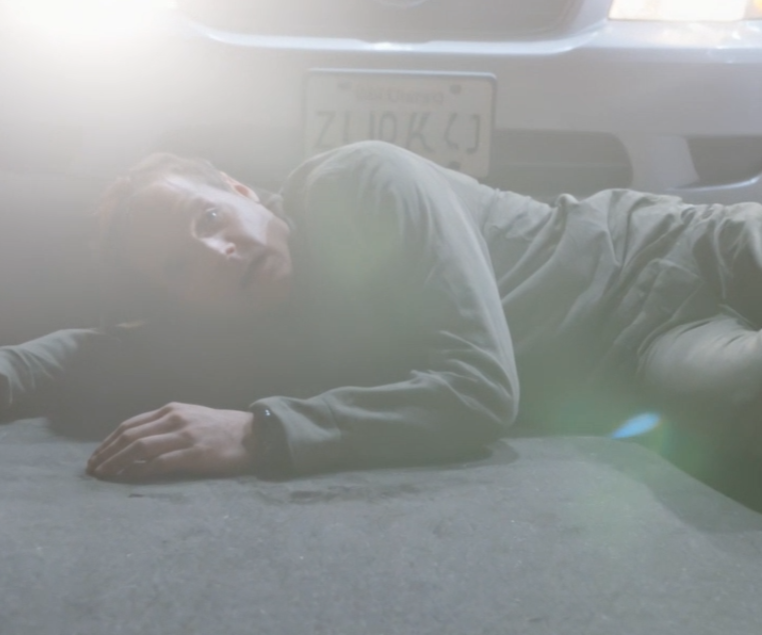
The fluorescent lights at the Sunoco on Route 9 buzzed like dying insects. It was eleven forty-seven on a Tuesday night, the kind of hour when the world thins out and things happen that no one can explain later.
Maya Reyes was seven years old. She had her mother’s dark curls, her father’s stubborn chin, and a small pink backpack shaped like a ladybug that she refused to go anywhere without. Her mother, Sandra, had gone inside to pay for the gas — just forty seconds, she’d told herself. Forty seconds. She’d counted them before, timing the transaction in her head the way anxious mothers do.
She was wrong.
The man moved out of a white sedan with the casual economy of someone who had done this before. He wore a gray hoodie and moved low, purposeful, cutting the distance between himself and Maya in the time it takes to blink. Maya was crouching by the rear tire, watching a beetle navigate a crack in the asphalt. She didn’t hear him until his hand was already closing around her wrist.
She screamed.
It was short — cut off when he lifted her, pressing her small body against his chest, moving fast toward the white sedan. The passenger door was already open. Someone was driving. The engine was running. The whole thing had a mechanical efficiency that turned the stomach.
What happened next was witnessed by a security camera, a trucker refueling at pump seven, and God, if God was watching that particular stretch of highway.
His name was Walter Breen. He was fifty-three years old. He had been sleeping behind the dumpsters at the back of the Sunoco for eleven days, wrapped in a moving blanket the manager hadn’t had the heart to take away. Before the drinking took everything, he had been a high school shop teacher in Trenton. Before the divorce, before the accident, before the long slow unraveling that had deposited him here, behind a gas station, watching beetles navigate cracks in the asphalt.
He had been awake when Maya arrived with her mother. He’d watched them pull in with the specific, invisible attention of the homeless — cataloguing without seeming to, alive to every shift in the environment. He’d noticed the ladybug backpack. He’d noticed the child’s delight at the beetle.
He noticed the man in the gray hoodie the moment the car pulled in on the far side of the lot.
Something in his body understood before his mind caught up. He was on his feet before Maya screamed. When the sound cut off, he was already moving.
Walter Breen had nothing. He had a moving blanket and a cracked phone that didn’t make calls and a pair of boots with the left sole separating at the toe. He was not a large man. He had not been fast, even in his prime.
He ran anyway.
The white sedan’s engine revved. The man with the hoodie had the door half-open, was folding himself inside with Maya pinned against him. The driver was already pulling forward. The whole machine was moving, gathering itself to flee.
Walter hit the ground in front of the car.
He didn’t dive. He didn’t leap heroically. He threw himself flat, deliberately, face against the asphalt, arms spread wide, as if he were trying to become part of the road. His body slid a foot on the rough surface. The headlights blazed over him.
The driver braked — but not fast enough. The front wheel caught Walter’s lower left leg with a sound that the trucker at pump seven would describe as something he would never forget as long as he lived. The car lurched to a stop. The driver made a noise somewhere between a curse and a prayer.
For three seconds, nothing moved.
Then Walter Breen, his face pressed against the oil-stained concrete, looked up and said clearly into the white glare of the headlights: “I’m not moving.”
It was not said with heroics. It was said the way a man states a fact he has already made peace with.
Inside the car, something broke. The calculus of it — the screaming child, the witness at pump seven now running and shouting into his phone, the man simply lying in the road with a willingness that had no bottom to it — became suddenly too much. The man in the hoodie shoved the door open and ran north on foot. The driver followed. The white sedan stayed running with Maya still in the back seat, rigid with terror, the ladybug backpack crushed against the headrest.
Sandra came out of the gas station at the exact moment her daughter began to wail.
It took a long time to understand what she was seeing. The running men. The idling car. The trucker kneeling in the road beside a man who was not getting up.
She got Maya out of the car, held her until her own legs stopped shaking, and then she walked to where Walter lay and she knelt beside him in the oil and the grit. He was conscious. His face was turned toward her. He was breathing through his teeth.
“She okay?” he asked.
Sandra could not speak. She looked at him — this stranger, this broken and discarded man — and she could not find language for what she needed to say. She took his hand instead and held it until the ambulance came, her daughter pressed against her side, both of them an anchor in the dark.
The surgery took four hours. The left leg was amputated below the knee. The right suffered fractures that required two pins and a long, uncertain recovery. The doctors were careful and honest about the road ahead.
Walter Breen spent six weeks in the hospital. Sandra Reyes spent a considerable portion of those six weeks in the waiting room, and then the hallway, and then the chair beside his bed. She brought Maya on the third week, when the doctors said it was alright. Maya walked in carrying a drawing she had made herself — a man lying in front of a car, rendered in crayon, the proportions of a child’s reckoning with an adult world. In the drawing, the man was surrounded by a gold outline.
“That’s so people know,” Maya explained.
“Know what?” Walter asked.
“That you’re important.”
He looked at the drawing for a long time. The gold crayon, applied with the heavy pressure of a child who meant it, caught the light in the room.
He did not go back behind the dumpsters. There is not space here to describe every step of what came after — the housing program Sandra found, the legal proceedings, the men in the gray hoodie and the sedan who were caught eleven days later two states over. What matters is this: Walter Breen had spent years disappearing, becoming invisible by degrees, believing in some corroded corner of himself that the world had finished with him.
He learned, in a hospital room, with a child’s crayon drawing taped to the wall and a woman who would not leave his side, that the world had not finished with him at all.
He had simply been waiting, without knowing it, for the one moment that required everything he had.
He gave it freely.
And in that giving, on the oil-dark asphalt of a gas station on Route 9, he was finally, after so long, found.
