The chandelier above the grand ballroom shimmered like a crown of a thousand suns. But beneath its golden light, something was about to shatter — and it wasn’t the crystal.
Elena had been warned. Her sister had whispered it at the rehearsal dinner, her college roommate had texted it the morning of the wedding, even the florist — a woman who’d worked a hundred of these events — had pressed her hand and said, “Watch yourself tonight, sweetheart.” Elena had smiled at all of them, smoothed her ivory silk gown, and told herself that love was enough armor for any battlefield.
She was wrong.
The reception was two hours old when Margaret Ashworth made her first move. She’d spent the evening circling the room like a hawk in pearls, kissing cheeks, accepting congratulations for her son’s happiness as though she were personally responsible for the sun rising. Daniel — Elena’s husband of exactly four hours — stood at the bar, laughing with his college friends, his jacket already loosened, a man who believed that the hard part was over.
He had no idea.
Elena felt the hand before she saw the woman. Fingers — cold, deliberate — wrapped around her wrist and pulled her sideways, away from the head table, toward the gilded archway near the ballroom’s east wall. A few guests glanced over. Most looked away. That, Elena would later understand, was the point.
“We need to talk,” Margaret said. It wasn’t a request.
“Margaret, tonight isn’t really the—”
“The centerpieces.” Margaret’s voice was ice poured over gravel. “You chose white roses. I specifically told Daniel — specifically — that white roses were his father’s funeral flowers. I buried my husband surrounded by white roses.” She paused, letting it land. “Did you do that on purpose?”
The absurdity of it hit Elena like a cold wave. She almost laughed. “No. Of course not. I didn’t know—”
“You didn’t know.” Margaret repeated it slowly, turning the phrase into an indictment, facing the nearest cluster of guests — the Ashworth cousins, three of them, watching with barely concealed hunger. “She didn’t know. My son’s wife didn’t bother to learn the first thing about this family before decorating our most sacred celebration with funeral flowers.”
“Margaret—”
“And the vows.” Her voice climbed. “Did anyone else find those vows a little — thin? No mention of family. No mention of honoring the people who came before. Just I love you, I choose you — like a greeting card. Like a post on social media.”
The music at the far end of the ballroom continued — some forgettable pop song covered by a jazz trio — but Elena could feel the silence spreading around them like ink dropped in water. Heads turning. Glasses stilling.
“I think,” Elena said carefully, her voice steady in a way that cost her everything, “that this is a conversation we should have another time.”
She turned to walk away.
That was when Margaret grabbed the dress.
The sound was surgical. A clean, violent rip — silk parting under force — and Elena spun around, stumbling, her hand catching the archway to stop herself from falling. The tear ran six inches up the seam of her gown, from the hip upward, and the room went absolutely, catastrophically silent. The jazz trio played one more note, then stopped. Someone’s champagne glass clinked against a table.
Margaret’s hand was still raised, still clutching the torn fabric.
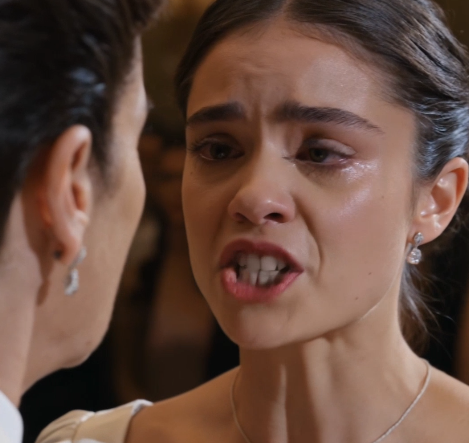
“Look at me when I’m talking to you!” Her voice had become something unrecognizable — not a mother, not a woman — something older, rawer, humiliated by the very act of being ignored. Her eyes were bright and terrible. “You don’t even know how to be a proper wife!”
Elena’s lips trembled. The tears came without permission — not from sadness, she would realize later, but from the pure physiological shock of public destruction. Two hundred guests. The photographer, whose camera made a single, damning click. Her mother, across the room, already moving, held back by Elena’s father’s arm and the paralyzing social mathematics of a wedding reception.
“My son,” Margaret continued, her voice dropping now, which was somehow worse — an intimate cruelty, close and precise, “deserves a woman who understands sacrifice. Who understands that marriage is not a romance novel. Who understands that when you marry Daniel, you marry this family.“
“He married me.” Elena’s voice broke on the last word.
“A girl,” Margaret said quietly, “who can’t even hold herself together on her wedding day.”
Something shifted in Elena then. Later, she would describe it as a door closing. A sound like a key turning in a lock inside her chest, some room she would never again open for this woman.
She straightened. She released the archway. She stood in her torn dress, in front of two hundred people, and she looked Margaret Ashworth directly in the eyes.
“You’re right,” she said. “I don’t know how to be the wife you wanted for your son.” She paused. Around her, the room held its breath. “But Daniel didn’t marry your expectations. He married me. And I promise you — I will spend every day of my life making him glad he did.”
She reached out calmly, and took the torn piece of silk from Margaret’s fingers.
Then Priya — Elena’s maid of honor, who had been moving through the crowd like a woman on a mission for the past thirty seconds — appeared at Elena’s side, champagne flute in hand. She looked at Margaret with an expression that could only be described as surgical.
“Margaret,” she said pleasantly, and poured the entire glass of champagne — slowly, deliberately — onto the woman’s cream-colored designer shoes.
The room erupted.
Not in horror. In something more complicated — gasps, then laughter, then the breaking of two hundred people who had been holding their breath simultaneously. Margaret shrieked, stumbling backward. One of the Ashworth cousins lurched forward. Someone dropped a plate.
And Daniel was there — finally, suddenly, pushing through the crowd, his face a map of horror and dawning understanding. He reached Elena first. He took her hands. He looked at the torn dress, at the champagne spreading across the marble floor, at his mother’s heaving shoulders, and something passed over his face that looked like a man choosing, in real time, who he was going to be for the rest of his life.
He turned to his mother.
“Go home,” he said quietly. “We’ll talk tomorrow. Go home.”
“Daniel—”
“Please.“
Margaret went. She gathered her purse, her dignity — such as remained — and the youngest Ashworth cousin, and she walked out of the ballroom while two hundred people pretended not to watch her leave.
Daniel turned back to Elena. He cupped her face in both hands. The photographer’s camera clicked again.
“I’m sorry,” he whispered. “Elena, I am so sorry.”
“Don’t,” she said. Not coldly. Gently. “Not tonight.”
He nodded. He understood. He took her hand, and together they walked back toward the dance floor, toward the jazz trio who, reading the room with professional grace, had begun to play something slow and aching and beautiful.
Elena danced in her torn dress. She danced with her head on her husband’s shoulder, and her eyes dry now, and the chandelier throwing gold across the silk and the scar where it had been ripped — worn openly, unapologetically, like a decoration she had chosen herself.
Some of the guests cried. A few raised their glasses.
No one looked away.
