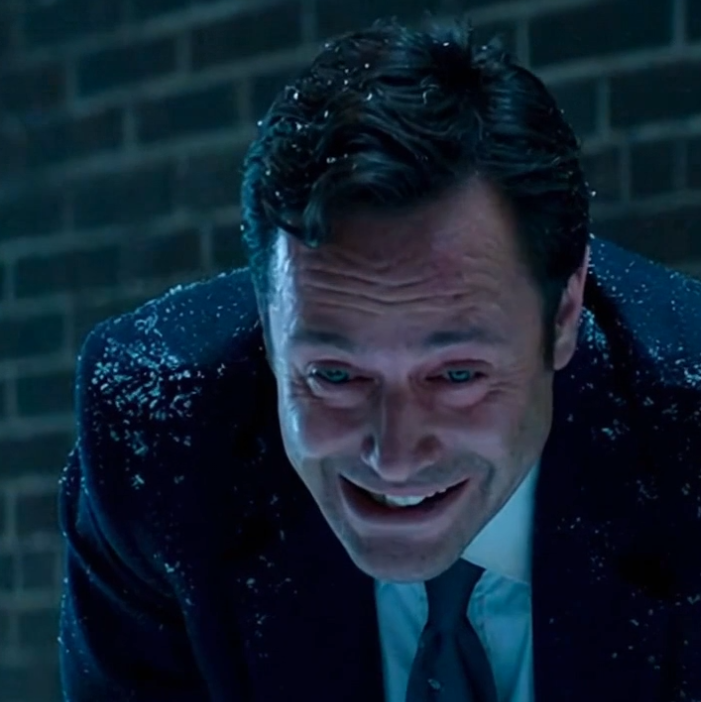
A homeless man used his last shirt to keep a dying stray dog warm in a blizzard… But when a drunk driver crashed nearby laughing, he crawled toward the wreck with a broken bottle — because a baby was crying from the back seat.
The snow had been falling for six hours straight.
Darnell hadn’t eaten since Tuesday. He’d stopped counting the cold somewhere around midnight, when counting felt like optimism and optimism felt like cruelty.
He was wedged between two dumpsters behind the old Harwick Savings building on Clement Street, the kind of place the city forgot on purpose. The alley smelled like frozen grease and rust. His boots had split along the left sole two weeks ago. He’d taped them with electrical tape he found in a recycling bin.
He wasn’t thinking about warmth anymore. He was just watching the snow.
That’s when he heard it — a sound so small it almost got buried in the wind. A whimper. Low, wet, ragged.
He tilted his head. Listened.
There it was again.
He pulled himself up, joints screaming, and shuffled toward the mouth of the alley. Tucked against the base of a concrete planter, barely visible under a ridge of accumulated snow, was a dog. Beagle mix, maybe. Small. Female. Her fur was matted and dark with wet. Her ribs moved in shallow, uneven spasms.
Her eyes were open. That was the worst part. She was still looking.
Darnell crouched down. His knees popped. He reached out a hand and she didn’t flinch — just blinked, slow, like she’d already accepted whatever came next.
“Not yet,” he said quietly. “Not yet, sweetheart.”
He looked around. The street was empty. The nearest shelter was eleven blocks east and they didn’t take dogs. He knew because he’d tried, back in October, with a three-legged shepherd he’d found on the 38 line. They’d made him choose. He’d left with the dog.
He pulled off his outer jacket first. Set it over her like a blanket. She didn’t move. He tucked the edges under her, felt the cold immediately hit his flannel shirt, then his skin. He held still for a second, assessing. The flannel wasn’t enough. He knew it wasn’t enough.
He peeled the flannel off over his head. The wind hit him like a slap. He wrapped it around the dog’s body, doubling the fabric over her chest, her neck, her legs. He could feel her breathing change almost immediately — just slightly, just barely — but it changed.
She blinked again. Less slowly this time.
Darnell sat back against the planter in just his undershirt and pulled his jacket back on. It helped almost nothing without the layers beneath it. He put his arms around his own chest and tucked his chin down and watched her breathe.
The snow kept falling.
He didn’t let himself think too hard about what he was doing. Thinking too hard was dangerous when you had nothing. It led to arithmetic he couldn’t win. He focused on her breathing instead. In. Out. In. Out. Getting steadier.
Twenty minutes passed. Maybe thirty.
She lifted her head.
It was only an inch. Maybe less. But she lifted it and looked at him and something in her eyes had shifted — the resignation had cracked open and underneath it was something else. Something that wanted.
“There you go,” he said. “There you go.”
He was reaching into his jacket pocket for the half-sleeve of crackers he’d been saving — saving for what, he never quite asked himself — when the sound hit him.
It wasn’t a crash, exactly. It was more of a sequence. A screech of tires that started too late, then a grinding crunch of metal that seemed to go on longer than physics should allow, then the flat, hard bang of something solid meeting something immovable.
Then silence.
Then, unbelievably: laughter.
Darnell stood up fast. The dog scrambled, startled, then settled back into the flannel. He moved to the mouth of the alley and looked out at Clement Street.
A silver sedan had jumped the curb forty feet east of him and plowed into the base of a streetlight. The hood was crumpled. The driver’s side door was hanging open. A man — thirties, heavy coat, ball cap — was crawling out of it, one hand on the door frame, one on the wet pavement. He was laughing. The kind of laugh that doesn’t know what else to do.
Darnell watched him stand. The man looked at the car, looked at the streetlight, and laughed again. He patted his pockets. Started walking in the wrong direction.
Darnell almost let him go.
Then he heard it.
It was faint — buried under the wind and the settling metal sounds of the wrecked car — but it was unmistakable. Small. High. Furious with need.
A baby.
The sound was coming from the back seat.
Darnell was moving before he finished the thought. He covered the forty feet fast, faster than his body had moved in months, his split boot slapping the wet pavement. He hit the rear door of the sedan and yanked. Locked. He yanked again. The frame had bent in the crash — it wouldn’t give.
He looked at the driver. The man had stopped walking and was standing under a dead traffic light, staring at his phone, still half-laughing at something on the screen. Completely unaware. Completely somewhere else.
The baby cried harder.
Darnell looked down. There was a bottle by the front tire — a forty-ounce he didn’t stop to wonder about — and he picked it up and smashed it against the curb. The bottom third shattered cleanly. He took the neck in his fist and used the broken edge to punch through the rear passenger window, once, twice, the glass spiderwebbing and then collapsing inward.
He reached through carefully. Found the latch. Pulled the door open.
The baby was in a rear-facing car seat, safety harness still buckled. She couldn’t have been more than four months. Her face was red and clenched and wet. She was furious and freezing and absolutely, completely alive.
Darnell unclipped the harness with hands that were shaking badly now from the cold. He lifted her out, tucked her against his chest, pulled the jacket around them both. She screamed for two more seconds, then stopped. Just stopped. Like a switch.
She pressed her face into his undershirt and breathed.
“Okay,” he said. “Okay. I got you.”
The driver finally looked up from his phone.
He took a few unsteady steps back toward the car, squinting through the snow. Saw Darnell. Saw the baby. His expression moved through several things — confusion, recognition, something that might have been alarm if the alcohol would let it sharpen — and then he pointed, finger wagging.
“Hey. Hey, that’s my — “
“Your baby,” Darnell said. “In a locked car. In a blizzard. While you walked away laughing.”
The man blinked. “I was gonna — “
“Don’t.”
It wasn’t loud. It wasn’t a threat. It was just a word that had no room for anything after it.
The man went quiet.
Someone had already called it in — the crash, the sound, something. Blue and red lights were sweeping around the corner from two blocks west, moving fast. A patrol car pulled to the curb and two officers were out before it fully stopped, hands up, reading the scene.
Darnell stayed still. Baby against his chest. Hands visible. He’d done this before — the staying still, the not startling anyone. He knew how to make himself easy to read.
The younger officer came toward him first, cautious, then saw the baby and shifted entirely. “Sir — is she hurt?”
“I don’t think so,” Darnell said. “She’s cold. She needs to be checked.”
The officer reached for the baby, gently, and Darnell let her go. He watched the officer wrap her in a foil blanket from the patrol kit and hold her close. The baby made a small, satisfied sound.
The second officer had the driver against the car. The man was arguing — gesturing, explaining, the laughter completely gone now. His voice had taken on the particular wheedling quality of someone realizing that the story he was about to tell had no good version.
It took forty minutes. Paramedics came. The baby was checked — cold, but unhurt. The driver failed a field sobriety test so badly that one of the paramedics shook her head. His name, Darnell learned from the radio chatter he wasn’t supposed to be able to hear, was Kevin Pratt. He had two prior DUIs. He had been on his way home from a bar four blocks away. His daughter had been in the car the whole time.
His daughter.
Kevin Pratt was handcuffed and put in the back of the patrol car and he’d stopped laughing completely now and started crying instead, which was too late and too private and Darnell turned away from it.
The younger officer — Martinez, her nameplate said — came back to him. She looked at him. The undershirt. The split boot. The cold he’d been sitting in for hours.
“You broke the window to get to her,” she said. It wasn’t a question.
“Yes, ma’am.”
“With your bare hands?”
“I had a bottle.”
She looked at his hands. His knuckles were cut in three places — he hadn’t noticed. She took a breath. “Mr. — “
“Darnell.”
“Darnell.” She paused. “There’s a family shelter on McAllister. They take walk-ins until two a.m. I can give you a ride.”
He thought about the dog in the alley. The flannel shirt. The small chest rising and falling.
“I’ve got something I need to check on first,” he said.
Officer Martinez looked at him for a long moment. Then she went to the patrol car trunk and came back with a thermal blanket and a pair of thick wool socks still in the packaging — the kind patrol kept for cases involving people who’d been outside too long. She held them out without a word.
He took them.
He walked back to the alley. The dog was still there, still wrapped in his flannel, and when she heard his footsteps she lifted her head again — higher this time, ears up. Her tail made one small, thumping movement against the concrete.
He sat down next to her and wrapped the thermal blanket around them both.
“We’re okay,” he told her. “We’re both okay.”
She put her head on his knee.
At 1:47 a.m., Officer Martinez, finishing her report in the patrol car, looked up and saw a light in the alley — not fire, just the glow of a phone someone had propped against a dumpster. Darnell was sitting against the planter, asleep, a small dog curled against his chest, both of them breathing slowly inside a silver thermal blanket.
She sat there for a minute, just watching. Then she radioed the McAllister shelter and made a call she didn’t have to make, flagging a reservation for one person plus one small dog, first thing in the morning. The shelter director — a woman named Cora who’d known Martinez for six years — asked no questions.
Kevin Pratt was booked at 2:15 a.m. His daughter was placed in temporary care with his sister, who drove forty minutes in the snow to get there and arrived crying and did not look at Kevin when she left. The DA’s office, made aware of the prior DUI record and the infant in the vehicle, filed a motion before dawn.
In the alley on Clement Street, the snow stopped at 3 a.m.
Darnell slept through it.
The dog didn’t leave him once.
