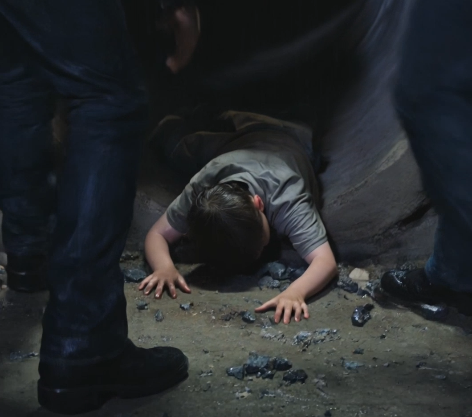
Rain fell steadily, turning the narrow street into a ribbon of reflections. Water streamed along the cracked pavement and gathered in the drainage ditch that ran beside the road, now swollen and restless from the storm. The sound of rushing water mixed with distant traffic and the uneven rhythm of laughter.
A group of teenagers stood near the edge of the ditch, their voices loud in the quiet neighborhood. Their laughter wasn’t entirely kind—it carried that sharp edge that sometimes appears when people forget where the line is.
“Come on, it’s not that bad,” one of them said, nudging a smaller boy standing just a little too close to the water.
The boy shook his head, his sneakers slipping slightly on the wet ground. “I don’t want to,” he muttered, glancing at the fast-moving water below. It looked deeper than it should have been.
Another shove—meant as a joke, careless more than cruel—shifted everything.
The boy lost his footing.
For a second, he tried to regain balance, arms flailing, shoes scraping against the slick concrete. Then he slipped over the edge and dropped into the ditch with a splash that sounded far too loud.
The laughter stopped.
Cold water rushed around him instantly, pulling at his clothes, dragging him sideways. He gasped, trying to find something to hold onto, but the current was stronger than he expected. Panic set in quickly, sharp and overwhelming.
“Hey—” one of the teenagers said, stepping forward, his voice uncertain now. “Hey, get up!”
But the boy couldn’t just “get up.” The sides of the ditch were steep and slick, and every attempt to climb only sent him sliding back. His fingers scraped against the concrete, searching for grip.
“Do something!” another voice said, louder this time.
From a few meters away, near a cluster of worn tents and patched tarps, a woman stepped out into the rain. She had been watching quietly before, invisible in the way people like her often become. But now her stillness broke.
“What happened?” she called, her voice cutting through the air.
No one answered immediately.
She didn’t wait.
The moment she saw the boy struggling in the water, something in her expression changed completely. She hurried forward, her steps uneven but urgent, shoes splashing through puddles as she reached the edge of the ditch.
“Hold on!” she shouted, dropping to her knees.
The boy’s head dipped under for a second before he came back up, coughing. The water kept pushing him, relentless, giving him no time to think.
“I can’t—” he tried to say, but the words broke apart.
The teenagers stood frozen, their earlier confidence gone. What had seemed like nothing moments ago now felt heavy, real, impossible to undo.
“Give me your hand!” the woman called, leaning down as far as she could without slipping in herself.
The distance was just slightly too far.
She stretched more, bracing herself with one hand on the ground, reaching with the other. Her fingers brushed the air above him but couldn’t quite reach.
“Come closer!” she urged.
“I’m trying!” he cried.
The current shifted him again, pulling him just out of reach.
The woman’s breath grew uneven, her movements frantic but focused. She looked around quickly, searching for anything—anything—that could help.
“Don’t just stand there!” she snapped at the teenagers. “Help me!”
That broke something.
One of them stepped forward, then another. Their hesitation didn’t disappear entirely, but it changed shape. They moved closer, carefully, as if afraid the ground itself might betray them.
“What do we do?” one asked.
“Lie down,” she said immediately. “Don’t get too close to the edge. Reach him.”
Two of them dropped to the wet pavement, extending their arms. The boy tried again, pushing against the current, reaching upward.
Their hands met—barely.
“Hold on!” one of the teenagers said, gripping tightly.
The connection wasn’t strong yet, but it was enough.
“Don’t let go,” the woman said, her voice steadier now.
Together, they pulled.
It wasn’t easy. The water resisted, dragging at the boy as if unwilling to release him. But slowly, inch by inch, he moved closer to the edge.
Then, with one final effort, they pulled him out.
He collapsed onto the pavement, coughing and shaking, water streaming from his clothes. For a moment, no one spoke.
The rain softened slightly, as if the storm itself was catching its breath.
The woman stayed beside him, her hand hovering near his shoulder, not quite touching but ready.
“You’re okay,” she said gently. “You’re okay.”
The boy nodded weakly, still trying to steady his breathing.
The teenagers stood a few steps back now, silent. Their earlier laughter felt distant, almost unreal.
One of them looked down at his hands, as if seeing them clearly for the first time.
“We didn’t mean—” he started, but the sentence didn’t finish.
The woman glanced at them, not angry, just tired. “Sometimes that’s how it starts,” she said quietly.
No one argued.
The street felt different now. Quieter. Heavier in a way that wasn’t entirely bad—just real.
The boy slowly sat up, wrapping his arms around himself. He looked at the woman, his voice small but clear.
“Thank you.”
She gave a faint smile. “You held on,” she replied. “That matters.”
For a while, they all stayed there, listening to the water rush past.
But something had shifted.
And none of them would forget it.
