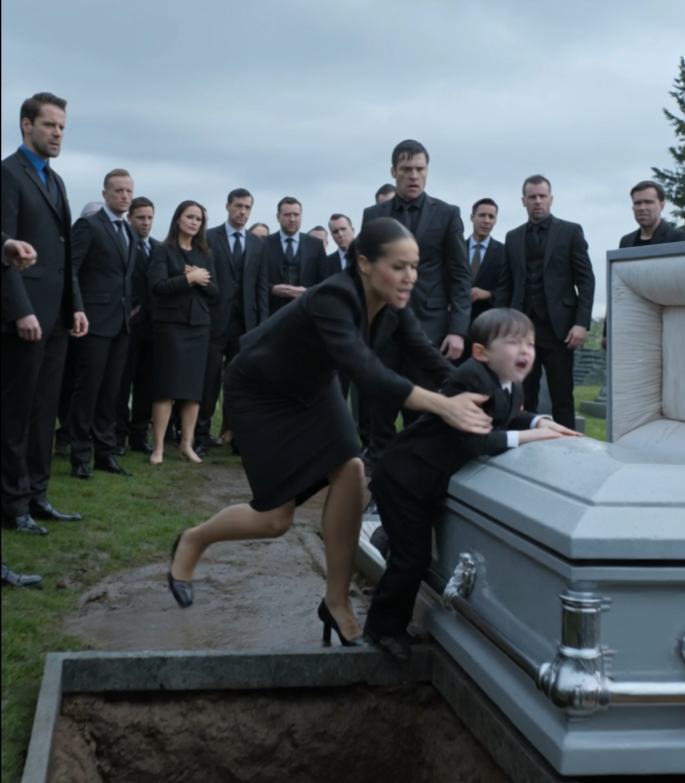
The funeral hadn’t even started properly when the boy broke free.
One second he was standing beside his mother, small and pale in his oversized black jacket, and the next he was sprinting through the mud toward the coffin — screaming at the top of his lungs.
“Don’t close it! He’s not my father!”
The gasp that moved through the crowd was something physical. You could feel it — a collective intake of breath sharp enough to cut through the sound of rain hammering the cemetery grass.
People froze. Umbrellas stopped moving. A priest’s lips parted and stayed that way.
The boy — no older than nine, maybe ten — had both arms thrown over the dark wood of the coffin lid, his small knuckles white, his face buried and shaking. He wasn’t just crying. He was wailing from somewhere deep and animal, the kind of sound that doesn’t belong to children, the kind that only comes when something enormous and irreversible has finally cracked open.
A woman pushed through the crowd.
She moved fast, her heels sinking into the wet earth with each step, black dress soaked at the hem. Her face was a mask trying desperately to hold itself together.
“Stop this right now,” she said through her teeth, grabbing the boy’s arm. “Marcus. Stop.“
But Marcus wouldn’t stop.
He twisted away from her grip with a fury that shocked everyone watching — because children that age aren’t supposed to be furious like that. Desperate, yes. Heartbroken, yes. But this was something older. Something that had been locked inside him for a long time and had finally found a door.
“You lied to me,” he sobbed, turning to face her, rain pouring down his cheeks like the sky itself was crying for him. “You lied to me my whole life.“
The mother — her name was Claire, though none of the onlookers knew that yet — reached for him again. He stepped back. Just one step. But it was the most devastating step anyone in that cemetery had ever seen a child take.
There was a man standing at the edge of the mourners.
He hadn’t moved since the boy started screaming. He stood completely still in a black suit that fit him like it had been tailored for a different version of himself — a version that had never needed to stand at a graveside hearing the truth announced in a child’s voice.
His name was Daniel.
The camera of someone’s phone — because of course someone had a phone out, because this was the world they lived in — caught the exact moment his face changed. The muscles went slack. The color drained. He looked, in that instant, like a man watching a building collapse that he had always known was poorly constructed but had prayed would stand just a little longer.
Marcus turned and looked directly at him.
The boy raised one small, trembling finger.
“Tell them,” Marcus said. His voice had dropped. It was almost quiet now, which somehow made it worse. “Tell them who my real father is.”
Silence.
Not the polite silence of a ceremony. Not the reverent silence of grief.
This was the silence of a secret that had lived underground for a decade finally forcing itself up through the soil.
Thirty-seven people stood in that cemetery. Not one of them breathed.
Daniel opened his mouth. Closed it. His jaw worked like a man trying to chew through something he couldn’t swallow.
“This is not the place,” he said finally. His voice was low and controlled and it cost him everything to keep it that way.
Marcus screamed.
“He told me before he died!”
The words exploded out of him and hit the crowd like a wave.
Because the man in the coffin — the man whose funeral this was supposed to be, the man whose name was on the order of service, the man who Marcus had believed for nine years was his father — had spent his final three days alive doing something no one had expected.
He had told the truth.
Not to Claire. Not to Daniel. To the boy himself, sitting beside his hospital bed, holding his hand, watching the machines blink.
He had whispered it — all of it — in the careful, deliberate way of a man who knows he is running out of time and has decided, at last, that honesty is the only thing worth leaving behind.
And then he had done something else.
The camera — the phone, still recording, hand shaking — tilted downward almost involuntarily.
Because the coffin lid was not fully closed.
It had been closed. It was meant to be closed. But in the chaos of Marcus throwing himself across it, the lid had shifted, just slightly, just enough.
And there, in the dead man’s folded hands, pressed between his fingers with the careful intention of someone who had planned this moment down to its last detail — was an envelope.
White. Sealed. Already going soft at the edges from the rain that was reaching it now, drop by drop, through the gap.
Someone near the back of the crowd made a sound that wasn’t quite a word.
Claire saw it at the same moment everyone else did. And something in her — the last structural wall of the composure she had been holding onto — simply gave way.
She went to her knees in the mud.
Not gracefully. Not dramatically. Just down — the way a person drops when the weight becomes more than legs can manage. Her hands went to her face. Her shoulders shook. And the sound that came out of her was not loud, but it was the most honest sound she had made in nine years.
“I begged him,” she whispered.
She wasn’t talking to the crowd. She wasn’t talking to Marcus, or to Daniel, or to the priest who was now hovering at a cautious, helpless distance.
She was talking to the man in the coffin.
“I begged you not to tell.”
And here was the thing that no one standing in that cemetery could have known — the thing that made it unbearable, the thing that would keep them awake later, lying in the dark, thinking about what they had witnessed:
She wasn’t angry.
She had loved both of them. That was the whole disaster. She had loved the man she married and she had loved Daniel too, in a different and equally ruinous way, and the pregnancy had arrived like a verdict before she could decide between them. And so she had decided the only thing that felt survivable at the time.
She had said nothing.
She had chosen the man who became Marcus’s father on paper. She had built a life over the secret. She had told herself — the way people always tell themselves — that silence was the same as protection.
But the man in the coffin had known all along.
He had known and he had raised the boy anyway. He had coached his football games and read his bedtime stories and held his hand through every fever and nightmare and first day of school. He had loved Marcus with everything he had.
And then, at the end, he had decided that love meant telling him the truth.
Not to wound Claire. Not to punish Daniel. But because he believed — with whatever certainty a dying man can hold — that a child deserves to know who he is.
The envelope was his last act of love.
And his last act of war.
Daniel took one step toward the coffin.
Then stopped.
The crowd watched him. Marcus watched him. Claire, still on her knees in the mud, her face wet and ruined, watched him through her fingers.
He looked at the boy — really looked at him — perhaps for the first time without the protection of pretending.
And Marcus, who was nine years old and had just had his entire world shattered, looked back.
There was something terrifying about how much they looked alike.
Daniel reached down slowly, with a steadiness that seemed to cost him more than anything he had ever done — and lifted the envelope from the dead man’s hands.
He held it for a long moment.
Rain hit it.
He turned it over. On the back, in careful handwriting, were two words.
For Marcus.
Daniel held it out to the boy.
His hand was shaking.
Marcus didn’t move. He just stared at the envelope like it was the last door he hadn’t yet opened — knowing that whatever was inside would divide his life into before and after, knowing there was no version of this moment where he got to stay a child.
Then, slowly, he reached out and took it.
The rain fell harder.
No one spoke.
And the man in the coffin — the one who had started all of this, who had planned this moment from his deathbed with the precise, loving cruelty of someone who believed the truth was always worth its price — lay still, and quiet, and finally, finally at peace.
