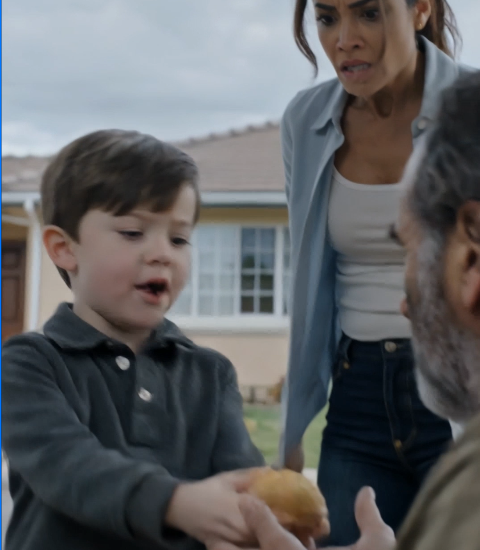
The old man didn’t look up when people walked past him.
He had learned, over the years, that it was easier that way.
He sat on the cold concrete outside a quiet suburban house, his back against a rusted fence post, his hands trembling in his lap. Not from cold. From something deeper. Something that had lived in his chest for so long he’d forgotten what warmth felt like.
His beard was gray and unkempt. His coat was two winters too thin. And his eyes — if anyone had bothered to look — were the saddest eyes on the street.
Nobody bothered to look.
Until a little boy did.
The child had stopped on the sidewalk, maybe six or seven years old, backpack still strapped to his shoulders from school. He stared at the old man with the open, unguarded gaze that only children have — the kind adults spend their whole lives learning to suppress.
“Are you hungry?” the boy asked simply.
The old man looked up. Just barely.
“Go home, son,” he said quietly.
But the boy didn’t move. He reached into his jacket pocket and pulled out a small piece of bread — half a sandwich, really, the kind a mother packs without thinking about how much it will matter — and held it out with two small, shaking hands.
What happened next changed everything.
She came out of nowhere.
The front door of the house burst open and a woman stormed down the path — mid-thirties, coat half-buttoned, hair still damp — moving with the terrifying speed of a mother who senses danger.
“Daniel!” she screamed.
She grabbed her son by the arm, yanking him backward so hard he stumbled. The bread fell to the pavement.
“Stay away from him!” she shouted, planting herself between the boy and the old man like a wall. Her voice cracked across the quiet street. “He’s dangerous!”
The old man flinched. Looked back down at the ground.
Daniel pulled against his mother’s grip.
“Mom, stop! He’s hungry!“
“I said come inside.“
“You’re hurting me!”
But she didn’t let go. She never let go. That was the thing about her — she held on so tightly to the things she loved that she sometimes forgot she was the one causing the pain.
Daniel broke free.
It happened fast — a sharp twist of his small body, the way only children can slip from an adult’s grip — and he ran back. Back to the old man. Back to the piece of bread on the ground, which he picked up and held out again, this time with both hands pressed together like an offering.
The woman froze, stunned by her own son’s defiance.
And then Daniel said the words.
Soft. Certain. Like he’d been waiting to say them for a very long time.
“Grandpa… I finally found you.”
The street went silent.
The wind stopped.
Even the gray overcast sky seemed to hold its breath.
The old man slowly raised his head. His jaw trembled. His eyes — those impossibly sad eyes — filled with something that wasn’t quite tears yet, something that comes before tears, when the body doesn’t know whether it’s allowed to feel again.
He stared at the boy.
The boy stared back.
And the woman behind them whispered — not shouted, whispered — in a voice that barely made it past her lips:
“What did you just call him?”
Nobody moved.
Daniel didn’t turn around. He kept his eyes on the old man’s face, watching something shift there, something ancient and buried slowly pushing its way to the surface.
“Mom,” the boy said quietly, “he has the same eyes as me.”
The woman took one step forward. Then stopped.
Because the old man was reaching into the inside pocket of his worn coat — slowly, the way people move when they’re afraid something real might finally be happening — and pulling something out.
A photograph.
Faded. Creased along every fold. The edges soft from years of being held.
He turned it toward her with a trembling hand.
And the world ended.
In the photograph, a man stood in a garden — younger, stronger, clean-shaven, laughing — and beside him, a little girl. Maybe five years old. Pigtails. A gap-toothed smile. Holding his hand with both of hers.
The woman’s face went white.
Because she knew that garden.
She knew that dress.
She knew that smile.
It was her.
The old man looked at her. Not with anger. Not with accusation. With something far more devastating than either of those things.
He looked at her with forgiveness he hadn’t been asked for yet.
“You told everyone I was dead,” he said quietly.
Three seconds of silence.
Three seconds that contained seventeen years.
The woman’s mouth opened. Nothing came out.
She had rehearsed this moment, in the private theater of her worst nightmares, dozens of times. She had imagined being cold. Being certain. Being righteous in the reasons she had given herself — the drinking, the disappearances, the night she came home and found her mother on the kitchen floor, crying, again, because of him.
She had told herself it was the right thing.
She had told Daniel his grandfather had died before he was born.
She had told her husband the same.
She had told it so many times it had calcified inside her into something that felt like truth.
But truth has a way of sitting on sidewalks.
Truth has a way of waiting.
“Claire.”
He said her name.
Her real name. The one nobody had called her in seventeen years, not since she’d moved to this city and become someone new, someone without a past, someone whose father had died.
Her knees nearly buckled.
“Claire,” he said again. “I’ve been looking for you for three years.”
“Don’t.” Her voice was barely a sound.
“I got sober.” He said it simply. “Eight years ago. I got sober and I looked for you and your mother told me—” He stopped. Swallowed. “She told me you didn’t want to be found.”
Something inside Claire cracked open.
Because that was true. That had been true. She had told her mother exactly that.
But that was eight years ago.
And somehow eight years had become forever without her noticing.
Daniel was still holding his grandfather’s hand.
He hadn’t let go. Not once. As if some ancient, cellular knowledge had passed between them the moment they touched — something that bypassed all the years of silence and lies and said, quietly, simply: this is family.
The old man looked down at the boy.
And for the first time in longer than he could remember, he smiled.
It was a broken smile. A smile with cracks all through it.
But it was real.
Claire pressed her hand over her mouth.
She was thinking about every Christmas. Every birthday. Every time Daniel had drawn a picture of their family in school and there had been no grandfather in it — because she had erased him. Painted over him like a wall you want to forget was ever a different color.
She was thinking about the photograph in his pocket.
The garden. The pigtails. The gap-toothed girl who had loved her father with the simple, total faith that children have before the world teaches them otherwise.
She had been that girl.
Once.
She took one step forward.
Then another.
Her legs weren’t working right. The world had gone slightly sideways, the way it does when something enormous is happening and your body hasn’t caught up yet.
She stopped in front of him.
Up close, she could see how much he had aged. How many winters were written in his face. How many of them had been spent outside.
How many of them had been her fault.
“Dad,” she whispered.
The word came out like something she had swallowed a long time ago and couldn’t keep down anymore.
The old man looked up at his daughter.
And the tears came. For both of them. At the same time. Like a door opening that had been sealed shut for seventeen years, and on the other side — just light.
Daniel looked up at his mother, then at his grandfather, then back at his mother.
“See?” he said softly. “I told you he wasn’t dangerous.”
And Claire, for the first time in seventeen years, dropped to her knees on the cold concrete and put her arms around her father.
He held her like he used to.
Like she was five years old.
Like no time had passed at all.
