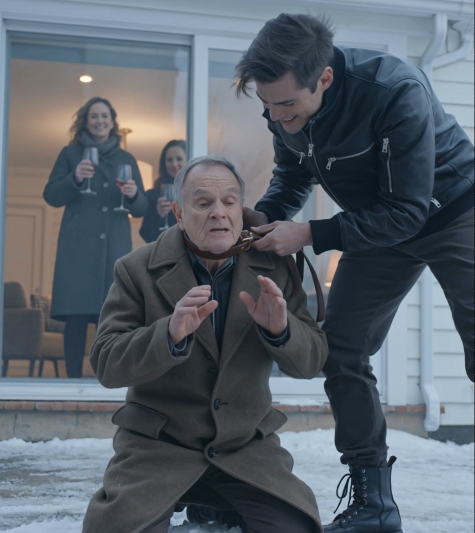
The old man’s knees hit the slush before anyone could blink.
One second he was standing in his own driveway — the driveway he’d shoveled ten thousand times, the concrete he’d poured with his own hands forty years ago — and the next, he was down. Cold water soaked through his wool trousers instantly. His palms caught the ground. His breath exploded in a white cloud into the freezing air.
Tyler stood over him, grinning.
He was twenty-six years old, broad-shouldered, wearing a jacket that cost more than most people’s rent. He had the kind of smile that had never been challenged — not seriously, not once. The kind of smile that believed the world was arranged specifically for his amusement.
“There we go,” Tyler said, crouching slightly, tightening the leather collar around the old man’s neck with slow, deliberate fingers. “That’s exactly where you belong.”
His name was Walter Crain. He was eighty-two years old. And he said nothing.
Inside the house, through the large living room window, two women stood in warm amber light. Karen — Tyler’s mother — lifted her wine glass slowly, her lips curling. Beside her, Donna laughed at something under her breath, already holding her phone up, recording.
Steam rose from their glasses.
They looked comfortable. They looked entertained.
The driveway was covered in slush — that miserable gray mixture of snow and salt and regret that accumulates in late winter afternoons when the sky can’t decide whether to snow or just threaten. The light was flat and cold. Every shadow looked bruised.
Walter’s hands trembled — not from fear. From the temperature. His fingers were bare because he’d stepped outside without thinking, following the sound of Tyler’s voice calling him out like you’d call out a dog.
Tyler yanked the leash.
It was a sharp, contemptuous motion — the kind designed not to hurt but to humiliate. To make a man feel like property.
Walter’s throat strained. His jaw tightened.
He still said nothing.
Tyler circled him slowly, boots crunching in the slush, enjoying the sound of his own footsteps. The handheld phone camera in Donna’s hand tracked them through the glass — unsteady, slightly zoomed, getting everything.
“You should’ve sold when we asked nicely,” Tyler said, coming around to Walter’s left side. “We asked nicely. Twice.” He crouched down until his face was level with the old man’s. “Now we’re not asking.”
Walter’s eyes moved — not to Tyler’s face, but downward. To his own right hand.
His fingers had been closed loosely around something small. Something matte-black. Cylindrical. About the size of a thick marker.
It slipped.
Walter watched it fall into the slush between his knee and Tyler’s boot.
Tyler noticed it immediately.
He stood, looked down at the small device, and nudged it with the toe of his boot. Casual. Dismissive. Like flicking away a cigarette butt.
There was a click.
Soft. Almost inaudible beneath the ambient hiss of winter air.
Then — a faint vibration. Not a sound exactly. More like a feeling. The kind you sense in your back teeth before you can hear it with your ears.
Tyler didn’t notice.
He was already pulling the leash again, stepping back, reclaiming the theater of the moment. “Pull harder,” he said, grinning back toward the window, making sure the women were watching.
They were.
Karen raised her glass slightly — a toast.
Walter stayed perfectly still on his knees in the slush. He looked up at Tyler, and when he finally spoke, his voice was barely above a whisper.
“You should go inside.”
Tyler laughed. “What was that?”
“I said—” Walter’s voice was quiet, but there was something underneath it. Something old and very certain. “You should go inside. Now.”
Tyler opened his mouth to respond.
And then he heard it.
It started as almost nothing — a low, rhythmic pulse somewhere at the edge of perception. Like a storm still miles away but already making the air feel different. Like something very large moving through space toward a very specific point.
Tyler’s grin didn’t fall immediately. It shifted first — a hairline fracture in the confidence. His eyes moved involuntarily upward toward the gray sky, then back down to the old man still kneeling in the slush.
“What is that?” Tyler said.
Walter didn’t answer.
The sound grew.
It was rotors — unmistakably rotors now — but not the casual chop of a news helicopter passing overhead. This was deeper. More deliberate. The kind of sound that has coordinates attached to it.
The snow on the driveway began to move. Not falling — lifting. Swirling in slow patterns at first, then faster, more aggressive, the slush catching air and spraying sideways across Tyler’s expensive boots, across Walter’s coat, across the face of a man who was rapidly running out of composure.
Inside, Karen lowered her wine glass.
Donna stopped recording.
The rotor sound was enormous now — chest-deep, pressure-shifting, the kind of frequency that makes car alarms go off three blocks away and sends birds evacuating trees in every direction. The gray sky above the driveway seemed to darken further, thicken, like something was descending through it.
Tyler stepped back.
He looked up. His mouth opened slightly.
“Walter—” he said, and the name came out wrong — stripped of mockery, stripped of power. Just a word. Just a scared young man saying the name of someone he had badly, catastrophically miscalculated.
Walter still hadn’t moved from his knees. Not because he couldn’t — because he didn’t need to. His eyes were steady. His breathing was even. He looked like a man sitting in a waiting room, entirely certain his appointment was on time.
“What did you do?” Tyler’s voice cracked on the last word. “What did you do?“
The collar was still around Walter’s neck. His hands were still trembling from the cold. His trousers were soaked through with freezing slush.
He looked up at Tyler and, very gently, he almost smiled.
“Thirty-one years,” Walter said quietly. “Air Force. Then twelve years doing things you’re not cleared to know about. Then fifteen years living quietly in this house—” he glanced toward the window, where both women had stepped back from the glass, “—bothering absolutely no one.”
The rotor sound peaked.
The entire driveway was a storm of displaced snow now, swirling in tight geometric patterns. Tyler stumbled backward against his own car, grabbing the door handle to steady himself, his face completely undone.
“I pushed that button—” Walter looked at the small black device half-submerged in the slush, “—the moment you put that collar on me.” He paused. “They were already close.”
What happened next took eleven seconds.
Later, Tyler would not describe it to anyone. Not because he’d been told not to — though he had been, clearly and firmly, by two men in dark clothing who spoke to him in a very quiet tone for a very long time. He wouldn’t describe it because some moments carve themselves into a person’s nervous system in a way that makes language feel stupid.
He would say only this, to his mother, in the car afterward, his hands still shaking:
“He wasn’t scared. Not even for a second. He was never scared.”
Walter Crain removed the collar himself, set it on the hood of Tyler’s car, and walked back toward his front door.
His knees were soaked. His hands still trembled — still from the cold, always from the cold.
At the door, he paused and looked back at the driveway. At the slush. At the small black device someone had already retrieved without him needing to ask.
He thought about the forty years of memories in the concrete beneath all that gray ice. He thought about how much noise the world makes when it thinks it has found someone who won’t push back.
He opened the door.
Went inside.
Put the kettle on.
