Nobody stopped it.
That’s the part that haunts you. Not the cruelty itself — though that was real enough — but the silence of sixty people who watched and did nothing.
Marcus didn’t even see it coming.
One second he was at his locker, spinning the combination for the third time because his hands were shaking and he kept losing count. The next second, a hand slammed flat against the metal door beside his head, and the world got very small, very fast.
“Hold still.”
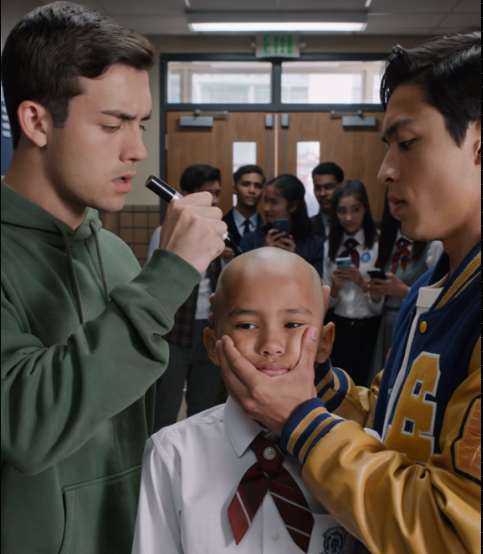
That was Derek’s voice. Derek Calloway — varsity jacket, easy smile, the kind of boy who had never once been told no by anyone who mattered. He grabbed Marcus by the jaw with one thick hand, fingers pressing into cheekbone, forcing his chin up and forward like Marcus was a specimen being examined.
Marcus’s backpack slid off one shoulder. He didn’t reach for it.
He had learned, in the three weeks since transferring to Millbrook High, that reaching for things only made it worse.
“Don’t move,” said the other one — Kyle, in the green hoodie, already uncapping something. A marker. Black. Thick-tipped. The industrial kind, the kind that doesn’t wash off.
The fluorescent lights overhead buzzed with that particular frequency that seems designed to make every bad moment feel worse.
It started with a few people noticing. Then a few more. Then it was a crowd, the way crowds form in high school hallways — not by invitation, but by gravity, everyone drifting toward the spectacle without fully admitting that’s what they were doing.
Phones came out.
Someone laughed, short and sharp, then covered their mouth.
Nobody said stop.
Kyle pressed the marker to the top of Marcus’s head — his shaved head, the one thing about himself Marcus had always been quietly proud of, clean and sharp every Sunday morning when his grandfather would line it up for him — and began to draw.
The tip dragged across his scalp.
Marcus felt every millimeter of it.
He stared forward, because Derek’s grip didn’t allow for anything else. His jaw ached. His eyes burned. He focused on a point in the middle distance — a dent in a locker across the hall, oval-shaped, like someone had punched it a long time ago — and he tried to go somewhere else inside his head.
He tried to think about his grandfather’s kitchen. The smell of coffee. The sound of gospel music playing low on a Sunday.
But the marker kept dragging.
And then — he couldn’t help it.
A single tear broke loose from his right eye and rolled down his cheek.
He didn’t make a sound. He refused to make a sound. But the tear was there, catching the fluorescent light, completely visible to everyone who was watching.
Someone in the crowd whispered. Someone else giggled.
And Marcus’s eyes — still staring forward, still fixed on that dented locker — shifted upward, just slightly. Not in defiance. Not in anger.
Just in pain.
The kind of pain that is too deep for anger. The kind that comes from understanding, at thirteen years old, that the world can look at you suffering and choose to film it.
The ink on his scalp was cold and wet.
And then something changed.
Not the cruelty. The cruelty didn’t stop — not yet. But something in the air shifted, subtle as a barometric drop before a storm.
The double doors at the far end of the hallway swung open.
Not thrown open. Not kicked. They opened with controlled, deliberate force — the kind of movement that belongs to people who have been trained to enter rooms.
Two women walked through.
The crowd heard them before it saw them. The particular rhythm of dress shoes on linoleum — measured, unhurried, absolute. The crowd parted. Not because anyone told it to. It just did, the way water moves around something solid.
The women were in formal military dress uniforms. Navy blue so dark it was almost black, with red piping sharp as a razor along every seam. White covers — officer’s caps — perfectly level. Brass buttons polished to mirrors. Not a thread out of place. Not a single deviation from perfect.
They walked in sync, shoulders even, eyes forward.
The ambient noise of the hallway — the whispers, the shuffling, the low murmur of sixty students — dropped away like someone had turned a dial.
Everyone felt it.
Even Kyle felt it. He slowed. The marker lifted slightly from Marcus’s scalp.
Even Derek felt it. His grip loosened — not released, just loosened — and for the first time, a flicker of something moved across his face. Not guilt. Not yet. Just the first tremor of uncertainty, the sensation of a boy who has never been truly checked suddenly sensing that something large is approaching.
Marcus felt the grip loosen.
He didn’t move.
He was afraid to believe it.
The officers walked the length of the hallway with the unhurried patience of people who have never once needed to rush because the outcome was always already decided.
Students pressed back against lockers on both sides.
Nobody spoke.
The first officer — taller, with close-cropped silver-streaked hair beneath her cover — had eyes that moved across the scene the way a professional’s eyes move: cataloging, assessing, missing nothing. She saw the marker in Kyle’s hand. She saw the ink on the boy’s head. She saw the phones. She saw every single face in that crowd.
Her expression did not change.
That was what made it terrifying.
Not fury. Not even cold anger. Just complete, utter composure — the face of someone for whom this situation, as grotesque as it was, represented a problem to be handled with precision rather than emotion.
The second officer — slightly shorter, jaw set, moving with the same measured authority — had her eyes fixed on one specific point.
On Derek Calloway.
Her son.
Derek’s face went through five emotions in three seconds.
Surprise. Recognition. Confusion. The beginning of a smile — the instinct to perform normalcy. And then, as he truly registered her expression, as he saw what was in her eyes, the smile died before it finished forming.
His grip released Marcus entirely.
He stepped back.
Just one step. But it was a step that said everything — it was the step of a boy who has never in his life been genuinely afraid, suddenly understanding what afraid feels like.
His mother stopped three feet in front of him.
She didn’t touch him. Didn’t raise her voice. Didn’t say his name.
She simply looked at him.
And in that look was everything. Every deployment she had survived to come home to him. Every sacrifice she had made to raise him right while she was halfway around the world serving a country she believed in. Every letter she had written him from places she couldn’t name. Every prayer. Every phone call where he’d said yes ma’am and I’m fine and I’ll make you proud.
Every single thing she thought she had built in him, looking back at her from a boy holding a black marker over a child’s shaved head while sixty people filmed it.
She held his gaze for a long, long moment.
Then she turned to Marcus.
Her voice, when it came, was quiet. Not soft — quiet is different from soft — the way a precision instrument is different from a blunt one.
“Are you alright, son?”
Marcus opened his mouth. Closed it. He was thirteen years old, and he had spent three weeks being invisible, and a woman in a military dress uniform with a chest full of ribbons was looking at him like his answer was the most important thing in the room.
“No, ma’am,” he said. Honestly. Because she was the kind of person you told the truth to.
She nodded once. “You will be.”
Later, people would talk about what happened next. The conversation with the principal. The phone calls home. The way Derek Calloway didn’t say a single word the entire time, just sat very still in the office chair with his mother beside him, her posture perfect, her silence enormous.
But what people really remembered — what ended up on every phone, in every repost, in every comment section where people argued about schools and bullying and children and what we owe each other — was the hallway.
The moment when a boy with ink on his scalp and tears on his face looked up.
And the doors opened.
Nobody stopped it.
Until someone did.
