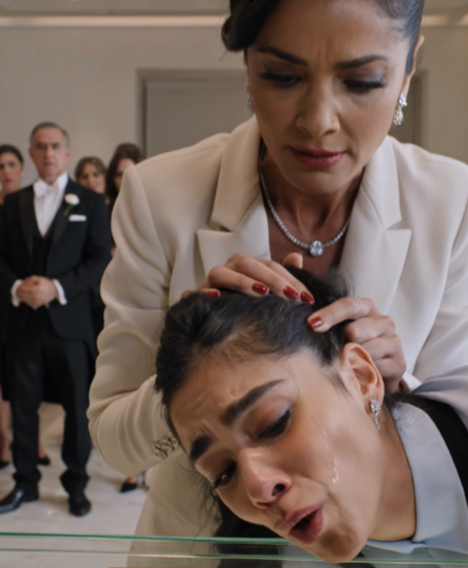
Nobody walks into a jewelry store expecting a ghost.
But that’s exactly what happened on a Tuesday afternoon in the most expensive jeweler on the Rue du Faubourg, when a girl with red hands and a borrowed blazer reached for a necklace she had no business touching — and changed every life in the room forever.
It started, the way most cruelties do, with a woman who had never once been told no.
Céleste Marchand was fifty-three years old and wore that fact like a weapon.
She arrived the way she always arrived — ahead of everyone else in the room, her presence preceding her physical body, the kind of woman who made other women instinctively straighten their posture. Pale mink coat despite the mild weather. Heels that announced each step on the polished marble like a small gavel strike.
She was here for one reason.
Her son’s wedding was in eleven days, and she had decided — as she had decided everything related to this wedding — that the bride would wear a necklace selected by the Marchand family. Not requested. Selected. The distinction mattered enormously to Céleste.
The showroom was quiet and bright, diamond light bouncing softly off every reflective surface. Display cases lined the walls, their contents arranged like artifacts in a museum — not merely objects for sale, but evidence of a particular kind of world.
Céleste moved through it comfortably.
She belonged here in a way that was almost territorial.
The girl behind the center counter did not.
Her name was Mara.
Twenty-two years old, four months into this job, still slightly terrified of the inventory. She wore a blazer that was one size too large — the store’s loaner jacket for floor staff who couldn’t afford their own — and her hands, if you knew what to look for, bore the faint roughness of someone who’d spent previous years doing something physical. Waiting tables, maybe. Or something harder.
She was reaching into the center display case, carefully repositioning a piece that had shifted during the morning rush, when Céleste’s shadow fell across the counter.
“Not that one,” Céleste said flatly, not yet bothering to look at her directly. “I want to see the Vallière collection.”
Mara straightened. “Of course. I’ll have Mr. Auclair—”
“I didn’t ask for Mr. Auclair. I asked to see the collection.”
Mara hesitated. The Vallière pieces were the most valuable in the store. Protocol required senior staff. She knew this.
She also knew the way Céleste was looking at her — or rather, not looking at her, her gaze drifting past Mara’s shoulder with the mild impatience of someone waiting for a door to open — and she understood that the calculus here was not about protocol.
She reached for the velvet tray.
The slap came without warning.
One moment Mara’s hand was extending toward the display case. The next, the flat of Céleste’s palm connected with her face hard enough to turn her head sideways, hard enough to send her stumbling backward into the glass counter behind her with a sound that cracked across the silent showroom like a branch breaking.
The room stopped.
Every customer. Every staff member. A couple near the window selecting engagement rings — the woman’s hand frozen midway to her mouth, the man half-risen from his stool.
“Don’t you dare,” Céleste said, her voice shaking with a fury that had clearly been looking for something to attach itself to, “touch a necklace worth more than your entire life.“
Mara’s hand went to her face. Her eyes were immediately bright with involuntary tears — not sadness, the automatic response of a body that has just absorbed impact — and she pressed her lips together hard.
But Céleste wasn’t finished.
She reached across the counter and grabbed a fistful of Mara’s hair — grabbed it, in the middle of the brightest and most public room imaginable — and forced her head downward, toward the velvet tray of necklaces below, holding her there while Mara’s hands gripped the counter’s edge and the tears came for real now, hot and uncontrolled.
“Apologize,” Céleste hissed. “Apologize for stealing from real people. For pretending you belong in rooms like this.”
The room was not silent now. Someone gasped. Someone said something sharp in French. A woman near the door took a step forward and stopped.
Mara was shaking.
Her face was inches from the velvet tray, from the pieces she’d been repositioning, and through the blur of tears she could see them — the careful, extraordinary craftsmanship of the Vallière collection, necklaces that would never belong to a person like her.
And one in particular.
A simple gold chain with a pendant. Almost modest, compared to the others. But something about it—
“Apologize!“
Mara closed her eyes. Opened them.
When she spoke, her voice was barely sound.
“Then open the clasp.”
The words were so quiet, so unexpected, that it took Céleste a full three seconds to process them.
Her grip on Mara’s hair loosened slightly — not from compassion, but from confusion.
“What?“
Mara straightened, slowly, the tears still running freely, one cheek red with the clear signature of a palm. She didn’t look away from Céleste.
“The necklace,” she said. “Open the clasp.”
Something in her voice — or maybe something in the room, some shift in atmosphere that the onlookers felt before they understood — made Céleste pause.
She looked down at the pendant.
Then, with the particular contempt of a woman who believes she is humoring madness, she scoffed — a sharp exhale through her nose — and reached for the necklace.
She flipped it.
Her fingers found the clasp.
And she froze.
Engraved on the interior of the clasp — the hidden face, the side that rests against skin, the place you put words meant only for the person wearing it — was a date.
April 14th, 1987.
And beneath it, in letters so small they required Céleste to lean close: Pour toujours, mon amour.
Forever, my love.
Céleste’s face had gone the particular gray of someone who has just heard a sound they cannot source.
She straightened. Looked at the necklace. Looked at it again.
“Where did you get this.”
It was not a question.
“It came with the estate lot,” Mara said quietly. “Three weeks ago. Bought at auction. I catalogued it myself.”
“Where did you get this.“
The voice from the doorway behind them — older, rougher, cracking at its edges — belonged to Henri Auclair, the master jeweler, who had emerged from the back office at the sound of the commotion and now stood completely still, twelve feet away, staring at the necklace in Céleste’s hand with an expression of absolute incomprehension.
He crossed the floor in four long steps and took the necklace, gently, from her grip.
He looked at the clasp.
He looked at the date.
The color left his face so completely that the couple by the window later said he appeared to age ten years in ten seconds.
“That date,” he said. And stopped. Seemed to need to start again. “That date. This necklace.” He looked up at no one in particular. “This necklace was buried with the groom’s mother.”
The silence that followed had a different quality than any silence the room had held before.
Somewhere near the door, a man stood up from his chair.
He had been there the whole time — part of Céleste’s party, her son, the groom, thirty-one years old, in a dark wool coat, who had come to the jeweler today because his mother had insisted and because he had learned long ago that it was easier to come along than to explain why he didn’t want to.
He had been watching from the moment the slap landed.
He had been watching when his mother grabbed the girl’s hair.
And he was watching now, as Henri Auclair held the necklace with shaking hands, as his mother stood with her arm suspended in mid-air with nowhere to go, as the date glowed on the clasp —
April 14th, 1987.
His mother’s birthday.
His father’s handwriting.
His mother had worn that necklace every single day until the night she died. He had watched them place it in her hands at the funeral home. He had watched the casket close.
He stepped forward.
His eyes moved from the necklace to the girl behind the counter.
To Mara.
Standing with her back to the glass display case, her face still wet, her blazer still borrowed, her hands still red — looking back at him with an expression he couldn’t name, that he’d never seen before on a stranger’s face.
Recognition.
That was what it was.
But they had never met.
He was certain of it.
Completely, absolutely certain.
He looked at her face.
He looked at her hands.
He looked at her eyes — the particular shape of them, the color he had always believed existed in only one family.
And the room went quiet in a way that had nothing to do with sound.
