The whiskey glass never even finished falling before the laughter started.
It hit the edge of the table, spun once, and shattered across the worn wooden floor — amber liquid spreading fast, soaking into cracks that had absorbed a thousand other spills, a thousand other nights. The neon light above the bar — red on the left, blue on the right — painted everything in colors that had no business being pretty in a place this mean.
The man at the table didn’t flinch.
Not even close.
His name was Daniel Carr. He was forty-four years old, wearing a plain gray shirt that now had someone else’s whiskey drying across the chest. He’d driven three hours to get here — not to this bar specifically, just to away. Away from the city, away from the noise, away from the version of himself that wore a tie and answered emails and pretended the last two years hadn’t happened.
He’d wanted one quiet drink.
He’d picked the wrong table.
The biker who’d slammed his hands down was named Russ. Six-foot-three, leather vest covered in patches that told a story nobody had ever asked to hear, knuckles like quarry stone. He had the particular energy of a man who had never once walked into a room and wondered if he belonged there.
He leaned down until his face was eight inches from Daniel’s.
“You lost, city boy?”
Laughter erupted behind him — two, three other bikers spreading out in a loose, practiced semicircle. The kind of formation that looks casual until you realize it isn’t. One of them kicked the leg of Daniel’s chair — not enough to tip it, just enough to send a jolt up his spine.
From somewhere behind Russ, one of the others laughed and said, “He don’t even blink.”
That should have been a warning.
It wasn’t taken as one.
Daniel slowly lifted his head.
He didn’t look scared. He didn’t look angry. He looked the way a man looks when he’s been interrupted during something he was actually enjoying — mildly inconvenienced, completely in control of what he planned to do about it.
His eyes found Russ.
Held there.
Russ didn’t like what he saw in them. So he reached for the bottle.
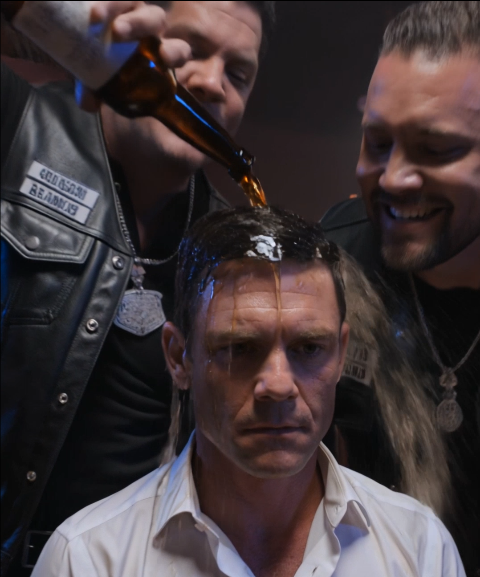
He poured it slow — deliberate cruelty disguised as entertainment. Beer cascaded over Daniel’s head in a cold, foaming rush, soaking his hair, running down his collar, dripping from his jaw onto the table.
The bar erupted again.
Somebody whistled. Somebody else banged a table.
Russ straightened up, spread his arms wide like a performer acknowledging applause, and looked back down at the man drowning in beer with the satisfaction of someone who had never experienced a consequence in his life.
“Dance for us,” he said.
The liquid dripped.
Daniel didn’t move.
Not his hands. Not his shoulders. Not his expression. He sat with the stillness of something geological — a thing that had been exactly where it was long before this moment and would remain long after.
His voice, when it came, was so quiet that Russ had to lean in to hear it.
“You’re done.”
Two words. Flat. Certain. The kind of voice that doesn’t threaten because it doesn’t need to.
The laughter didn’t stop all at once. It stuttered — caught on something it couldn’t identify, like fabric snagging on a nail.
Across the bar, the young bartender — twenty-two years old, two months into this job, name tag reading Cole — had been watching with the frozen expression of a man calculating his own liability.
He knew this bar. He knew these nights. He’d seen Russ and his group come through before, and he knew how the math usually worked: loud entrance, louder exit, broken something, and a tip that insulted the damage.
But something was different tonight.
He couldn’t name it. He just felt it — the way you feel a change in air pressure before a storm that hasn’t announced itself yet.
He whispered to himself, barely moving his lips:
“Not again…”
His hand was trembling. He grabbed the edge of the bar to steady it.
Russ stepped closer to the table. The amusement had curdled slightly — not into fear, not yet, but into irritation. He didn’t like the two words. He didn’t like how they’d been delivered. He especially didn’t like the way the laughter behind him had gone a half-beat quiet.
“What did you say?”
Daniel turned his head — just slightly, just enough to be deliberate — and spoke a fraction louder than before.
“Walk away.”
Then he did something that made the temperature in the room seem to drop by several degrees.
He looked past Russ. Past the circle of leather and boots and crossed arms. He looked directly at Cole behind the bar.
And he gave a single, small nod.
Cole’s hand was already on his phone.
He didn’t know why. Muscle memory, maybe. Or instinct. Or the simple recognition that whatever was about to happen was so far outside the category of bar fight that it required a different kind of phone call than the one he usually made.
His lips barely moved.
“I’m calling it.”
The music had faded without anyone touching the jukebox.
That was the thing about these moments — the room always seemed to know before the people in it did. The low country rock that had been bleeding through the speakers for the last hour had dissolved into something else: a low, structural hum that you felt in your sternum more than your ears.
One of the bikers at the back of the group shifted his weight.
He’d been around long enough to know what rooms felt like before they went bad. And this room felt like that — but backwards. Usually the bad feeling came from whoever was doing the intimidating.
This was coming from the other direction.
He said, quietly, to no one in particular:
“Something’s off.”
Nobody laughed this time.
Russ put his hand flat on the table and leaned in one more time. He was committed now — you couldn’t back down in front of your own people without paying a price — but something behind his eyes had shifted. A hairline fracture in the architecture of his confidence.
Daniel looked at him.
Just looked.
No anger. No fear. No performance of either. Just a man who knew exactly where he was, exactly what he was, and exactly how this was going to end — and had known all three things since approximately the moment Russ’s hands had slammed onto the table.
“Last time,” Daniel said quietly. “Walk. Away.”
What Russ didn’t know — what none of them knew — was that Daniel Carr had spent eleven years running protective details for people whose names you’d recognize. He’d stood in rooms with much higher stakes than this one. He’d read threat assessments at breakfast and made judgment calls at midnight that he’d never be able to discuss with anyone.
He hadn’t come to this bar looking for trouble.
He also hadn’t been afraid of it for a very long time.
Cole was already talking into the phone.
Outside, something was changing — the gravel parking lot, the night air, the geometry of the evening. Two vehicles that had been idling down the road with their lights off began to move.
Daniel hadn’t come alone.
He’d never said he had. He’d never said he hadn’t. He’d simply sat down, ordered a whiskey, and waited to see what the night would bring.
The night had brought Russ.
Russ was about to meet the rest of the night.
The biker at the back of the group took one step backward.
Then another.
Russ saw it happen in his peripheral vision and felt something he hadn’t felt in years: the specific cold that arrives when you realize the ground beneath a situation is not where you thought it was.
He looked at Daniel one more time.
Daniel hadn’t moved. Hadn’t blinked. His shirt was soaked with whiskey and beer, his hair still dripping, and he sat in that chair like a man who owned every room he’d ever entered — including this one, including right now.
The grin on Russ’s face finished dying.
And in the silence that followed, the only sound in the bar was Cole on the phone, the low hum underneath everything, and the quiet, distant crunch of tires rolling slow across gravel outside.
Daniel watched Russ’s face.
And waited for the man to finish understanding what he’d done.
