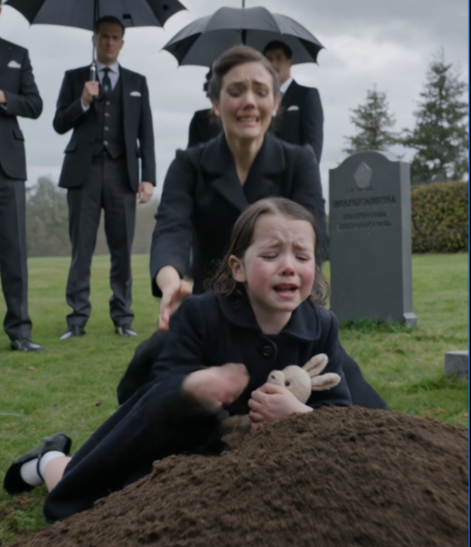
Nobody told Ellie what a funeral was for.
They had dressed her in her black coat — the one with the velvet collar she usually saved for Christmas — and put her small feet into her good shoes and told her they were going somewhere important to say goodbye to Daddy.
She had asked if she could bring Mr. Rabbit.
They said yes.
Nobody thought to tell her that goodbye, this time, meant something different than it had every other time she had said it at the front door, watching her father’s car pull out of the driveway and disappear around the corner while she counted the minutes until he came back.
Nobody told her he wasn’t coming back.
And so, when she saw the hole in the ground, she understood it — the way a five-year-old understands the things that terrify them — as something that needed to be fixed immediately.
She ran.
She broke from her mother’s hand without warning.
One moment Claire was holding her daughter’s fingers in her own, feeling the small, warm weight of them, the only solid thing left in a world that had become entirely liquid — and then the hand was gone.
She heard Ellie before she fully registered that she’d moved.
“Daddy! Daddy, wake up!“
The cry tore across the cemetery with a force that had nothing to do with the size of the person producing it. It silenced the priest mid-sentence. It turned forty heads simultaneously. It passed through every black umbrella and every carefully maintained expression of adult grief and reached something underneath all of that — something undefended — and broke it open.
Ellie ran on her short legs across the wet grass, her black coat flying behind her, Mr. Rabbit clutched to her chest with both arms, her small shoes finding the soft ground and sinking slightly with each step.
She reached the edge of the grave and fell to her knees.
“Please wake up,” she screamed. “Please, Daddy, please wake up!“
Her small hands pressed flat against the dark wet soil, the rain coming down in soft, indifferent curtains, and she pushed — as if she could reach through the earth, as if love at sufficient volume and pressure might accomplish what nothing else had managed.
Mr. Rabbit fell from her hands.
She didn’t notice.
Claire reached her in seconds, but the seconds were enormous.
She dropped to her knees in the wet grass behind her daughter — her black dress immediately soaking through at the knees, the cold of the ground rising instantly through the fabric — and reached for her.
“Ellie, baby—“
“He’s in there, Mama!” Ellie sobbed, turning a face so devastated, so entirely undone, that Claire’s breath left her body completely. “He’s in there and nobody’s helping him!“
“I know,” Claire whispered. It was all she had. “I know, sweetheart.“
“Tell them to get him out!” Ellie turned back to the grave, pressing both palms to the soil again, leaning her weight into it. “Daddy! Daddy, I’m here! I came to get you!“
Claire wrapped her arms around her daughter from behind and held on.
She did not try to explain.
She did not try to comfort, not with words — because there were no words engineered for this, none that could do anything but bounce off the surface of a pain this size.
She just held on.
And wept into her daughter’s wet hair.
And the rain came down.
And nobody moved.
They had all frozen.
Forty mourners, each holding their grief in the careful adult way — in the set of a jaw, the pressing together of lips, the deliberate management of breathing — and every single one of them had been undone by thirty seconds of a five-year-old who did not know how to do it the careful adult way.
Some were crying openly now. Others had turned away, unable to look, though looking away helped nothing because Ellie’s voice was still there, smaller now, dropping from screaming into something worse — the broken, hiccupping sound of a child exhausting themselves against an immovable thing.
Near the headstone, slightly apart from the main group, a man stood in a dark suit.
Thomas Brennan.
He was forty-four years old and had been James’s closest friend since university, and he was the one who had made the phone call. The one who had been in the car. The one who had walked away without a scratch while James did not walk away at all, and he had been trying, for eleven days, to understand the geometry of that — why one person and not the other, what invisible calculation had distributed survival so catastrophically unevenly.
He had no answer.
He had shown up today because not showing up was unthinkable, and because Claire had asked him to, and because James would have expected it.
He stood near the headstone and watched Ellie with his head lowered, and something in his face suggested a man standing trial for a crime whose verdict he had already accepted.
The priest beside him said nothing.
The woman to his left said nothing.
Thomas lowered his head further and said, very quietly, to no one in particular —
“She still thinks he’s coming home.”
Claire heard him.
She looked up from her daughter’s wet hair and found Thomas’s face, and what passed between them in that glance was not forgiveness or accusation but simply the shared acknowledgment of people standing in the wreckage of the same catastrophe from different positions.
She looked back down at Ellie.
Her daughter had gone quieter now. Still crying — the tears still coming in a steady, unstoppable stream — but no longer screaming. She had her cheek pressed against the wet soil, her eyes closed, her arms as far around the grave as they could reach, which wasn’t very far.
She was hugging it.
The only part of her father she could reach.
“He promised her,” Claire said. Her voice was not directed at Thomas, not directed at anyone. It simply came out, the way things come out when the internal container has exceeded its capacity. “He promised her he’d never leave.“
She could hear it — the specific morning it had been said. Six-fifteen AM, Ellie refusing to let James put on his jacket because if he put on his jacket he was going to work and she didn’t want him to go to work, she wanted him to stay, and James had crouched down in the hallway and taken her small face in both his large hands and said —
I always come home, bug. Every single time. I promise.
He had said it with such absolute, confident certainty.
He had believed it when he said it.
She knew that. She had to know that. She held onto it.
“He believed it,” she said aloud, though no one had spoken. “He really believed it.”
The rain had softened to something barely there — a fine, cold mist that settled on black fabric and wet grass and the white marble of the headstone and the dark curls of a five-year-old’s hair without discrimination.
Ellie had stopped trying to reach through the earth.
She was kneeling now, quietly, her small hands in the soil, her face lifted slightly.
Looking at the sky.
The gray, total, impenetrable sky that offered nothing back — no break in the clouds, no light, no message, no answer.
Her face was so open.
That was the thing that undid everyone who was watching, who would carry the image of this child for the rest of their lives whether they wanted to or not — the openness of her face. No adult armor. No management. No strategy for surviving the unsurvivable.
Just a little girl looking up at the place she had decided her father had gone, with the specific, devastating faith of someone who still believed, despite all current evidence, that the world was the kind of place where the people who promised to stay actually stayed.
Her lips moved.
Barely a sound. Barely a breath.
“Daddy.”
A pause.
The mist falling.
The umbrellas still. The mourners still. Claire’s arms still wrapped around her from behind, eyes closed, forehead pressed to her daughter’s wet hair.
“I’m scared,” Ellie whispered.
To the sky.
To the gray and silent sky.
“I’m scared, and I want you to come home now.”
Mr. Rabbit lay in the wet grass beside the grave.
One button eye looking up.
Waiting too.
Later — weeks later, in the particular silence of a house that used to contain more sound — Claire would find the rabbit on Ellie’s pillow, carefully tucked under the blanket.
A small paper was folded in its lap.
Ellie couldn’t write more than a few letters yet. But she had tried.
The paper said: DAD COM HOM.
DAD COM HOM.
Claire sat on the edge of her daughter’s bed in the dark for a very long time.
And then she lay down next to her sleeping child, and she pulled her close, and she whispered into the back of her small neck:
“He’s not scared. Because you’re here. Because you’re here, and you’re his, and that means part of him never left.”
She didn’t know if it was true.
She knew it was necessary.
And she held her daughter in the dark and listened to her breathe — the small, steady, impossible miracle of her breathing — until morning came, and the day began, and they started the long work of learning to carry it.
Together.
