Nobody in that house was prepared for the truth.
But the truth had been waiting — patient, quiet, hidden behind a closed door at the end of the east wing — for fourteen months.
It came down the staircase on a Tuesday morning, not on its own feet, but in the trembling hands of a young woman who had run out of reasons to keep carrying it alone.
And when it arrived, it destroyed everything.
Her name was Rosa.
Twenty-four years old. Four years of service in the Vauclaire household. She had come at nineteen from a small town whose name none of the family had ever asked, hired through an agency, given a uniform and a room on the third floor and a set of rules she had memorized and followed without complaint.
She was good at being invisible.
She had learned, in the way that people in her position learn such things, that the best version of herself — the safest version — was the one that moved through rooms without disturbing the air. That poured coffee without being thanked. That carried things and cleaned things and witnessed things and kept all of it locked behind a face that revealed nothing.
She had been very good at this.
Until she wasn’t.
Madame Vauclaire had found out the way she found out everything — through the elaborate, unconscious surveillance network of a woman who controlled her household the way a conductor controls an orchestra, with minimal visible effort and absolute attention.
A missing laundry schedule. A changed bed. A door that was always closed when it had never been closed before.
Small things. The vocabulary of a secret being kept badly.
She had assembled them over the course of a week with the cold efficiency of someone building a legal case, and by the time she walked into the main hall on that Tuesday morning, she was not investigating anymore.
She was sentencing.
Rosa came down the stairs at eight-fifteen AM.
She was still holding the small bundle of evidence she’d finally decided to carry — had convinced herself, in the sleepless honesty of 4 AM, that she could no longer protect everyone at the cost of protecting no one.
She had taken three steps into the main hall when Madame Vauclaire turned from the window.
The silence lasted exactly one second.
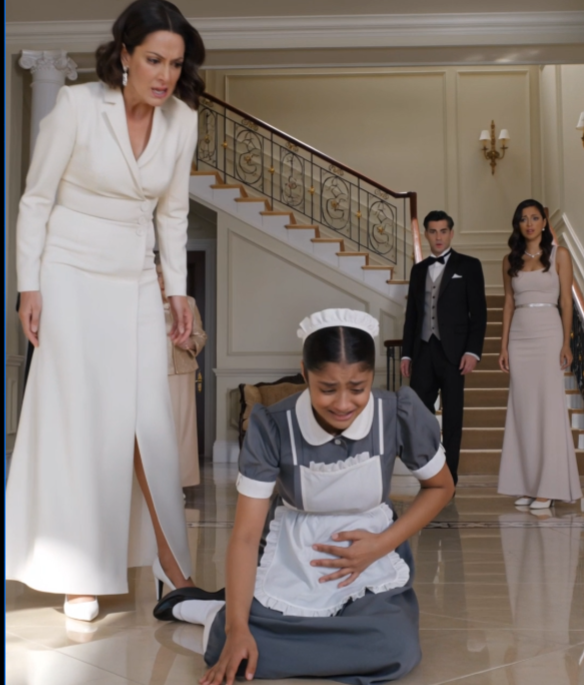
Then Madame Vauclaire crossed the marble floor in four steps and grabbed Rosa by the arm — grabbed her with a strength that came from somewhere beyond physical, from the compressed fury of a woman who had spent fifty years controlling every variable in her life — and threw her.
Rosa hit the marble on her knees, both hands going down to catch herself, one hand flying instantly to her stomach in an instinct so immediate and unthinking that everyone who saw it understood its meaning before they understood anything else.
“You lied to all of us!“
The words didn’t echo — the room was too large for that — but they landed, in the chests of the two servants frozen near the staircase, in the suddenly stopped moment of the entire house.
Rosa stayed on her knees.
She was crying before she’d fully registered that she’d fallen — the tears already coming, the breath already broken, the body releasing what the mind had been holding by force for so long.
She pressed her hand against her stomach.
And through the shaking, through the fractured breathing, she lifted her face.
“I never lied,” she whispered. “I never lied.”
The room waited.
Rosa closed her eyes. Opened them.
“He’s your son’s child.”
The silence that followed was total.
The two servants near the staircase did not move. Did not look at each other. Did not breathe loudly enough to be heard.
Madame Vauclaire stood above Rosa with her hands at her sides and her face doing something complicated — several expressions attempting to occupy it simultaneously, none of them winning.
And then, from the landing above, came the sound of footsteps.
Slow at first. Then faster.
Édouard Vauclaire was thirty-one years old and had his mother’s cheekbones and his father’s silence and a way of moving through rooms that suggested he had always, without quite meaning to, taken up exactly the space he was entitled to and no more.
He appeared at the top of the staircase and looked down.
He saw Rosa on the floor.
He saw his mother standing above her.
He saw Rosa’s hand against her stomach.
And the color — all of it, the easy morning tan of a man who had not been worrying about this, who had somehow managed four months of an engagement and the planning of a wedding and the daily business of being Édouard Vauclaire while this had been happening in his own house — the color left his face completely.
He started down the stairs.
He had not seen her yet.
Cécile Fontaine, his fiancée, had been in the sitting room when she heard the shouting. She had moved into the doorway at the sound of Rosa’s name — because it was Rosa’s name that Madame Vauclaire had said first, before the throwing, and Cécile had caught it and filed it and followed the sound.
She stood now in the arched entrance to the main hall.
She looked at Rosa on the floor.
She looked at Édouard on the stairs.
She looked at Rosa’s hand.
Something traveled across Cécile’s face — not slowly, not in stages, but all at once, the full arrival of comprehension — and what it left behind was not the clean, simple fury of betrayal. It was worse than that. It was the particular devastation of a person who has just discovered that the story they were living was a different story entirely.
Her jaw tightened.
Her eyes filled.
She didn’t speak.
She didn’t need to.
Rosa was still on her knees when her hand went to her pocket.
It was a small movement — quiet, deliberate — and the room watched it the way you watch someone about to show you something that cannot be unseen.
Her fingers closed around something. Drew it out.
A silver baby bracelet.
Tiny. Delicate. The kind of thing made for a wrist so small it barely seems real, engraved with a date so fine you had to hold it to the light to read it.
Her hand was shaking so badly the bracelet caught the morning light in small, scattered flashes.
From somewhere near the back of the room — from the wingback chair near the east window where she sat every morning with her tea and her newspaper and her absolute ownership of this house and everyone in it — came a sound.
Not a word.
A sound. Involuntary. Ancient.
The grandmother’s hands went to her mouth.
Marguerite Vauclaire was seventy-eight years old and had outlasted two husbands and one child and the particular grief that sits at the back of every room and waits — the grief she had carried for fourteen months, since the doctor had come out of the hospital room with a face that said everything before his mouth said anything.
I’m so sorry. The baby didn’t survive.
She had held that grief like a stone in her chest for fourteen months.
She rose from her chair now with a speed that seemed impossible for her age.
“That bracelet,” she said. Her voice barely functioned. “That bracelet belonged to the baby.“
She stopped.
Her hands were still at her mouth.
“The baby,” she whispered, “we were told died.”
Édouard reached the bottom of the stairs.
He walked to Rosa, and he crouched in front of her — not standing over her the way his mother was standing, but down, at her level, on the cold marble floor — and he looked at the bracelet in her hand.
He looked at it for a long time.
His eyes were doing something he had probably not permitted them to do in a very long time.
Rosa watched him.
She had imagined this moment — had rehearsed it in the dark of her third-floor room in a hundred different versions, had built it and dismantled it and built it again — and in none of those versions had she been able to predict his face.
She couldn’t read it now, either.
She just held the bracelet out toward him, and through the tears, through the broken breathing, through the weight of fourteen months of carrying something that was never supposed to be hers to carry alone, she looked at the man whose child she had been told was dead.
Whose child she had been told was dead.
Whose child was upstairs.
Right now.
Awake, probably.
Waiting for her, the way he waited for her every morning.
“They told me he was dead,” Rosa cried, the words barely holding their shape. “They told me—”
She couldn’t finish.
She didn’t need to.
“He’s alive,” she said. “He’s alive. He’s upstairs.”
The bracelet caught the light.
And Édouard Vauclaire — who had grieved a son he never held, who had agreed to move forward, to get engaged, to continue, because what else do you do, what else can you do — looked up at the ceiling of his own house.
Toward the east wing.
Toward the closed door.
Toward the room where a child was waking up.
A child who had his grandmother’s eyes.
A child nobody in this room had ever been allowed to know.
A child who had been breathing, quietly, fourteen months of mornings, just above their heads.
All along.
