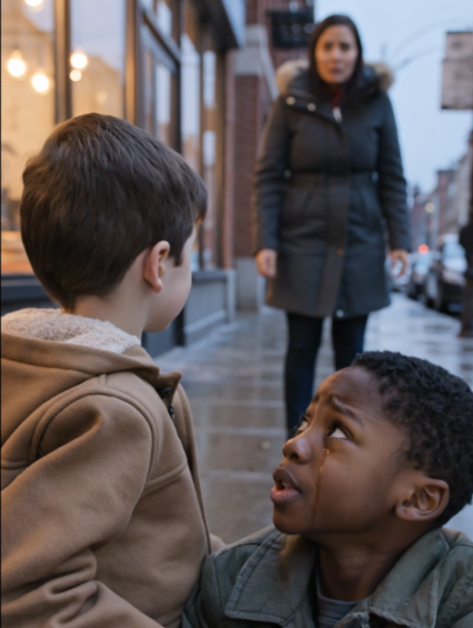
Nobody taught him to do it.
That was the thing that stayed with everyone who witnessed it — the woman with the grocery bags who stopped on the opposite side of the street, the old man walking his dog who found himself unable to keep moving, the teenager who pulled out her phone and then put it away again because some moments refuse to be reduced to content.
Nobody taught the boy to do what he did.
He just did it.
Because he was five years old, and five years old is the age before the world has successfully explained to you all the reasons why you shouldn’t.
His name was Noah.
He had spent the last twenty minutes inside the warm belly of the bakery with his mother, pressed against the glass display case with his nose leaving a small fog circle on the surface while he studied the options with the absolute seriousness that only children bring to decisions of pastry.
He had chosen the bread.
Not the croissant, not the cookie with the chocolate on top that he had asked about three times and been told three times was too much sugar before dinner. The bread. A small, warm, golden-crusted roll that the woman behind the counter had wrapped in paper and handed over with a smile and told him to enjoy.
He had unwrapped it immediately.
He was holding it in both hands — still warm from the oven, the smell of it extraordinary in the cold evening air — when he pushed through the bakery door ahead of his mother and stepped out onto the wet pavement.
And saw him.
He was sitting against the bakery wall like he was trying to take up as little space as possible.
A small boy. About Noah’s age — though it was difficult to be certain, because hunger does something to the proportions of a child’s face that makes guessing hard. He wore a coat that had once belonged to someone much larger, its hem pooling around him on the wet sidewalk, its collar swallowing his chin. His shoes were wrong for the weather in a way that was painful to look at directly.
He had his knees pulled to his chest and his arms wrapped around them, making himself into the smallest possible version of himself, as if he could compress his body tightly enough to hold in whatever warmth remained.
His face was wet.
Not from the mist, though the mist was there.
From crying.
The silent kind — the kind that happens when a person has been crying long enough that the sound has exhausted itself and only the tears continue.
Noah stopped.
He looked at the boy.
He looked at the bread in his hands.
He looked at the boy again.
And he walked forward.
“Please,” Noah said.
His voice was soft. Not the practiced soft of someone being careful — the natural soft of a child who has simply assessed the situation and matched his volume to it, the way you lower your voice in a library without being told.
“Please. Take this.”
He held the bread out in both hands.
The way you’d offer something precious.
The homeless boy’s eyes came up slowly from the pavement.
They were dark and large and full of the particular exhausted wariness of someone who has learned, at an age when learning this should be impossible, that the world is not reliably safe. That things offered can be withdrawn. That kindness sometimes arrives wearing a costume.
He looked at Noah’s face.
Noah looked back at him.
Something passed between them — the specific communication of children, which operates below the level of language and requires no translation.
The boy reached out.
His hands were trembling.
Not from cold, though the cold was there. From something older and deeper — the shaking of a body that has been tensed against the world for too long and is only now, in the presence of one small warm roll and one open face, beginning to release.
His fingers closed around the bread.
He held it for a moment without doing anything else.
“Thank you,” he whispered.
A breath.
“I was so hungry.”
Noah did not respond with words.
He sat down.
Right there on the wet pavement, in his good coat, in the shoes his mother had reminded him twice not to get dirty — he folded himself down to the sidewalk until he was level with the other boy, and then he opened his arms.
And he hugged him.
Simply. Completely. The way children hug, with their whole bodies, without reservation or strategy or any consideration of what it looks like from the outside.
The homeless boy went very still.
For a moment he did nothing — his hands holding the bread, his body held by someone else’s arms — and then something gave way in him, some last internal architecture that had been holding everything up through sheer necessity, and he began to cry.
Really cry.
Not the silent kind from before. The other kind. The kind that comes when safety — unexpected, undeserved, utterly unearned — arrives without warning and the body doesn’t know what to do with it except release.
He cried into Noah’s shoulder.
And Noah held on.
The warm light from the bakery window fell across both of them — gold against the cold blue of the evening — and the wet pavement reflected it back upward, so that they were surrounded, briefly, by something that looked almost like warmth doubled.
The woman with the grocery bags across the street had stopped moving entirely.
The old man’s dog sat down and waited.
Nobody who was watching said anything.
Because nobody wanted to be the thing that ended it.
The bakery door opened.
The sound arrived first — the burst of warm air, the brief return of the smell of bread and sugar — and then the voice.
“Noah!“
Sharp. Panicked. The specific frequency of a mother who has looked away for fifteen seconds and looked back to find her child gone from the place she left him.
Claire came through the door fast and saw him immediately — on the ground, on the wet ground — and her eyes went to the person he was holding and her mouth was already forming the words before her brain had fully processed the image.
“No!” Her voice came out hard and loud, bouncing off the shopfront glass, filling the cold air. “Get away from him right now!“
She was moving toward him as she said it, reaching for his shoulder.
Noah turned.
He turned but he did not let go — kept his arms around the other boy, kept his body between his mother’s reaching hand and the small person he had decided, in the uncomplicated way of five-year-olds, to protect.
His face was not defiant.
It was something simpler and harder to argue with than defiance.
“But Mommy,” he said. His voice was entirely steady. “He’s cold and hungry.“
Claire’s hand stopped in the air.
She looked at her son.
She looked at the boy her son was holding.
She looked at the bread — her son’s bread, the bread he had spent so long choosing, the bread he had unwrapped immediately because he’d been waiting for it, held now in two small trembling hands that had gone still.
She looked at the boy’s coat.
The shoes.
The tear-streaked face now turned up toward her — not with fear, exactly, though there was fear in it — but with something more complicated. The face of someone who has learned to read adults quickly and is currently reading her, calibrating, waiting to learn which version of the world this woman represents.
Something happened to Claire’s face.
It didn’t happen instantly. It moved through several expressions in quick succession — the remnant of the alarm, then something that might have been embarrassment, then something that had no clean name, something that lived in the territory between guilt and recognition.
She lowered her hand.
She lowered herself, slowly, to a crouch on the wet pavement.
She looked at the boy.
Really looked.
The bakery light was very warm on his face.
He was, she could see now, impossibly young. Impossibly small for what he was carrying — the coat, the cold, the sidewalk, whatever road had led him here to this particular piece of pavement outside this particular shop on this particular evening.
He looked back at her.
He had stopped crying.
His breath was still uneven from it, still hitching in the aftermath, but his eyes were clear and direct and enormous.
He looked at her for a long moment.
And then, very quietly, in a voice so small it barely made it through the cold air between them —
“Can I stay with you?”
Nobody moved.
Not Noah, still holding on.
Not Claire, still crouched, her hand still suspended in the space between reaching and resting.
Not the woman across the street, whose grocery bags were leaving red marks on her fingers because she’d forgotten she was holding them.
The bakery light held all of them in its small gold radius.
The city moved around them, indifferent and enormous.
And three words hung in the cold air, asking the oldest question in the world:
Is there room?
