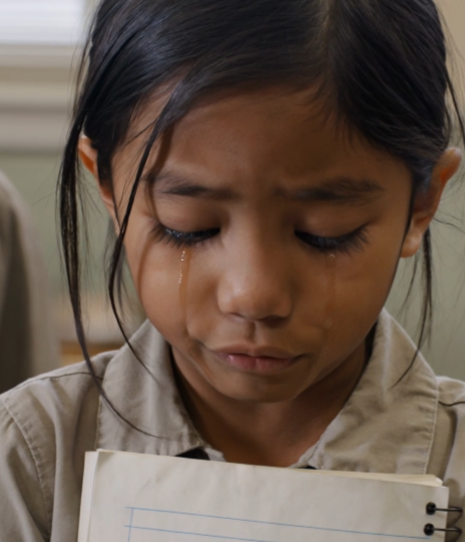
The silence in Room 3B wasn’t the usual quiet of children concentrating; it was a heavy, suffocating stillness that made the air feel thin. Mrs. Gable stood at the front of the class, her gaze fixed not on the chalkboard, but on the floor.
At her side stood Maya, an eight-year-old with a ponytail that was beginning to fray and a sweater that had seen better decades. Maya’s head was bowed so low her chin touched her collarbone. She looked like she wanted the linoleum tiles to open up and swallow her whole.
Mrs. Gable’s eyes were locked onto Maya’s feet. Specifically, her left shoe. It was a scuffed, dusty sneaker, once white but now a tired grey. Near the big toe, a jagged hole had worn through the canvas, revealing a thin, damp sock underneath.
The teacher’s voice was a soft, jagged whisper that cut through the silence like a blade. “Maya, honey… why didn’t you tell your mother your shoes were broken?”
The question hung in the air, vibrating with a tension that made the other students freeze. Several classmates glanced over, their eyes darting from their textbooks to the hole in Maya’s shoe.
In a classroom where most kids wore glowing LED sneakers or brand-name boots, that small hole was a gaping wound of shame. The daylight streaming through the tall windows seemed to act as a spotlight, illuminating every frayed thread and every speck of dirt.
Mrs. Gable stepped closer, her brow furrowed in genuine concern. She was a woman who took pride in knowing her students, yet she felt she had missed something vital. She saw Maya’s knuckles turn white as she clutched her spiral notebook against her chest like a shield.
Maya didn’t look up. Her shoulders began to tremble, a rhythmic shaking that preceded the storm.
A single tear hit the floor, dark against the pale tile. Then another. The camera of human observation zoomed in on her face—the way her lip quivered, the way she bit down on it to try and stop the sob from escaping.
The entire room was a vacuum of sound. No pencils scratching, no chairs creaking. Just the sound of Maya’s shallow, ragged breathing.
Finally, the little girl’s voice broke the silence. It wasn’t a cry; it was a trembling whisper, so fragile it felt like it might shatter.
“I didn’t tell Mommy…” she started, her voice catching in her throat. She took a shuddering breath and looked up, her eyes swimming in a sea of hurt. “…because she cries at night when she can’t buy food for me.”
The words hit the room like a physical blow. Mrs. Gable recoiled slightly, her hand flying to her mouth. The heartbreak on her face was instantaneous, a mask of professional concern melting into raw, human agony.
In the second row, a boy named Leo, known for his loud mouth and expensive gadgets, slowly lowered his eyes to his desk. The teasing comment he’d been preparing died in his throat. The reality of Maya’s world had just collided with their sheltered existence, and the impact was devastating.
Maya wasn’t just talking about shoes. She was talking about a mother who skipped meals so her daughter could have a crust of bread. She was talking about the sound of muffled sobs coming through thin apartment walls.
She was talking about a burden no eight-year-old should ever have to carry.
Mrs. Gable didn’t stay standing. She couldn’t. She slowly sank to her knees, bringing herself down to Maya’s level until they were eye-to-eye.
The teacher’s own eyes were now brimming with tears. She reached out, her hand hovering for a second before she gently placed it on Maya’s trembling shoulder. It was a gesture of solidarity, a promise that the weight was no longer Maya’s to carry alone.
Maya looked up, her tear-stained face searching Mrs. Gable’s for judgment, but finding only an ocean of empathy.
“I didn’t want to make her cry again,” Maya whispered, one last tear rolling down her cheek.
Mrs. Gable pulled her into a quiet, fierce embrace, but as she did, her eyes caught something else—something hidden inside Maya’s notebook that had just fallen open on the floor.
The notebook didn’t contain math homework or spelling words.
As Mrs. Gable reached down to pick it up, her heart stopped. The pages were filled with meticulous drawings of shoes—beautiful, sturdy, colorful shoes. But under each drawing, Maya had written a price, and next to that, a list of chores she had been trying to do around the neighborhood to save pennies.
“Collecting cans – 12 cents,” “Sweeping Mrs. Miller’s porch – 50 cents.”
At the bottom of the page, the total was circled: $4.12.
Maya wasn’t just hiding the truth to protect her mother’s feelings; she was secretly trying to solve the poverty of her household with the strength of a child’s hands.
Mrs. Gable looked from the notebook to the little girl in her arms. She realized that while she was the teacher, she was the one who had just been taught the most profound lesson of her life.
She stood up, holding Maya’s hand, and turned to the class. The atmosphere had shifted from pity to a quiet, burning resolve.
“Class,” Mrs. Gable said, her voice thick with emotion but steady. “We have a lot of work to do. And it doesn’t start with books.”
But the real twist came the next morning. When Maya arrived at school, she didn’t find a new pair of shoes waiting for her. She found something much bigger.
The hallway was lined with boxes. Every parent in the district, moved by a viral post Mrs. Gable had shared (with permission) about the “Secret in the Sole,” had responded.
But it wasn’t a charity drive for Maya. It was a “Community Pantry” established in Maya’s name.
As Maya walked toward her classroom, she saw her mother standing there, talking to the principal. Her mother wasn’t crying. She was wearing a new uniform—the school had hired her as the new coordinator for the student nutrition program.
Maya looked down at her feet. She was wearing brand new, sturdy boots. But more importantly, when she looked at her mother, she saw a smile that finally reached her eyes.
The hole in the shoe had been mended, but the hole in their lives had been filled with something much stronger: a community that refused to let a child cry in the dark.
