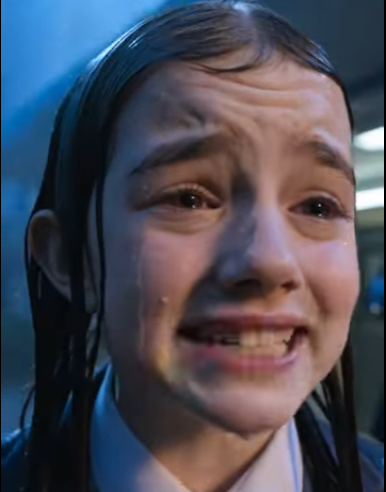
Nobody told them who her father was.
That was their first mistake.
Their second was pulling out their phones.
The rain had started twenty minutes ago — one of those sudden, heavy autumn downpours that arrives without warning and commits completely, turning the world into a dark, wet version of itself in minutes.
Everyone had moved under the awning.
Everyone except Maya.
She stood on the pavement six feet from the covered entrance, her backpack straps gripping her shoulders, her hair plastered flat against her face, the cold water running in continuous streams down her neck and into the collar of her jacket.
She wasn’t standing in the rain because she wanted to.
She was standing in the rain because they had told her to.
Not in those exact words — they were cleverer than that, or thought they were. It had been a series of smaller things. A bag placed in her way. A shoulder that turned. A space that was not quite large enough, and an expression that made the insufficiency of the space very clear.
And so Maya stood in the rain.
And tried not to cry.
And failed.
Her name was Maya Reeves and she was sixteen years old and she had transferred to Lakewood High eleven weeks ago, and in those eleven weeks she had learned, with the comprehensive education of sustained exclusion, exactly how a group of people can make one person feel invisible while simultaneously making them the center of every cruel kind of attention.
The group under the awning numbered seven.
Six of them were watching her.
One of them — Jordan Calloway, seventeen, varsity lacrosse, the particular kind of handsome that had taught him early that the world would organize itself around his preferences — had his phone up.
Horizontal. Recording.
He had been recording for four minutes.
“Keep recording,” he said to the girl beside him, passing the phone without lowering it. “This is too funny.”
Laughter. The kind that needs an audience and feeds on itself.
Maya kept her eyes on the pavement.
Don’t react. Don’t react. Don’t give them the reaction.
But the rain kept coming.
And her hair kept dripping.
And the laughter kept coming too.
The camera — because there were now three phones up, not one — found her face and zoomed in with the particular cruelty of technology that allows people to humiliate at distance.
Maya looked up.
This was her mistake, and she knew it was a mistake the moment she did it — looked up directly into the lenses, into the grinning faces behind them, and let them see what her face was doing.
She couldn’t help it.
“Please,” she said.
Her voice came out smaller than she intended. Younger.
“Please don’t do this.”
She hated how it sounded. Hated the please. Hated that her chin was shaking.
“My dad is coming,” she said. “He’s coming right now.”
The laughter didn’t stop.
It got louder.
Jordan lowered his phone slightly — not to stop recording, but to deliver the next line at full volume for the benefit of the recording.
“Yeah right,” he said. Grinning. Performing. Sixteen years of unchallenged confidence compressed into six words. “Let’s see your hero dad.“
More laughter.
Someone made a sound. A mock-heroic sound, like a movie trailer voice.
Maya’s hands were shaking now.
Not from cold.
She reached into her jacket pocket and looked at her phone screen — the last message, sent seven minutes ago:
On my way. Ten minutes. Stay where you are.
She closed her phone.
Ten minutes.
She could last ten minutes.
She looked back at the pavement and she breathed and she counted the raindrops hitting the concrete and she did not — she absolutely did not — let herself think about how the video was going to look, how many people were going to see it, how she was going to walk into school Monday morning and whether it would be worse than today or exactly as bad or something she didn’t have a category for yet.
She just breathed.
And counted.
And waited.
The headlights came first.
A sweep of white light across the wet pavement — the kind of bright that cuts through rain, that makes the water on the ground suddenly visible in a thousand individual drops — moving in a fast arc as the car turned into the school drive.
Then the sound.
A black car. Not flashy. Not the ostentatious signal of someone who needed the exterior world to know they had money. Just dark and clean and moving with a kind of purposeful speed that suggested the person driving it had decided, some time ago, exactly how fast they were going to travel and had not deviated.
It stopped at the curb.
Sharp. No hesitation.
The engine cut.
Under the awning, the laughter faded.
Not all at once — it wound down in stages, Jordan’s trailing last, because he was the kind of person who needed a moment longer than everyone else to read a room, having spent most of his life in rooms that adjusted themselves to him rather than the reverse.
The driver’s door opened.
He was not what they expected.
They had expected — if they’d thought about it at all, which most of them hadn’t — something ordinary. A father in office clothes. A dad. Someone who would jog through the rain looking slightly embarrassed, holding a jacket over his head, calling Maya’s name in a way that would provide its own secondary source of entertainment.
What stepped out of the car was not that.
Marcus Reeves was forty-three years old and had spent fourteen of those years in occupations that had shaped his body and his bearing and his relationship to danger into something that was immediately, physically legible to anyone paying attention.
He was tall. The fitted dark jacket he wore did nothing to minimize this.
He stepped out of the car and he did not jog.
He did not look at the awning.
He did not look at the phones, several of which were still technically raised, though the hands holding them had gone uncertain.
He walked through the rain — directly through it, without any adjustment to his pace or his posture, as if the rain had made a decision about where to fall and he had made a different decision entirely and he was simply more committed to his — and he walked straight to his daughter.
He stopped in front of her.
His face, for a moment, was only for her.
And what it showed — underneath the jaw that was set and the eyes that were doing something that people under the awning would later struggle to describe accurately — was something that Maya saw and nobody else did.
I’m here. I’ve got you. I’m sorry it took ten minutes.
He said none of this.
He shrugged off his jacket.
He placed it across her shoulders, both hands settling it carefully, making sure it covered her properly.
Maya grabbed the lapels and pulled it closed and looked at her father and — she had promised herself she wouldn’t, had held it the entire time, through all of it — she put her face against his chest and cried for real.
Not the rain-muffled, trying-not-to version.
The real kind. The kind that had been waiting.
His hand came up to the back of her head.
One second. Two.
And then he turned.
He turned to face the awning.
He didn’t move toward it. Didn’t need to.
He simply turned, and the full weight of his attention moved across the group of seven teenagers like weather.
Phones came down.
Every single one of them.
Not because anyone said to put them down. Not because anyone made a move toward them. Simply because the decision to keep them up suddenly seemed — in the new atmosphere, in the altered air — like an option that was no longer rationally available.
Jordan Calloway, who had not been nervous in a very long time, was looking at the pavement.
Marcus looked at the group.
At their faces. At the phones now held at their sides. At the space where, a moment ago, there had been laughter.
When he spoke, his voice was not loud.
It didn’t need to be.
The rain was loud. His voice didn’t compete with it.
It simply arrived — deep, and even, and carrying the weight of a man who said things once.
“Who touched my daughter?”
Nobody answered.
Of course nobody answered.
Seven teenagers stood under an awning in the absolute silence of a question that had made the evening reorganize itself around it, and not one of them said a word or moved or breathed in a way that called attention to themselves.
Jordan was still looking at the pavement.
Marcus held the silence for five full seconds.
He was not in a hurry.
He had waited ten minutes.
He could wait longer.
And in the waiting, in the specific quality of the stillness he was holding, every person under that awning understood — completely, physically, in a way that they would feel in their chests for a long time after this evening — that the question was not rhetorical.
It had an answer.
And the answer had consequences.
And whoever had been recording this would want to consider, very carefully, exactly how much of the footage they wanted to keep.
The rain fell.
The lights of the school reflected off the wet pavement.
And Marcus Reeves stood in the rain with his jacket around his daughter’s shoulders and waited for someone to be brave enough.
Nobody was.
Not yet.
But the night was young.
And he was very, very patient.
