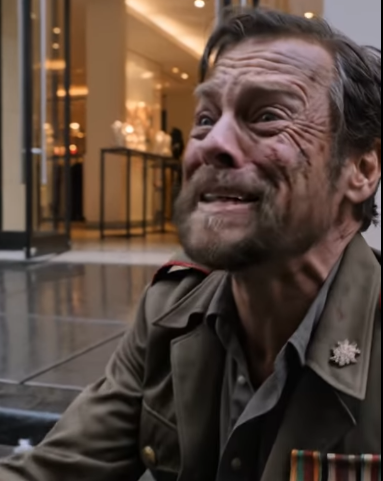
Nobody expected the General to break.
Least of all in front of four hundred witnesses, three open bars, and enough recording devices to ensure that whatever happened next would outlive everyone in the room.
The Whitmore Foundation Gala was the kind of event that existed to celebrate order — the careful, inherited order of people who had always had things arranged exactly as they preferred them. Black tie. Assigned seating. A string quartet playing something approved and unobtrusive in the corner. Chandeliers throwing their hard, expensive light across two decades of military commendations, political connections, and the particular social architecture of people who had confused proximity to power with the possession of it.
General Arthur Whitmore had built this world.
Tonight, he was about to detonate it.
Elena Vasquez had been standing near the third pillar from the east wall — not hiding, exactly, but occupying the specific margin of a room that people occupy when they are present out of obligation and surviving through careful stillness.
She was twenty-six. She wore a midnight blue gown that had cost her three months of saving and had been worth it for approximately the first twenty minutes of the evening, before the weight of being in this room had settled across her shoulders like something physical.
She had a glass of water she wasn’t drinking.
She was watching the room with the measured attention of someone who has learned, through specific and unpleasant experience, that the room is always worth watching.
She did not see him coming.
Nobody did, not really — or if they did, they assumed, the way people at events like this always assume, that whatever the General was doing had a reasonable explanation and would resolve itself into something appropriate in a moment.
He crossed the ballroom floor in twelve steps.
She saw him at step nine.
She had exactly three seconds to register his face — crimson, jaw set, eyes carrying the specific fury of a man who has decided that the normal rules of public behavior no longer apply to this particular situation — before his hand closed around her arm.
The grab was violent.
There was no other word for it — no diplomatic softening available, no interpretation that made it something else.
His hand locked around her upper arm and he yanked, and Elena came away from the pillar like something uprooted, stumbling sideways, her heel catching the edge of the parquet floor wrong, and then she was going down and the row of gilded chairs was there and she hit them — her shoulder catching the first one, the impact radiating up through her collarbone, chairs clattering apart in a sound that cut through the string quartet like a gunshot.
The room stopped.
Then it exploded.
Gasps — the involuntary, overlapping kind that meant genuine shock in a room full of people who had spent decades performing the more curated version. Then voices, multiple and simultaneous, and then — immediately, reflexively, the specific modern instinct that now accompanies every witnessed catastrophe — phones.
Screens lit up across the ballroom like a field of small fires.
The chandelier light caught them all.
Elena was on the floor, surrounded by toppled chairs, her hand going immediately to her shoulder, her breath coming in hard pulls that she was fighting to control because she would not — she had decided this in a flash of absolute clarity even as she was falling — she would not give him the satisfaction of hearing her make a sound.
The General stood above her.
His chest was heaving.
His medals caught the chandelier light with every breath — four rows of them, each one representing something, a campaign or a commendation or a moment someone had decided was worth commemorating in metal.
They looked very heavy suddenly.
“You have no idea,” he said, his voice shaking with the effort of compression, “what you’ve done.”
He reached for her again.
“Don’t.“
The word came from the left.
One syllable. Quiet enough that it shouldn’t have carried over the noise of the room.
But it did.
Lieutenant James Calloway was twenty-nine years old and had been stationed under General Whitmore’s command for three years, and in three years he had learned, with the comprehensive education of sustained proximity, exactly who Arthur Whitmore was.
He also knew who Elena Vasquez was.
He stepped between them.
It was not a dramatic movement. No raised hands, no fighting stance, no performance for the phones that were pointed at all of them from every direction. He simply moved his body into the space between the General and the woman on the floor, and stood there.
The two men were eighteen inches apart.
The General was sixty-one years old, decorated, silver-haired, with the physical authority of a man who had spent four decades being obeyed.
James was twenty-nine years old, lean, and completely still.
“Step back, Lieutenant.” The General’s voice had dropped into the register he used for commands — the one that had ended arguments and redirected careers and generally functioned as a kind of sonic architecture that organized the world around him into compliance.
“No, sir,” James said.
The word sir carrying, in this context, something that was simultaneously respectful and absolute.
The General’s jaw tightened.
He turned to the crowd — the sea of silk and black tie and phone screens — and raised his voice.
“Everyone put those away. Now. This is a private family matter and I will not have it—”
Nobody put their phone away.
Nobody moved at all, except to shift their angle slightly, because everyone in that room understood, with the collective instinct of people who have spent their lives reading rooms, that whatever this was, it was not over.
And whatever it was, it was not private.
The double doors at the end of the ballroom slammed open.
Four security personnel came through them fast — not running, but the controlled, purposeful movement of people trained to cover ground quickly while projecting calm. They spread across the room’s perimeter with the practiced efficiency of a choreography they’d rehearsed but hoped never to use.
The lead security officer — a woman in a black blazer who moved like someone who had handled worse than this and documented all of it — reached the General in seconds.
“Sir, I need you to step back and lower your voice.”
“Do you know who I am?”
“Yes, sir. I need you to step back.”
Elena had gotten to her feet.
Nobody helped her — or rather, by the time anyone moved to help her, she was already up, which was characteristic, though nobody in this room knew that about her except James, who had seen it before.
She stood with her hand pressed to her shoulder, her gown slightly torn at the left seam, her hair displaced, and she looked at the General with an expression that was not — despite everything that had just happened — afraid.
It was something more complicated than fear.
It was the expression of someone who has been waiting, for a very long time, for a moment that has finally arrived.
“Tell them,” she said.
Her voice was steady.
Steadier than his. Steadier than the room.
“Tell all of them. Right now, while everyone’s watching. Tell them why you’re so angry.”
The General’s face worked through several configurations.
The crowd leaned in — four hundred people, collectively, imperceptibly, like a tide responding to something it didn’t understand yet but felt.
“Elena—”
“Tell them,” she said again. “Tell them what you found in the study. Tell them what my mother kept. Tell them what she told you before she died.”
The room was very quiet now.
The phones were still up, still recording, but the people holding them had forgotten, temporarily, that they were holding them.
The General’s medals caught the light.
His mouth opened.
Closed.
He looked — for the first time in a career built on the absolute and visible certainty of a man who has never needed to doubt himself — he looked lost.
And in that lostness, the room saw something shift.
Something enormous.
James stepped slightly to the side so that the space between Elena and the General was clear.
Elena reached into the small clutch bag she had somehow held onto through all of it.
She removed a single envelope. Old — the paper yellowed at the edges, the handwriting on the front faded but legible.
She held it up.
The General saw it.
And the crimson left his face entirely.
What replaced it was something nobody in that room had ever seen on Arthur Whitmore’s face in thirty years of public life — not at press conferences or hearings or the funerals of people he had outlasted.
Something that looked, unmistakably, like grief.
“She told you,” he said. Barely a whisper. “She actually told you.”
“She wrote it down,” Elena said. “Everything. Years ago. And she gave it to me six months before she died.”
She paused.
“She gave it to me because I’m your daughter, Arthur.”
The chandelier light held everything perfectly still.
Four hundred witnesses.
Every phone recording.
A man in four rows of medals, completely undone.
And a young woman in a torn blue gown, standing in the wreckage he had made, finally — finally — no longer invisible.
The envelope in her hand.
His whole life on the other side of it.
5 Clickable Viral Titles
- A Decorated General Attacked a Young Woman at a Gala in Front of 400 Guests — When She Pulled Out the Envelope, He Fell Apart
- Everyone Filmed as He Grabbed Her and Threw Her Into the Chairs — No One Knew Who She Really Was to Him
- He Built His Entire Legacy on One Secret — She Walked Into His Gala With the Proof in Her Hands
- He Told the Crowd It Was a Private Family Matter — She Looked Him in the Eye and Said “Then Tell Them the Truth”
- The General Thought He Could Silence Her in Public — He Had No Idea What She Was Holding in That Envelope
Write a highly engaging emotional story in fluent natural English based on the following prompt: [Ultra-realistic cinematic viral emotional street drama, 15 seconds, vertical 9:16, one continuous shot, no cuts, intense handheld camera, sharp focus, high contrast, dramatic motion blur, ultra-detailed facial expressions, 4K hyper-realistic live action, extreme emotion, crying, shouting, fast crowd reactions, sunset luxury shopping street, warm boutique lights reflecting on wet pavement. The video opens instantly with raw emotional impact: a very old war veteran sits collapsed on the freezing pavement at the entrance of a luxury boutique. His face is extremely dirty, covered with dust, tear streaks, and deep wrinkles, his beard messy and untrimmed, clothes torn, stained with mud and street dirt, old military coat hanging heavily from his thin body, covered in faded medals that still glimmer under the golden lights. His hands shake violently as he reaches out and cries in a broken voice, “Please… I’m hungry… please help me…” The camera violently rushes into an extreme close-up of his filthy tear-covered face, showing trembling lips, wet eyes, and tears rolling through the dirt on his cheeks. Suddenly, a small child, about 5 years old, breaks away from his mother and runs fast through the crowd toward the veteran. The camera follows in a sharp handheld rush. The mother screams emotionally in English, “Wait! Stop!”] Requirements: – Story length: exactly around 1500 words – Write in clear, fluent, native-level English – Make the story emotionally intense and highly engaging from the first paragraph – Use a strong hook in the opening lines to instantly grab attention – Build suspense and curiosity throughout the story – Add vivid descriptions, realistic dialogue, and strong emotions – The pacing should keep readers interested until the final sentence – End with a powerful emotional twist or surprising ending – The story should feel cinematic and highly shareable for social media audiences – Write in a storytelling style suitable for Facebook reels / viral story pages – Use short paragraphs for better readability – Make every section end with curiosity so readers continue reading After writing the story, provide 5 highly clickable viral titles in English. The titles must be emotional, curiosity-driven, and optimized for high CTR on social media. Style examples for titles: – He Humiliated the New Kid… But He Had No Idea Who He Really Was – Everyone Laughed at Her Until the Truth Came Out – They Thought He Was Weak… Until This Happened Return the result in this format: 1) Story 2) 5 Clickable Titles Tags: crying child in first second, funeral heartbreak, little girl at grave, emotional loss, viral tearjerker, family tragedy The child kneels immediately in front of the old man, holding warm bread with both hands, almost crying, and says with trembling voice, “Please take mine… you need it more.” The old veteran freezes, his eyes widen in shock, then instantly fills with tears. He begins to cry openly, voice shaking: “No one… no one looked at me all day…” The camera sharply pans across the crowd: shocked faces, people stopping suddenly, one woman begins crying and says loudly, “Oh my God…” A wealthy man suddenly rushes forward, pulling money from his wallet: “Someone help this man now!” Instant chain reaction — people quickly gather around, voices overlapping: “Give him water!” “Call someone!” “Take this!” “Here, sir!” Bills rapidly fall onto the pavement one after another, shopping bags placed beside him, people kneeling, some crying. The mother runs in, tears in her eyes, pulls the child close while the child hugs the old veteran tightly. The veteran breaks down in tears, voice trembling and emotional: “You reminded them what kindness looks like…”Show more
20:07
The Boy Who Stopped a Street
Nobody stopped.
That was the thing that would stay with everyone who witnessed it — not the ending, not the tears, not the bills falling like paper snow onto the wet pavement — but the beginning. The long, ordinary, terrible beginning, when a street full of people in good coats with warm places to be looked at an old man on the ground and kept walking.
Nobody stopped.
Until a five-year-old boy did.
His name was Henry.
He was wearing a red wool hat that kept sliding down over his left eye and a coat his grandmother had chosen because it was practical and he had tolerated because it was warm, and he was holding a piece of bread his mother had bought him from the bakery three doors down — still warm, wrapped in white paper, the smell of it extraordinary in the cold evening air.
He was eating it in small, careful bites the way his mother had taught him, making it last, watching the shop windows with the specific intensity of a five-year-old who has been promised they are almost done shopping and is choosing to believe this.
He was happy.
It was a simple, complete happiness — the kind that exists before the world has taught you to complicate it — and it lasted until the moment he saw the old man on the ground.
He was sitting collapsed against the stone facade of the boutique like something that had simply run out of whatever was holding it upright.
The golden light from the shop window fell across him in a way that seemed almost deliberately cruel — warm and beautiful and completely indifferent to what it was illuminating.
His coat was military, dark beneath the layers of street dirt, the brass buttons dulled but still there. Medals across the chest — rows of them, faded and tarnished, but catching the boutique light in small, stubborn flickers. His hands were in his lap, shaking with a tremor that wasn’t from cold, or not only from cold. His beard was heavy and unkempt. His face was mapped with wrinkles deep as carvings, and across those wrinkles — through the dust and the grime and the particular exhausted weathering of a man who had been outside in all seasons for longer than most people spent inside —
Tears.
Clean tracks through the dirt. The only clean thing about him.
His lips were moving.
And then his voice — broken, barely there, a sound that had clearly been produced many times that day with decreasing hope of being heard:
“Please… I’m hungry… please help me…”
The crowd moved around him.
Not cruelly — nobody sneered, nobody stepped over him deliberately. They simply navigated around him the way water navigates around a stone, adjusting their path with the efficient, unseeing courtesy of people who have somewhere to be and have learned, through the specific education of city living, not to look directly at certain things.
The boutique door opened and closed.
Heels on wet pavement.
A laugh from somewhere nearby.
The old man’s hands kept shaking.
And Henry stopped walking.
He stopped so suddenly that his mother, one step behind him, nearly walked into him.
“Henry—”
But he was already turning his head, already locating the source of the voice that had reached him in a way it hadn’t reached the twenty people between him and the boutique, and his face — his open, unguarded, five-year-old face — was doing something that his mother would spend years trying to describe accurately.
Not pity. Pity was too complicated for five years old, too layered with self-awareness.
Something simpler.
He saw a person hurting, and he felt it.
Directly. Immediately. Without the buffer of adult composure.
He felt it, and then he ran.
“Wait! Stop!“
His mother’s voice broke across the crowd, sharp with the specific panic of a parent whose child has suddenly entered a gap in the perimeter — not the distant danger panic, but the close, lurching kind that makes your heart arrive in your throat before your body has finished processing.
She moved after him, heels on wet pavement, shopping bags swinging.
But Henry was fast.
He was always fast — had been running before he’d fully mastered walking, had skipped several intermediate stages of childhood locomotion in his impatience to cover ground — and he covered it now, threading through legs and shopping bags and the slow-moving current of the evening crowd with the instinctive navigation of someone too small to be impeded by the same things that impede larger people.
He reached the old man.
He dropped to his knees.
Right there on the wet pavement, on the cold stone, in the good coat his grandmother had chosen, with the shopping from three stores in bags somewhere behind him and his red wool hat sliding down over his left eye again.
He knelt in front of the old man, and he held out the bread.
Both hands. Warm paper wrapping. Steam still rising faintly in the cold air.
His own voice was not entirely steady.
“Please take mine.”
A breath.
“You need it more.”
The old man stared at him.
For a moment, nothing moved.
Not the old man. Not Henry. Not — and this was the thing that happened first, before anyone fully registered it had happened — not the people immediately surrounding them, who had stopped, one by one, like a slow chain reaction of attention finally, finally being paid.
The old man’s eyes — pale blue, rheumy, the eyes of someone who had looked at a great many things across a great many years — went to the bread.
Then to the boy’s face.
Something traveled through the old man’s expression. Something enormous and slow, like weather moving across a landscape.
And then he broke.
Not quietly.
Openly — the kind of crying that happens when a person has been holding something compressed for so long that when it goes, it goes completely, with sound and with shaking and with the absolute inability to stop or manage or present any version of it that is easier for bystanders to witness.
“No one,” he said, his voice fractured, barely functional. “No one looked at me. All day.”
He put his face in his shaking hands.
“All day. No one looked.”
One woman made a sound.
It came from somewhere in the growing ring of people — not a word, just a sound, involuntary, the kind that escapes when something bypasses the filters and lands directly.
“Oh my God,” she said, and she was crying already, before she’d finished the sentence. “Oh my God.“
A man in a dark overcoat — the kind of coat that announces, without needing to announce, that its owner has not thought about money in a long time — pushed through to the front of the crowd. His hand was already in his wallet.
“Someone help this man,” he said. His voice was loud and directed at no one and everyone. “Someone help him now.“
He pulled bills without counting them and pressed them toward the old man’s lap.
Then it happened.
The chain reaction that nobody planned and everyone participated in — the spontaneous, stumbling, beautiful collective response of a crowd that has been reminded, by one small boy in a red wool hat, that it is made of people.
“Give him water — does anyone have water?”
“Here, sir. Please, here—”
“Take this. Take whatever you need.”
“Call someone — is there a shelter nearby, does anyone know—”
Shopping bags placed carefully beside him. Scarves removed from necks. Bills — more bills, from multiple wallets, from people who were not wealthy and people who were — falling onto the wet pavement in a slow, accumulating pile.
People kneeling.
On a luxury shopping street, in good clothes, on cold wet stone, kneeling.
Some of them crying.
Most of them not entirely sure why, except that something had cracked open in the evening, and what was inside it was something they recognized.
Henry’s mother reached him.
She came through the last gap in the crowd and found her son exactly where she’d been afraid to find him — right there, right in the middle of it — and she dropped to her knees behind him and wrapped her arms around him from behind, and she pulled him close.
Henry let himself be pulled.
But he kept one hand outstretched.
Resting on the old man’s arm.
The old veteran looked at the hand on his arm. Then at the boy. Then at the mother behind him, her face wet, her expression the compound thing that only mothers have — the relief and the love and the pride and the complicated, aching recognition of watching your child be more than you managed to teach them.
He looked at all of it.
The crowd around him, kneeling and standing and pressing things into his hands and speaking over each other in the urgent, overlapping way of people trying to do quickly what they should have done hours ago.
The bread, still in his other hand.
Still warm.
He closed his fingers around it.
When he spoke, his voice was still shaking.
It would probably shake for a while.
“You,” he said to Henry.
Henry looked up at him with his red hat over his left eye and the absolute, uncomplicated attention of a child who has done what seemed obvious and doesn’t understand yet why everyone is reacting as though it wasn’t.
The old man’s medals caught the boutique light.
“You reminded them,” he said, “what kindness looks like.”
The evening held them all for one more second.
The crowd. The kneeling strangers. The falling bills. The shopping bags and the scarves and the water bottles and the overlapping voices of a street that had, sixty seconds ago, been walking past.
A small boy in a red wool hat.
An old soldier who had not been looked at all day.
And the bread — warm, ordinary, extraordinary — that had passed between them and changed the temperature of an entire street.
Some things don’t need teaching.
They just need remembering.
And sometimes it takes five years old to do it.
