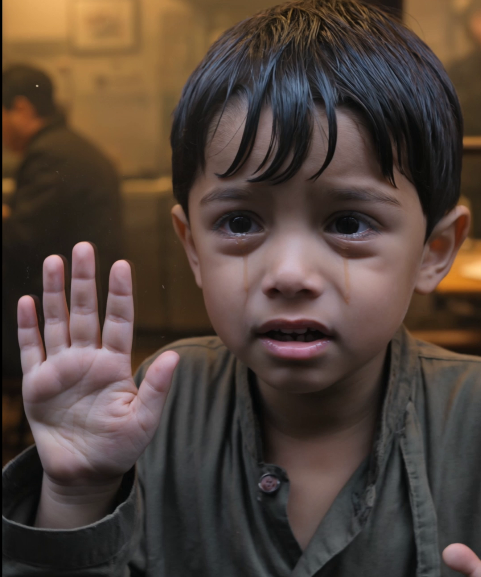
That was the worst part — not the cold, not the rain, not the smell of food drifting through the gap under the door like a slow kind of torture. The worst part was that the world he was pressed against was right there, separated from him by nothing more than one inch of glass, blazing with warmth and noise and plates full of things he couldn’t name, and not one person inside had looked up long enough to see him.
His name was Mateo. He was six years old.
And he was so hungry it had stopped feeling like hunger and started feeling like something else — something hollow and permanent, like a room with no furniture and no promise of any.
The restaurant was called Fiore, and on a rainy Wednesday evening it was precisely the kind of place that made the outside feel more outside by comparison. Warm amber light pressed against the windows from within. Candles on tables. The sound of silverware and conversation bleeding softly through the glass — not loud enough to make out words, just loud enough to know that good things were happening in there, that people were together and fed and warm.
Mateo had been standing at the window for eleven minutes.
He’d counted to sixty. Eleven times. It was the only way he knew to measure things.
His hand went to the glass.
The cold of it moved through his palm immediately — but he kept it there, pressed flat, fingers spread, as though contact with the warmth on the other side might travel backward somehow, might reach him through the physics of wanting badly enough.
His breath fogged the glass.
Through the fog, a woman cut into a piece of meat. Steam rose from the plate. A child — maybe his age, maybe younger — was eating bread without thinking about it, the way you eat things when eating is just a thing that happens to you rather than a thing you’re desperately trying to make happen.
Mateo’s throat moved. He tried to swallow.
There was nothing to swallow.
His hand slid down the glass, slowly, leaving a long streak in the condensation.
He whispered — not to anyone, just into the cold because there was nowhere else to put it:
“Please. I’m so hungry.”
Inside, the kitchen was controlled chaos — the beautiful, practiced kind, where every collision has a purpose and every raised voice is really just emphasis. Chef Marco Reyes had been running the kitchen at Fiore for nine years. He’d seen most things from back there. Burnt orders, difficult customers, a waiter fainting on a Friday night, a fire that turned out to be a very dramatic crêpe.
He hadn’t seen what his sous-chef said quietly in his ear at 7:43 PM.
“Marco. There’s a kid outside. Been there a while. He’s—” a pause, the particular pause of someone choosing words carefully, “—you should just look.”
Marco looked through the small pass window that faced the dining room and, beyond it, the street-facing glass.
He saw the streak first.
Then he saw what had made it.
He was outside in forty seconds.
The tray was heavy — he’d loaded it fast, instinctively, the way you act when thinking too long would give doubt a chance to get involved. Bread. Soup, still steaming. A plate of pasta. A cup of warm chocolate. Things that were ready, things that would stay warm, things that a child could eat.
The kitchen door slammed behind him.
The cold hit him immediately. The rain was light but persistent, the kind that soaks you slowly and politely and doesn’t apologize.
Mateo hadn’t heard him coming — he was still facing the glass, still watching the family inside, locked into the world on the other side with the focus of someone who has learned that watching is the closest available substitute for having.
Marco dropped to one knee on the wet pavement.
Eye level. Always eye level. His mother had taught him that.
“Hey.”
Mateo went very still.
“Hey. Come here.” Marco set the tray on the ground between them. “This is for you.”
The boy didn’t turn immediately.
He stayed facing the glass for a long moment — and if you understood anything about what a six-year-old learns when the world has been unpredictable, you understood why. Because turning around meant believing it. And believing something that turned out to not be real was a specific kind of pain he’d already learned by heart.
So he waited one breath. Then another.
Then he turned.
He looked at Marco. Then at the tray. Then at Marco again.
His breathing was audible — shallow and uneven, the aftermath of a long time trying to hold something together.
He didn’t reach for the food.
Not yet.
Inside Fiore, a woman at the window table had been watching.
She’d noticed the boy four minutes ago — had noticed the streak, had noticed the posture, had noticed the particular stillness of a child who has gone quiet in the way children go quiet when noise has stopped being useful. She’d been trying to decide what to do about the feeling in her chest since then.
When she saw the chef go to his knee on the pavement outside, something in her simply resolved.
She stood. Grabbed her plate. Pushed through the door.
The rain hit her immediately. She didn’t go back for her coat.
She knelt beside the tray and set her plate down next to it — a piece of roasted chicken, half a portion of roasted vegetables, bread she hadn’t touched.
“Here, sweetheart,” she said. Just that.
A man at the adjacent table watched her go through the glass. He looked at his plate. He looked at his companion. He picked up his bread basket and went outside.
Then a couple near the back.
Then a teenager who’d been sitting alone with a book.
Then more.
It happened in under two minutes.
The wet pavement around Mateo became something else — covered in plates and cups and bread and small containers of soup, hands setting things down gently and then stepping back, not wanting to crowd him, not wanting to make it feel like something he had to perform gratitude for.
The street had gone quiet. Even the rain seemed to ease slightly, or maybe it just stopped mattering.
Mateo looked at the food surrounding him.
Then at the people.
Then up at the window, where more faces were watching from inside — warm and lit and leaning toward the glass.
His face did something complicated that wasn’t quite crying and wasn’t quite smiling and was more honest than either.
When he spoke, his voice cracked clean down the middle.
“Why — why are you helping me?”
Marco opened his mouth to answer.
And the voice came from behind them all like something thrown.
“WHAT ARE YOU DOING?!”
Every head turned.
“WHO TOLD YOU TO FEED HIM?!”
The man was big — wide through the shoulders, moving fast, his face doing the particular thing that anger does when it’s covering something it doesn’t want examined. He was wearing a work jacket, steel-toed boots, three days of unshaven face. He came across the pavement like weather.
Mateo flinched.
The full-body flinch of a child who has learned the specific geometry of incoming.
The man grabbed the boy’s arm — not gently, not carefully, the way you grab something you’re afraid of losing.
“I told you not to beg.” His voice had dropped from a shout to something lower and in some ways worse. “You embarrass me. You understand that? You embarrass me.”
Mateo’s face had closed. The tears, the fragile opening toward the strangers and their plates and their inexplicable kindness — all of it shuttered. What replaced it was something practiced and automatic: the expression of a child who has learned to take up less space.
The food sat on the pavement, steaming quietly in the rain.
Marco stood up.
Slowly. Deliberately. To his full height.
He looked at the man — really looked, the way you look at something when you’re deciding what it actually is, underneath the noise and the posture and the volume.
And he saw it.
The eyes. Red-rimmed. The jaw working. The way the man’s hand on Mateo’s arm was gripping, yes — but also, in a terrible and complicated way, holding on.
The jacket. The boots. The three days of face that spoke of shifts and exhaustion and something running out.
The shame.
Not the cruelty of a man who didn’t love his child.
The shame of a man who did — desperately, imperfectly, in ways that were breaking both of them — and who had just watched strangers do in two minutes what he hadn’t been able to do in weeks.
Marco didn’t raise his voice.
He picked up the tray from the pavement.
And he held it out — not toward Mateo.
Toward the father.
“Come inside,” he said quietly. “Both of you. Sit down.” A beat. “Nobody has to go hungry tonight.”
The man’s jaw worked. The grip on Mateo’s arm shifted — loosened — became something less like a grab and more like a hand holding a hand.
Mateo looked up at his father.
His father looked at the tray, at the door, at the faces watching from inside the warm and golden room.
For a long moment, the rain was the only sound.
Then, slowly, a big man’s shoulders came down from around his ears.
And a small boy felt his father’s hand, finally, hold his gently.
