Because of what the girl did after she picked it up.
But that part comes last. First, you need to understand what they did to her — and why every single person who stood there and watched without moving would spend the rest of their lives wishing they had done something different.
Her name was Anna.
Twenty-three years old. The daughter of a schoolteacher from a small town whose name didn’t impress anyone at this wedding. She had good hands — the kind that had done real work, that had learned early how to hold things carefully and how to let things go — and dark eyes that her fiancé had told her, on the night he proposed, were the most honest eyes he had ever looked into.
She had believed him.
She had believed a lot of things.
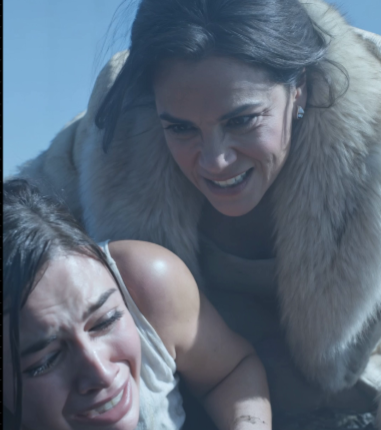
She was kneeling in the mud at the edge of the estate’s east garden, in a wedding dress that had cost her four months of savings, with her hands pressed into the cold earth and Margaux Vane standing over her like weather — like the kind of weather that has decided, in advance, that it does not care what it destroys.
Margaux Vane was fifty-four years old and had been the most feared woman in her social circle for so long that she had stopped noticing it, the way you stop noticing the sound of a clock you’ve lived with for years.
Her fur coat was dark and full and absolutely immaculate despite the mud around them — because Margaux Vane had spent five decades learning exactly how close she could stand to mess without being touched by it.
She had the face of a woman who had been beautiful and knew it and had decided, somewhere in her forties, that beauty was a tool she’d already extracted maximum value from and had moved on to sharper instruments.
She was looking down at Anna with the particular contempt that requires a long time to develop — not the hot contempt of anger, but the cold contempt of someone who has simply decided that another person does not merit the basic courtesies extended to full human beings.
She had decided this about Anna on the day they met.
She had been waiting, with enormous patience, for an opportunity to make that decision visible.
Today, she had manufactured one.
The ring had been in Anna’s hand.
She had been holding it — both hands, the way you hold something precious and borrowed, the way you hold something that isn’t yours yet but might be, the way you hold hope when hope has a physical form — and Margaux had stepped close, too close, close enough that Anna could smell the perfume, and Margaux’s hand had come forward.
Not to take the ring.
To flick it.
A single, sharp, precise movement — the gesture of someone discarding something without value — and the ring left Anna’s palm and hit the mud with a flat, conclusive sound.
Mud splattered upward.
Caught Anna’s cheek. Her lips. Cold and gritty and tasting of clay and something dark.
Anna stayed still.
She stayed still the way prey stays still — not from calm, not from courage, but from the overwhelming input of a moment that the body doesn’t know how to process and so simply freezes, suspended in the half-second before the next thing happens.
Margaux leaned down.
Into her space. Into the air she was breathing.
“You think you deserve gold?”
Her voice was not loud.
It didn’t need to be. Volume was a tool for people who lacked precision, and Margaux Vane was nothing if not precise.
“Pick it up, pig.”
The ring was sinking.
Slowly — the mud was thick, almost viscous with the recent rain, and the ring settled into it with the terrible patience of something being swallowed. The gold was still visible. A small bright circle, growing smaller, descending into the dark earth one millimeter at a time.
Anna was looking at it.
“Please,” she whispered. The word came out already broken, already inadequate for what she needed it to do. “Please. Please don’t—”
“Pick. It. Up.”
Each word a separate sentence. A separate verdict.
Anna’s hand moved.
She watched it move — watched her own hand reach toward the mud with the dissociated clarity of someone in shock, someone observing themselves from a slight distance, someone thinking: this is happening, this is real, this is my wedding day.
Her fingers went into the mud.
Cold. Thick. The earth closing around her hand with the indifferent intimacy of something that does not distinguish between the valuable and the worthless, the chosen and the discarded.
She found the ring.
She closed her fingers around it.
And then she stopped.
She stopped because of a sound.
Not from Margaux. Not from the garden around them, the cold and indifferent garden with its frozen flowerbeds and its bare trees and its absolute silence.
From above.
A window.
The east wing, second floor. She knew the room — it was the one that looked out over this garden, the one she had stood in three months ago when she’d first come to the estate, looking down at the garden and thinking, I could learn to love this place.
The window was open.
And there was someone at it.
She couldn’t see his face from here.
She knew the shape. The height. The particular way he held his shoulders that she had memorized without meaning to, the way you memorize the geography of someone you love.
Oliver Vane.
Her fiancé.
The man who had told her she had the most honest eyes he’d ever seen.
He was standing at the window.
Looking down.
He had been there — she understood now, with a clarity that arrived like cold water — for long enough to have seen all of it. The ring. The mud. His mother leaning into her space. The word she had used.
He was watching.
And he wasn’t moving.
Anna’s hand came out of the mud.
The ring was in her palm, dark with earth, the gold barely visible.
She stood.
She did it slowly — not from weakness, not from the heaviness of the dress or the cold of the mud on her hands and knees — but with the deliberate steadiness of someone who is thinking very carefully about what they are about to do.
She stood until she was fully upright.
Until she was facing Margaux.
Eye to eye, for the first time since this started. Equal height, despite the dress, despite the mud, despite everything — just two people standing in a garden in January.
Margaux held out her hand.
The hand that expected the ring.
Anna looked at it.
She looked at it for a long moment.
Then she looked up at the window.
Oliver was still there.
Still watching.
Still not moving.
Something in Anna’s face changed.
Not into anger — not the hot, reactive kind that Margaux would have known how to handle. Something colder and more permanent. The expression of a woman who has just finished doing an accounting and has arrived at a sum she cannot argue with.
She closed her fingers around the ring.
“No,” she said.
One word. Quiet. Completely steady.
Margaux blinked.
“Excuse me?”
“No.” Anna’s hand went not toward Margaux, but to her own dress — to the small inner pocket sewn into the seam that she had chosen specifically because she’d needed somewhere to put her own ring, her grandmother’s ring, the one she’d planned to give to Oliver as her own vow.
She placed Margaux’s ring inside it.
Then she reached into the pocket and took out her grandmother’s ring — plain silver, worn smooth at the edges from sixty years of living — and she looked at it for a moment.
And put it back too.
“Anna.” Margaux’s voice had changed. Fractionally. The first adjustment she’d made since this began. “You will—”
“I won’t.” Anna looked up at the window one more time.
Oliver had his hand on the glass now.
She held his gaze.
And she shook her head.
Not in anger.
Not with tears.
Just once. Gently. The way you close a door that deserves to be closed without slamming.
No.
She picked up the hem of her dress.
She turned.
She walked.
The mud pulled at her shoes with every step — the estate trying, until the very last moment, to hold her. She pulled free each time. The cold air moved against her wet dress and her mud-streaked face and her hands that were still trembling, that would probably tremble for a while.
She walked to the gate.
She put her hand on it.
She did not look back at Margaux.
She did not look back at the window.
She pushed the gate open.
Behind her, in the garden, there was a long silence.
And then — from somewhere above, from a window on the second floor of a house that had been in the Vane family for four generations — the sound of a latch.
The window being closed.
Later, the guests would argue about which sound was the more significant.
The ring hitting the mud.
Or that quiet, final click.
