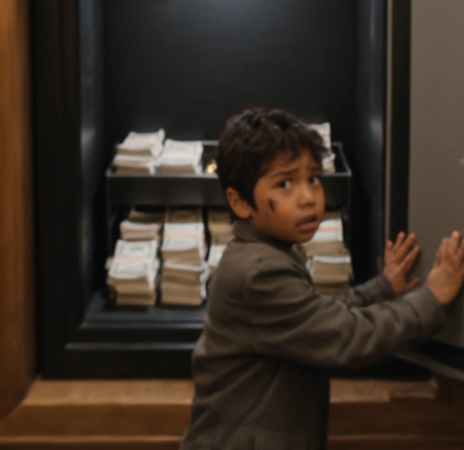
The safe was open.
No one knew why. Maybe the manager had forgotten to close it after the evening count. Maybe fate had a cruel sense of humor. But there it was — gaping open like a wound in the wall of the most expensive restaurant in the city, stacked floor to ceiling with banded cash and velvet jewelry cases — and standing directly in front of it, with two filthy hands resting on the cold steel door, was a boy who couldn’t have been older than nine.
The room exploded.
“Hey! What is he doing?!”
“Who let him in?!”
“Call security — NOW!”
“He’s stealing! He’s actually stealing!”
“Stop him! Don’t let him move!”
The voices crashed into each other like waves. Women in floor-length gowns grabbed their clutches. Men in tailored suits surged forward. Waiters froze mid-step, trays trembling in their hands. The chandelier above shimmered from the vibration of sixty people moving at once.
The boy didn’t run.
That was the thing nobody expected. He just stood there — messy hair matted against his forehead, jacket torn at both shoulders, face streaked with grime and something that might have been dried tears — and he didn’t run.
Marcus, the head of security, was already moving. Six feet of muscle and a decade of instinct pushed through the crowd like a battering ram.
“Step away from the safe!” he shouted, voice cutting through the noise like a blade. “Step away — RIGHT NOW!”
The boy flinched so hard his whole body jerked backward. His shoulders pulled up toward his ears. His eyes went wide — dark brown, enormous — and filled immediately with the kind of terror that only children and animals carry purely.
“I… I didn’t take anything,” he whispered. His voice was shaking so badly the words barely held their shape.
“Don’t speak.” Marcus grabbed his shoulder. “Don’t you dare move.”
The crowd tightened around them. Shoulders pressed against shoulders. Phones appeared — of course they did — little glowing rectangles pointed at the boy like accusations.
A woman near the front wrinkled her nose.
“Look at him. He’s absolutely filthy.”
“These kids are everywhere now,” the man beside her muttered, swirling his wine glass without looking away. “The city does nothing. Absolutely nothing.”
“Someone should call his parents.”
“He doesn’t have parents, Gerald. Look at him.”
The boy’s chin dropped to his chest. He was shaking — not performing fear, not calculating an escape — just shaking, the way a leaf shakes when the whole tree is being struck.
And then, from the far corner of the room, a single voice cut through everything else.
“What is going on here?”
The crowd parted.
Seated at a private corner table, half-shadowed, was a man in a wheelchair. His suit was charcoal and immaculate. His hair was silver at the temples. His face was the kind of face that had stopped reacting to surprises decades ago — controlled, still, expensive.
His name was Edmund Hale. And this was his restaurant.
“He was at your safe, Mr. Hale!”
“He tried to steal — we all saw it!”
“He had his hands right on it, sir, I swear—”
Edmund raised one hand. Barely moved it, really — just lifted it slightly from the armrest. The room quieted by half.
His eyes moved slowly to the boy.
“Come here,” he said. Not unkindly.
The boy looked at Marcus. Marcus looked at Edmund. A silent exchange passed between them. Marcus released the boy’s shoulder.
The boy walked forward. His shoes had no laces. His steps were almost soundless.
He stopped three feet from Edmund’s wheelchair and looked up at him with those enormous eyes — terrified still, but something else there too. Something steadier than anyone in that room expected.
“You were at my safe,” Edmund said. Statement, not question.
“Yes, sir.”
“Did you take something?”
A pause. The whole restaurant held its breath.
“No, sir.”
“Then what,” Edmund said slowly, “were you doing?”
The boy opened his hand.
Silence detonated across the room.
Sitting in the center of his small, dirty palm was a piece of bread. Slightly crushed from being held too tightly. Still warm from wherever he’d been keeping it.
“I… I just wanted to leave this,” the boy said. His voice cracked. He swallowed hard and pushed through it. “So you don’t feel hungry.”
No one moved.
Edmund stared at the bread. Something shifted in his face — slow, tectonic, the way mountains move. His jaw tightened. His eyes, which had been cold for so long he’d forgotten what warm felt like, did something unexpected.
“You came to give me food,” he said. Barely audible.
“You looked…” The boy hesitated. Glanced around at the crowd of strangers, then back at the man in the wheelchair, sitting alone at his private table while his entire restaurant celebrated around him. “You looked alone.”
The woman who had called the boy filthy looked down at her shoes.
The man who had said these kids are everywhere set down his wine glass.
Marcus, still standing two feet away with his hand half-raised, slowly lowered it.
Edmund reached out. His hand — large, clean, ringed with a single gold band — reached toward the boy’s outstretched palm. They touched. The bread passed between them.
Neither pulled away immediately.
Edmund looked at the bread for a long moment. Then he looked at the boy. His throat moved.
“What’s your name?”
“Daniel.”
“Daniel.” He repeated it like he was memorizing it. “When did you last eat?”
The boy thought about it with the devastating honesty of children who haven’t yet learned to lie about pain.
“I don’t remember.”
Edmund closed his fingers around the bread.
Then he looked up at the room full of people — his guests, his staff, his world — and something in his expression made several of them take a small, involuntary step back.
“Bring him a chair,” Edmund said quietly. “And bring him everything on the menu.”
Nobody clapped. It wasn’t that kind of moment.
Daniel sat down across from Edmund Hale — the boy with no shoes and the man with everything — and the restaurant slowly, carefully, returned to its sounds. Clinking cutlery. Low voices. The distant pulse of the city outside.
But something had changed in the air.
Something that bread had broken open.
