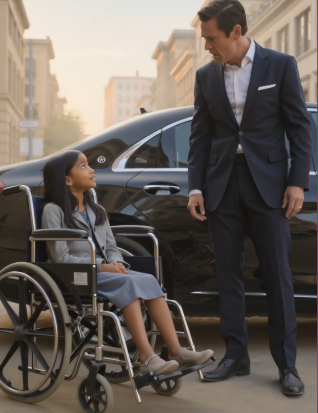
The black Mercedes sat like a monument to money — gleaming, untouchable, casting a sharp shadow across the cracked sidewalk where Marcus danced.
He was maybe ten years old. Barefoot. Shirt two sizes too big. But his feet moved like they had somewhere important to be, tapping rhythms into the dusty concrete, spinning slow circles in the afternoon heat. People walked past without seeing him. That was fine. Marcus had long since stopped dancing for other people.
Until the car door opened.
The man who stepped out wore a suit that cost more than most people’s rent. His name was Richard Calloway — though no one on this street knew that, and no one would have cared. He was on a call, one hand pressed to his ear, jaw tight, eyes scanning the world the way powerful men do — looking for problems to eliminate.
He saw Marcus immediately.
“Hey.” Richard’s voice sliced through the ambient noise of the street. “Get away from my car.”
Marcus stopped dancing. He looked up.
“I said —” Richard pulled the phone from his ear, his patience already gone, “— get away from my car.“
His hand moved to his jacket pocket. He produced a crisp hundred-dollar bill, rolled it between two fingers like it was nothing, and flicked it toward the boy. It spiraled through the air and landed flat at Marcus’s feet, face-up, still and silent in the dust.
Marcus looked down at it.
The whole street seemed to hold its breath.
Then, slowly — slowly — he raised his eyes. Not with anger. Not with hunger. With something far more unnerving: calm.
“Son, pick it up,” a passing woman muttered. “Don’t be foolish.”
But Marcus wasn’t looking at the money anymore. He was looking past Richard’s shoulder, toward the curb, where a girl sat in a wheelchair, half in sunlight, half in shade. She was around his age, maybe younger. Her hands rested still in her lap. Her eyes had been watching the whole scene with an expression that had learned long ago not to expect very much from the world.
Marcus looked at her.
Then he turned his back on the hundred-dollar bill and walked toward her.
Richard blinked. “What — where are you going?”
No answer.
Marcus crouched down in front of the girl’s wheelchair until he was at her eye level. He tilted his head. Made a ridiculous face — eyebrows waggling, mouth twisted sideways, eyes crossing.
The girl’s expression didn’t change.
He tried again. This time he added a little shoulder shimmy, a ridiculous spin on one heel, arms out wide like he was performing at Carnegie Hall.
A twitch. The corner of her mouth.
Almost.
Marcus doubled down. He launched into a full routine now — stomping beats into the dusty sidewalk, throwing his arms to invisible music, sliding left, sliding right, his whole body saying: Hey. I see you. You matter.
And then — it happened. Slow as sunrise, beautiful as anything Richard Calloway had ever paid money to see.
She smiled.
Not a polite smile. A real one. The kind that reaches the eyes and stays there.
The street went quiet.
Richard didn’t realize he’d stopped breathing until he exhaled.
He stood motionless, the arrogance draining from his posture like air from a punctured tire. He watched this barefoot boy in an oversized shirt make his daughter laugh — something three specialists, two therapists, and a dozen expensive outings hadn’t managed in months.
He stepped forward. His voice came out different now. Lower. Almost careful.
“Why didn’t you take the money?”
Marcus looked up at him. No fear. No resentment. Just that same unnerving calm.
“Because I used to sit like her,” he said quietly. “In a chair. For two years. After the accident.”
Richard’s mouth opened. Nothing came out.
“And every day people walked past,” Marcus continued, his voice steady, his eyes not leaving Richard’s face. “They looked away. Like looking too long might cost them something.” He glanced at the girl — at Sophie — still glowing from her smile. “Nobody stopped. Not once.”
The silence that followed was the loudest thing Richard had ever heard.
Something moved across his face — cracked across it, really, like a fault line giving way after years of pressure. His eyes filled. He tried to hold it together the way men like him are trained to — jaw tight, shoulders back, control the narrative.
But his knees gave out.
Richard Calloway, in his thousand-dollar suit, dropped to the ground beside his daughter’s wheelchair. His hand found hers. He pressed it to his forehead and stayed there, shaking.
“Dad?” Sophie whispered. “Daddy?”
“I’m okay,” he managed. “I’m okay.”
He wasn’t okay. He was undone.
Marcus stood a few feet away, watching. Not with satisfaction. With something older than his years — a kind of quiet recognition.
Richard lifted his head. His eyes were wet, his voice barely a sound.
“And I almost became one of them…”
He wasn’t talking about the homeless.
He was talking about the people who walk past.
