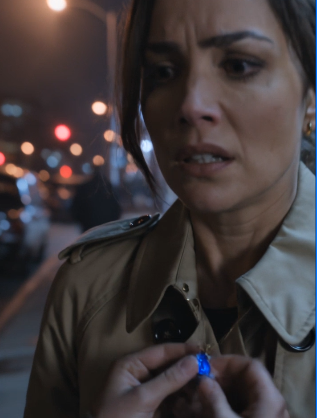
The street never slept. It breathed — hot asphalt, cigarette smoke, the low hum of a city that didn’t care about anyone. Neon signs bled color into the wet pavement, and a thousand strangers moved like currents around each other, heads down, earbuds in, eyes nowhere.
Catherine moved through them the way she always did — precise, purposeful, invisible in a crowd. Her trench coat was camel-colored, pressed, expensive. Her heels made a sound that meant somewhere to be.
She didn’t see the boy until he was already on her.
A hand — small, filthy, desperate — seized her collar so hard she stumbled sideways. The cold air rushed in as she spun, and suddenly she was face-to-face with a child she had never seen before. He was maybe twelve. Maybe less. It was hard to tell beneath the grime — dirt-black streaks across his cheeks, hair matted, a jacket three sizes too large and torn at both elbows. His eyes were wild. Wet. He was shaking like he was standing in a blizzard, not a 60-degree city night.
“YOU HAVE TO HELP ME!!” he screamed. His voice cracked down the middle. “THEY’RE GOING TO KILL HIM!!”
Catherine yanked backward on pure instinct. “Hey! What are you doing?! Let go of me!”
People flowed around them like water around two rocks, barely glancing over.
“Please!” he begged, not releasing his grip. “Please, please, please—”
“I said let go!” She grabbed his wrist — bony, frail — and that’s when she saw it.
Hanging from a cord around his neck, half-hidden beneath the torn collar: a pendant. Small. Blue. Hexagonal, like a cut gemstone, catching the orange streetlight in a way that made it almost glow.
Her fingers went cold.
Because she was wearing the same one.
Not similar. Not inspired by. The same. The same exact shade of cobalt. The same hand-cut facets. The same tiny silver loop at the top where someone — her mother — had threaded a cord through it thirty years ago.
Catherine had three of them. She’d given two away. One to her sister who lived in Paris. And one — one she’d placed in a small cloth bag and pressed into the hands of a woman at a shelter, six years ago, on a December night when it was too cold for anyone to be outside.
The boy had stopped pulling. He was holding the pendant up now — both hands trembling — offering it to her to examine like it was evidence.
“You gave this…” His voice barely made it out. “…to my mom.”
The world got quiet.
Not actually quiet. The city kept roaring. But something collapsed inside Catherine’s chest, some wall she hadn’t known was standing, and suddenly all she could hear was the sound of her own heartbeat and the boy’s ragged breathing.
“What?” she whispered.
“Marta,” he said. “Her name is Marta. She said a woman gave this to her. A woman with the same one. She kept it around my neck when they—” He stopped. Swallowed hard. “She said if I ever needed help, to find someone with a blue stone.”
Catherine’s throat closed. Marta. She remembered her. Thin face. Enormous eyes. A little girl clinging to her leg.
This is the little girl’s son.
“Where is she?” Catherine grabbed his arm now, the dynamic reversing entirely. “Where is your mother?”
“She’s sick.” The word came out gutted. “She’s been sick for a long time. But tonight — there was a man, from the shelter. He was going to take Marco. Marco helped me find food, he’s been protecting me, and they came, four of them, and Marco — he fought them so I could run and I ran and ran and I didn’t know where to go and I remembered what she said—”
“Stop.” Catherine’s hand gripped his shoulder, firm and steady. “Where is Marco right now?”
“Behind the alley.” He pointed past the bodega on the corner, past the newsstand, into a pocket of darkness that the streetlights hadn’t bothered to reach. “But they were hitting him bad. Real bad. I heard something — I heard—”
“Don’t.” She pulled off her coat, wrapped it around his shaking shoulders in one practiced motion, the way a person does when they’ve made a decision and the decision is final. “Show me where. Right now. Can you run?”
He looked up at her — this woman, this stranger, this person his mother had whispered about like a prayer.
“Yeah,” he said.
“Then run.”
They ran.
The city closed around their footsteps. The crowd swallowed the space where they’d been standing, and within seconds it was as if they’d never existed — just another moment the street had forgotten.
In the dark of the alley, a shape moved.
And Catherine’s hands balled into fists.
She had a phone in her pocket. She had a voice that carried. She had thirty years of anger at a world that looked away, compressed into something very small and very cold and very ready.
She was not going to look away.
Behind them, the two pendants — hers and the boy’s — swung together as they ran, and for one half-second under the last pool of light, they caught each other’s reflection, blue on blue, like a signal fire between two people who had never met but had always been connected.
Then the darkness swallowed them whole.
