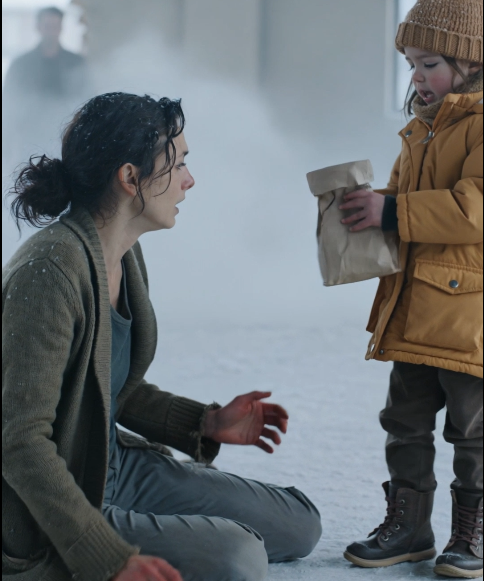
The wind came first — a vicious, hollow gust that swept through the broken bones of Harlow Station like a warning. Snow drove in sideways through the shattered windows, swirling in ghostly spirals across the frozen platform floor. Nobody came here anymore. Nobody except the forgotten.
Elena didn’t even feel the cold anymore. That was the terrifying part.
She sat with her back against the crumbling tile wall, her olive cardigan soaked through, her grey pants stiff with frost at the knees. The paper bag she’d found in the trash three hours ago had been empty. She’d kept it anyway — something to hold with her shaking red hands. Something that felt, faintly, like purpose.
Her dark hair hung in wet clumps against her cheeks. She hadn’t seen a mirror in weeks, but she knew. She knew what she looked like. Like someone the world had finally decided to stop pretending it cared about.
She heard the footsteps before she saw her.
Small boots. Quick, hesitant taps against the concrete.
Elena didn’t look up. Probably lost, she thought. They always are.
“Why are you sitting here?!” The voice was high and panicked, like a little bird colliding with glass. “You’re freezing!”
Elena lifted her head slowly. The motion took more effort than it should have.
Standing five feet away was a small girl — maybe five, maybe six — in a mustard-yellow winter jacket so bright it seemed to generate its own warmth. A knitted hat sat crooked on her light brown hair. Her cheeks were rosy, her brown eyes enormous, and they were filling, fast, with something that looked dangerously like tears.
“I’m okay,” Elena said. The lie came out in a vapor cloud.
“You’re not okay.” The girl stepped closer, boots crunching the thin sheet of ice on the platform. She pointed, very seriously, at Elena’s hands. “Your hands are shaking.”
“It’s just the cold.”
“It’s really cold. Why aren’t you inside?”
Elena looked away, toward the blurred grey horizon beyond the platform’s broken edge. A distant figure stood there — a man, coat dark, not moving. She blinked. He remained.
“I…” Her voice cracked. She swallowed it back. “I have nowhere to go.”
The girl was quiet for exactly three seconds. Then she said, with absolute certainty: “That’s not okay.”
Elena almost laughed. Almost. “No. I guess it’s not.”
“Do you have a family?”
The word cut like the wind. Family. She thought of her mother’s voicemail she’d stopped checking. Her sister’s last text, six months ago — I can’t keep doing this, Elena. I just can’t. The empty apartment she’d been evicted from on a Tuesday in October, standing on the sidewalk with one garbage bag and the sudden, vertiginous understanding that there was no one left to call.
“Not really,” she said. “Not anymore.”
The girl reached into her jacket pocket. Her little face was fierce with concentration, the way children look when they’ve decided something and nothing in the world will change it. She pulled out a wrinkled brown paper bag.
“I saved my sandwich,” she said. “Mom makes them with too much butter. I was going to throw it away, but then I thought someone might need it.” She held it out. “Please. Take it.”
Elena stared at the bag. Her throat closed.
“You don’t have to—”
“Take it.” The girl pushed it forward another inch. Her chin wobbled, but her arm was steady.
Elena reached out. Her fingers trembled so badly that the girl’s small hands closed around them for a moment, steadying them, passing the bag across.
“Thank you,” Elena whispered.
“You should eat it while it’s—well, it’s not warm anymore.” The girl frowned. “Sorry.”
“It’s perfect.” Elena hadn’t opened it yet. She was just holding it. She is six years old and she is saving me, she thought. What does that say about the rest of the world?
The wind howled again. A sheet of snow cascaded down from the ruined roof, spitting ice across the platform. The girl flinched but didn’t step back. She pulled her scarf tighter and looked at Elena with an expression of ancient, impossible seriousness.
“My name is Lily,” she said.
“Elena.”
“Do you have somewhere warm to go tonight, Elena?”
“Lily—” She stopped. Swallowed. “I’m working on it.”
“That means no.”
Elena closed her eyes. “That means no.”
Lily was quiet again. The wind filled the silence. Then, so softly that Elena almost missed it beneath the howl of the storm:
“You need a home.” A pause. “And I need a mom.”
The words detonated somewhere behind Elena’s sternum.
She opened her eyes. Lily was watching her with those huge brown eyes, not crying — not anymore — just looking, with a seriousness that belonged on a forty-year-old face, not this one. This small, rosy, butter-sandwich face.
“Lily—” Elena’s voice broke in half. “Lily, you have a mother.”
“I know.” Her voice was quiet. “But she’s been gone for a long time, even when she’s there.” She touched the strap of her backpack. “I practice being okay. But it’s hard to be okay alone.”
The man at the edge of the platform hadn’t moved. He stood like a dark post in the snow.
He’s watching, Elena realized. He’s been watching the whole time.
She didn’t know what he was to this child — father, uncle, stranger. She didn’t know if this girl had wandered here alone or been sent, by what impossible design, into this hollow station on this hollow afternoon.
All she knew was this: a six-year-old in a yellow jacket had looked at a shaking, broken woman on a frozen floor and seen not a warning, not a tragedy to scroll past — but a person. A possibility.
Elena’s hand found Lily’s, and held it.
The snow kept falling. The piano of the wind played its cold, endless note. And somewhere in the ruin of that station, between a woman with nothing and a child who needed everything, something small and stubborn flickered to life.
Not a rescue. Not yet.
But the first breath before one.
