The narrow street smelled of old stone and late afternoon rust. Shadows stretched long between the crooked buildings, and the antique shop on the corner glowed amber in the dying light — its window full of forgotten things. Watches that had stopped. Lockets without faces. Rings without fingers.
Nobody noticed the little girl at first.
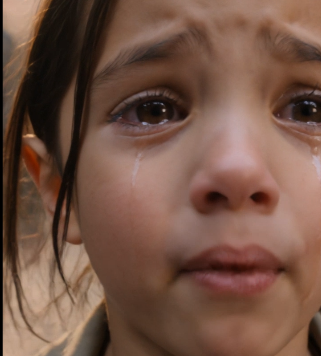
She was seven, maybe eight, in a faded blue jacket two sizes too big, her dark hair tangled from running. She pushed through the small crowd of evening strollers with the kind of desperate focus that only children and people with nothing left to lose ever manage. Her eyes were locked on one thing: the hand of an elderly woman standing in the shop doorway, turning a small gold ring between her fingers like it was nothing. Like it was merchandise.
The girl stopped two feet away. Her chest heaved.
“Please!” she cried out, her voice cracking the quiet street like a stone through glass. “That’s my mom’s ring!”
The elderly woman — sharp cheekbones, silver hair pinned tight, eyes like polished flint — looked down at the child without warmth. She raised the ring slightly, almost taunting.
“It’s not yours,” she said flatly. “Go away.”
The street went quiet. Even the pigeons stopped.
A man nearby — late forties, construction dust still on his jacket, a coffee going cold in his hand — slowed his walk. Something about the girl’s voice made him turn. He watched.
The girl stepped closer. Her lip trembled but she didn’t back down.
“She never took it off,” she whispered. “Not once. Not ever. Not even when she was sick.”
“Children imagine things,” the woman said, already stepping back toward the shop door. “I bought this legally. Whatever story you have, it’s not my concern.”
“Where did you get it?” the girl demanded, louder now, surprising even herself.
“An estate sale.” The woman’s tone was clipped, practiced — the tone of someone who’d said a version of this before. “Three weeks ago. Everything was documented.”
“My mother isn’t dead!” The girl’s voice shattered. Tears spilled fast and hard. “She’s missing. She’s been missing for four months and that ring was on her finger the day she disappeared and you need to give it back to me right now —”
“I don’t need to do anything.” The woman’s hand closed around the ring. “Now I’m asking you politely to step away from my shop before I call someone.”
That’s when the man in the dusty jacket stepped forward.
“Wait.”
It wasn’t loud. It wasn’t aggressive. But something in his voice — certain, grounded, like a nail going into solid wood — made everyone stop. Even the elderly woman froze.
He walked slowly toward them, eyes fixed on the ring.
“Let me see that.”
“Excuse me?” The woman drew back. “Who are you?”
“Someone who might matter here.” He held out his hand. Not demanding. Not asking. Just waiting — with the quiet authority of a man who’d already decided he wasn’t leaving. “Please.”
The woman hesitated. The crowd around them had thickened now — shopkeepers at doorways, a woman with groceries, two teenagers with their phones already raised. The antique shop window reflected all of them: a small girl with red eyes, an old woman with something tightening in her face, and a stranger with dust on his collar and certainty in his eyes.
She placed the ring in his palm.
He turned it slowly. Examined the outside. Then, carefully, tilted it toward the light and looked inside the band.
His breath caught.
He crouched down to the girl’s level.
“What’s your mother’s name?” he asked softly.
“Lena,” the girl whispered. “Lena Marsh.”
The man closed his eyes for exactly one second. When he opened them, they were wet.
“Your father,” he said carefully, “did he ever show you this ring? Did he ever talk about what was engraved inside it?”
The girl shook her head slowly. “He just said she wore it every day. He said it was her most important thing. He said when they find her, the first thing she’ll want is —”
“I know that engraving.” His voice broke slightly on the last word. He steadied himself. Turned the ring so the girl could see — though she was too short, too young to read the tiny script curling around the inner band. But the crowd could see him read it. See his face confirm everything.
He looked up at the elderly woman. The certainty in his expression had shifted into something harder.
“Your father showed me this,” he said to the girl, still holding her gaze, voice soft but unmistakable, “when your mother was missing. He showed every one of us in the search group. He wanted us to know what to look for.” He paused. “Those are their initials. And a date. The date they met.”
The girl made a sound that wasn’t quite a word. Half gasp, half sob.
The elderly woman’s hand tightened at her side. The composure she’d worn like armor developed its first visible crack — a flicker behind the eyes. A swallow she couldn’t quite hide.
“I told you,” she said, but quieter now. “Estate sale. I have documentation —”
“Then you’ll be happy to share it,” a voice from the crowd said.
Someone else: “She’s seven years old. Look at her.”
The man stood slowly, the ring still in his hand, and for a long moment the only sound was the girl’s unsteady breathing and the distant scrape of a shutter somewhere down the street.
He looked at the girl. She was staring at the ring like it was a piece of her mother’s heartbeat made metal.
“Your father is still looking,” he told her gently. “He never stopped.”
The girl reached out her small hand.
And every eye on that street turned to the woman who had not yet moved.
