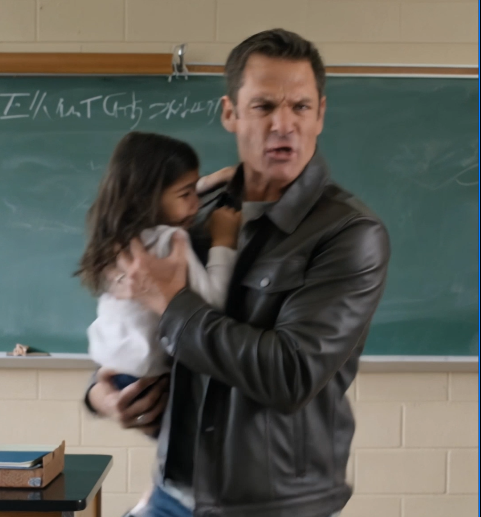
Room 14 at Westbridge Middle School had been quiet all morning.
The kind of quiet that comes after something has already happened — not peaceful, but held. Twenty-two students sat at their desks with the careful stillness of people pretending they hadn’t seen what they’d seen. The substitute teacher, barely twenty-five, shuffled papers at the front of the room with the focused determination of someone choosing not to acknowledge the tension sitting in every corner like furniture.
The clock on the wall read 10:47 AM.
At 10:48, the door came off its hinges. Not literally — but close enough.
The slam of it hitting the wall was the kind of sound that rewires your nervous system. Every student in Room 14 jerked upright simultaneously. The substitute’s papers scattered across the floor. The fluorescent light above the doorway flickered once, as though the building itself had flinched.
Marco Reyes stood in the doorway.
Thirty-eight years old. Construction foreman. A man whose hands had poured concrete and bent rebar and built things meant to last. He was still in his work clothes — dusty boots, worn jacket — which meant he had come directly from the site, which meant someone had called him and whatever they had said had made him drive here without stopping to change, without stopping to think, without stopping at all.
In his arms, pressed against his chest with both small hands gripping the front of his jacket, was his daughter.
Camila. Six years old. Her face was buried in his shoulder, her whole body shaking with the particular cry of a child who has been trying very hard to stop and cannot.
The substitute stood. “Sir, you can’t just—”
Marco stepped into the room.
“EVERYONE STAND UP.”
His voice didn’t need to be louder. It filled the room from floor to ceiling and pressed against the windows. It was the voice of a man whose love for his child had passed through fear and grief and arrived at something that had no ceiling.
“Who hurt my daughter?”
The scrape of twenty-two chairs against linoleum was instantaneous — students rising to their feet in a single collective movement, the way people stand in the presence of something they recognize as serious.
Camila made a sound against Marco’s shoulder — small, broken, the kind that parents hear in their sleep for years.
“Mija,” he said, low and close to her ear. “Mija, look. You’re safe. I’m here.”
She turned her face slightly. One eye visible, red-rimmed and swollen.
Marco scanned the room.
Twenty-two students standing. Eyes wide, hands at sides, the uniform posture of people who are very aware that they are in the presence of something with consequences.
Except one.
At the third desk from the back, left side — Tyler Marsh sat with his chair tipped back slightly, one arm draped over the back, ankles crossed. Fourteen years old. Built like a kid who had been told too many times that he was something special. The kind of relaxed that is performed, not felt.
His eyes met Marco’s.
And he smirked.
Not small. Not involuntary. A full, deliberate smirk — the expression of a boy who had calculated his response and chosen this one.
The room felt it. Three students near Tyler visibly shifted away from him, the instinctive distancing of people who sense what’s coming and don’t want to be adjacent to it.
Marco walked toward him. Slowly. Camila held tight, her face now turned to watch from the safety of her father’s shoulder.
He stopped at the desk.
“You,” Marco said. One word. Quiet now — which was worse. “You want to tell me what happened to my daughter?”
Tyler tilted his head. The smirk adjusted itself but didn’t disappear.
“She started it.”
The words landed in the silence like a stone through glass.
Someone near the window made a sound — half-gasp, half-something-else. The substitute took one step forward and then stopped, apparently concluding that whatever was about to happen was above her pay grade.
Marco looked at the boy for a long moment. Then he looked at his daughter.
“Camila,” he said gently. “What happened?”
She pulled back just far enough to speak. Her voice came in pieces, interrupted by the hiccups that follow hard crying. “He— he said I was— he said I was stupid in front of everyone. And when I cried he laughed. And then he—” She stopped.
“Then he what, mija?”
“He threw her backpack in the trash,” a girl’s voice said from the left side of the room.
Everyone looked. Emma Hargrove, thirteen, was standing with her arms crossed and her chin up, the expression of someone who had decided she was done being quiet. “In front of the whole hallway. He dumped everything out first. Her drawings. Her stuff. He threw it all in the trash and told her to go get it.”
The room went very still.
Marco turned back to Tyler.
Tyler had uncrossed his ankles. The chair had come down off its tilt. The smirk was still present but it had lost some of its structural integrity — the way a wall looks right before something gives.
“Is that true?” Marco asked.
“It was a joke,” Tyler said. “She’s a little kid. She overreacted.”
“She’s six.” Marco’s voice dropped even lower. Something in the drop of it made two students near the back step back without meaning to. “She’s six years old and she came to school today with drawings in her backpack because she worked on them last night to show her class. And you threw them in a trash can and made her cry in a hallway full of people.”
Tyler opened his mouth.
“Don’t,” Marco said. “Do not say she started it again.”
The substitute found her voice from somewhere. “Sir, I need to ask you to lower your—”
“Where is her backpack?”
Silence.
“Where is my daughter’s backpack right now?”
A boy near the window — quiet until now, clearly having an internal debate — slowly raised his hand. “I got it. After. I got it out of the trash and I put her drawings back.” He reached under his desk and pulled out a small purple backpack with a butterfly patch on the front. He held it out.
Marco took it. He looked at it for a moment. Then he carefully put it over Camila’s shoulders, adjusting the straps with both hands while still holding her.
She sniffled. Gripped his jacket tighter. Then, very quietly: “My butterfly drawing got bent.”
Something moved through the room that had no name — the specific ache of an undeserved thing.
Marco turned back to Tyler one last time.
“My daughter will be back in this school tomorrow,” he said. “And the day after. And every day after that. And you are going to find a way to live with what you did — not because I’m telling you to, but because one day you’re going to remember this and you’re going to understand exactly what you were.”
He turned to the boy who had rescued the backpack.
“What’s your name?”
The boy blinked. “…Daniel.”
“Thank you, Daniel.”
He walked out of Room 14 with his daughter in his arms and her butterfly backpack on her back.
The door closed quietly behind him.
Tyler Marsh sat in the silence of twenty-one people not looking at him.
And for the first time all morning, the smirk was gone.
