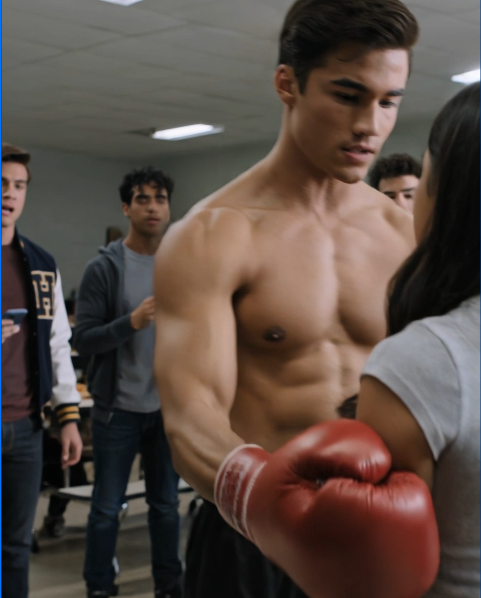
The Westfield High cafeteria ran on a social physics that everyone understood and nobody talked about — who sat where, who moved for whom, which tables had gravity and which ones existed at the margins. It was Tuesday, it was 12:14 PM, and the room was at full noise: trays clattering, chairs scraping, the particular roar of four hundred teenagers all talking at once beneath fluorescent lights that made everyone look slightly unwell.
Maya was carrying a full tray — chocolate milk, pasta, an apple she wouldn’t eat — and moving through the gap between tables the way she always did: efficiently, invisibly, head slightly down.
She didn’t see Connor step into her path.
Or rather — Connor stepped into her path knowing she wouldn’t see him in time. That was the point.
The sound of the slap was swallowed almost immediately by cafeteria noise, but the sound of the tray hitting the floor was not.
That one carried.
Chocolate milk detonated across the linoleum in a perfect radius. The apple rolled under a table. The pasta made a sound that was somehow worse than everything else. And Maya stood in the middle of it with one hand raised instinctively to her cheek and her eyes doing that rapid-blink thing eyes do when the brain hasn’t caught up to what the body just experienced.
“Watch where you’re going,” Connor said.
He was seventeen, letterman jacket, the kind of broad-shouldered physical confidence that gets mistaken for character in high school hallways. He was already half-turned away when he said it — which was deliberate — communicating with his body language that this situation was already beneath his attention.
The cafeteria hadn’t gone silent. It had gone still — a different thing. The noise continued in the background but in the immediate vicinity of Maya and the chocolate milk and Connor’s retreating posture, something had stopped. Forks paused midway to mouths. Phones rose with the practiced automaticity of a generation that documents first and processes later.
Maya lowered her hand from her cheek.
“I wasn’t in your—” she started.
“Save it,” Connor said, not turning around. He gestured vaguely at the mess on the floor. “Get someone to clean that up.”
A few people at the nearest table laughed. Not many — four, maybe five. But four or five laughs in a silent room is its own kind of violence.
Maya crouched down to start gathering what she could from the floor. Her hands were shaking slightly. Not from fear — from the specific adrenaline of being publicly humiliated, the body’s response to a threat it wasn’t given the chance to run from.
“You don’t have to do that,” said a girl nearby, reaching down.
“Leave it,” Connor said sharply, and the girl pulled back.
He turned then — fully — and looked at Maya crouched on the floor with her ruined lunch, and smiled at the room the way people smile when they’re performing for an audience they’re certain is on their side.
“This is why,” he started—
The gym doors hit the wall.
The sound of them was different from the cafeteria noise — heavier, more deliberate, and it was followed by a quality of movement that made people turn before they understood why.
Marco was still in his gear.
Red boxing gloves. Headgear pushed up off his face but not removed — the chin strap hanging loose, the padding still framing his jaw. He’d come straight from the gym room, which was on the other side of the building, which meant someone had gotten him a message and he had moved immediately and without stopping to change or think or decide whether this was his business.
He walked through the cafeteria the way his coach had taught him to walk into a ring — not fast, not aggressive, but with a specific quality of forward intention that made the space in front of him open up automatically. Students stepped aside without being asked. Chairs scraped. A lunch monitor near the wall took one look at the red gloves and reached for her radio and then apparently reconsidered.
Connor watched him come. The smile stayed on his face through what appeared to be significant effort.
“Marco,” he said, when the distance between them had closed to six feet. His voice carried the practiced lightness of someone buying time. “Seriously? You going to fight me in the cafeteria?”
Marco stopped.
He looked at Connor with an expression that was the opposite of what Connor had been expecting — not anger, not aggression, not the hot-faced urgency of someone about to do something stupid.
Just stillness. The particular stillness of someone who has been trained to be very calm precisely when things are not.
He looked down at his gloves. Then back up.
“You can’t do anything with those on,” Connor said. A half-laugh. Playing to the crowd. “So what exactly is the move here?”
Marco looked at him for one more second.
“I know,” he said. “That’s why I’m keeping them on.”
The sentence landed in the room and didn’t echo — it settled, the way things settle when they’re true and everyone recognizes it simultaneously.
Connor’s smile went through several expressions in rapid succession, none of them landing cleanly.
Marco turned away from him.
He crossed the last few feet to where Maya was still crouched on the floor, and he went down on one knee beside her — which with boxing gloves was not a graceful maneuver, and he didn’t try to make it one. He used both gloved hands with the careful clumsiness of someone working with tools not designed for delicacy, sliding them under the tray, steadying it against the floor.
“I’ve got it,” he said quietly. “I’ve got it, Maya.”
She looked at him. Her eyes were wet but she hadn’t cried — had refused to, was still refusing to, on principle.
“You’re going to drop everything,” she said. “With those on.”
“Probably,” he agreed. “Hold the tray.”
She held it. Together — her hands and his ridiculous red gloves — they got it upright.
He stood, and offered one padded forearm for her to use to push herself up, which she did, and the absurdity of the gesture in the middle of everything — a girl using a boxing glove as a handhold while the cafeteria watched in complete silence — was somehow the thing that made two people near the back start clapping.
Then more.
Not a roar. Not a movie moment. Just the quiet, spreading applause of people relieved to have something to respond to that wasn’t cruelty.
Marco didn’t look at the room. He looked at Maya.
“You okay?”
She touched her cheek briefly. “I will be.”
He nodded. Then — and only then — he turned back to Connor.
Connor was still standing in the same spot. The letterman jacket looked different now somehow, though nothing about it had changed. Four or five people who had laughed earlier were very interested in their food.
“We’re going to talk,” Marco said. Not a threat. A fact. “But not here.”
Connor said nothing.
Marco looked at him steadily.
“Not here,” he repeated, “because this isn’t about me.”
He picked up Maya’s apple from under the table with both gloved hands — dropped it, picked it up again, handed it to her without comment.
She almost smiled.
Almost.
And in the cafeteria of Westfield High, on a Tuesday at 12:17 PM, phones lowered one by one, the way they do when people decide that what they’re watching is something they want to be present for rather than just record.
