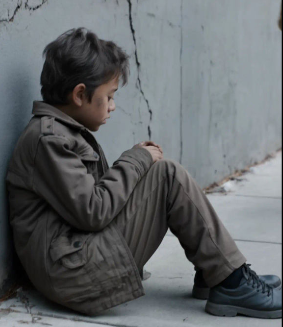
He was easy to walk past.
That was the truth nobody wanted to say out loud — that on a cold Wednesday morning on a city sidewalk, a dirty boy pressed against a cracked concrete wall was something most people had learned to unsee. Eyes forward. Pace steady. The particular urban blindness that protects the comfortable from the uncomfortable.
Ethan Cole had not yet learned that blindness.
He was nine years old. He was wearing a navy coat with brass buttons and clean sneakers that his mother had tied that morning while telling him to hurry up or they’d be late. He was carrying a paper bag with a loaf of bread and a carton of orange juice because it was Wednesday, which was the day they stopped at the bakery before school.
He stopped walking.
His mother didn’t notice immediately. She was three steps ahead, phone in hand, responding to something that needed responding to.
Ethan was looking at the boy against the wall.
“You look cold,” Ethan said. “Are you hungry?”
The boy on the sidewalk had learned not to expect much from voices.
Voices said move along and you can’t sit here and this isn’t a shelter. Voices called him names or called the police or called out to each other about him like he wasn’t present enough to hear.
He looked up slowly.
The boy standing over him had a navy coat and clean sneakers and a paper bag and an expression of pure, uncomplicated concern. No performance. No discomfort. Just a kid looking at another kid and seeing exactly that.
His name was Danny. He was eight. He had been sitting against this wall for three hours because the shelter had been full last night and the morning was warmer than the night had been and this patch of wall caught the thin winter sun in a way that helped, a little.
He didn’t say any of this.
He just looked at the bread in the paper bag and his stomach made a sound that answered the question for him.
Ethan knelt. Right there on the sidewalk, navy coat and all, and reached into the bag.
“Here,” he said, holding out the loaf with both hands. “Take it. We can get more.”
Danny’s fingers reached out. They were trembling — from cold, from hunger, from the specific vulnerability of receiving something you’ve needed for so long that accepting it feels dangerous.
He took the bread.
He held it against his chest.
“Thank you,” he whispered. His voice cracked on the second word. “I was so hungry.”
Tears came without warning, the way they do when the body finally believes it’s safe enough to feel what it’s been holding. They cut clean lines through the grime on his face.
He didn’t wipe them.
He didn’t have a free hand.
“Ethan.”
The voice came from behind — sharp, adult, stripped of its usual warmth by alarm.
Then the hand. Grabbing Ethan’s arm, pulling him backward and upright in one motion.
“No. Get away from him. Right now.”
Diane Cole had seen the scene from four steps back and three seconds too late — her son, crouched on a public sidewalk, handing food to a homeless child, and the particular complicated panic of a mother calculating risk faster than she could calculate anything else.
Ethan stumbled back a step, then turned — not to follow her, but to look back at the boy with the bread.
“Mom.” His voice was confused and raw. “He’s cold. He’s hungry. I was just—”
“I know. I understand. But we don’t—” She pulled him another step back. “We don’t know who he is or where he’s—”
“He’s a kid,” Ethan said. Simply. Devastatingly. “He’s just a kid, Mom.”
Diane opened her mouth.
The boy on the sidewalk made a sound.
Not a word, at first. Just a sound — high and fractured and involuntary, the kind of sound that escapes before a person can choose to keep it in. His eyes had moved from Ethan to Diane and locked there, and something in his face had changed completely. The exhaustion was still there. The hunger. But underneath it, something else had cracked open. Something terrified and desperate and ancient.
Diane looked at him.
Really looked. For the first time.
The red hair beneath the grime. The specific angle of the jaw. The shape of the eyes that she had spent eight months trying to forget because remembering them undid her entirely.
“Mom?”
The word came out of him like something breaking.
One syllable. Barely a sound. His voice cracked and failed and he said it again, even quieter, like a question he’d given up on ever getting answered.
“Mom?”
Diane’s hand came up over her mouth.
The phone hit the sidewalk.
She didn’t hear it.
“Danny.” Her voice was a wreck of itself — stripped of everything except the name, the name she had spoken into empty rooms and into the phone with police officers and into the dark for two years. “Danny.”
He flinched when she said it. Like he’d been hit. Like hearing his name in her voice was something his body didn’t know how to process.
“You left,” he said. The bread shifted in his hands, tilting, nearly falling. “You left and you didn’t come back and I waited and I waited and I—”
“I know.” She was moving toward him now, down to her knees on the sidewalk, the expensive coat hitting the concrete. “I know. Danny, listen to me—”
“I looked for you.” His voice collapsed. “I looked for you everywhere.”
“I looked for you too.” She reached out. Her hand hovered — one inch from his face — waiting, asking. “I never stopped. I promise you I never stopped.”
Ethan stood completely still three feet away, the paper bag hanging at his side, watching something unfold that he didn’t fully understand but understood completely.
The bread slipped.
Danny caught it. Held it tighter.
And then Diane’s hand made contact with his face — her palm against his cold, dirty cheek — and the sound that came out of him had no name in any language.
She pulled him in.
He didn’t resist.
He pressed his face against her shoulder and held the bread against his chest with both arms and wept the way children weep when they have been strong for far, far too long.
Ethan looked at the two of them on the sidewalk.
Then he sat down beside them.
Because he was nine years old, and he had not yet learned to walk away from people who needed someone to stay.
