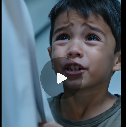
He had been standing in the hallway for eleven minutes before anyone acknowledged him.
That was the thing nobody would be comfortable admitting afterward — that a barefoot child had been standing in the corridor of Mercy General Hospital for eleven minutes, clutching a photograph, watching faces go past him like water around a stone, and the system that was supposed to notice things like this had not noticed.
He was six years old. Barefoot on the polished floor that reflected the overhead lighting back in pale strips. His jacket was an adult’s jacket, cut off at the sleeves, belted at the waist with a piece of cord. His face was the face of a child who had been outside for long enough that outside had become the default — weathered, careful, older than six in all the ways that mattered.
The photograph was crumpled. He’d been holding it so tightly for so long that the paper had taken the shape of his fist.
He picked his doctor.
Not randomly — with the specific deliberateness of a child who has learned to read faces. He watched the corridor for thirty seconds and then moved toward a man in scrubs who was walking fast with a chart in his hand, and he reached up and caught the edge of the white coat.
“Please,” he said. “Can you help my mom?”
The nurse appeared from nowhere.
That was how it felt — one moment the boy was holding the coat, the next a hand was on his arm, firm and official, and a voice was cutting through the corridor noise with the particular authority of someone who enforces boundaries professionally.
“You can’t be in here.” The nurse’s eyes swept the hallway. “Who let this child in? Who—” She looked down at him. “Where are your parents?”
“Outside,” he said. “That’s what I’m—”
“This is a hospital. You cannot be in here without an adult.” She was already steering him toward the entrance, her grip not cruel but absolute. “I need someone to call security—”
The photograph slipped.
He grabbed for it — missed — and it fell to the polished floor and skidded two feet, landing face-up. The woman in it was young, maybe mid-twenties, in summer light, laughing at whoever held the camera. The photograph was worn at the edges, soft with handling, the kind of worn that takes months of daily contact to achieve.
The nurse kept moving.
“Wait.” The voice came from behind them — young, female, firm in the specific way of someone who is choosing to interrupt a system she is also part of. “Stop. Let him go.”
The nurse turned.
Dr. Sarah Callahan was twenty-nine years old and eight months into her residency and had been heading toward room 412 when she’d caught the edge of the scene in her peripheral vision. She had stopped walking before she’d decided to.
She crossed the corridor. She crouched down to the boy’s level — not standing over him, not talking down at him, but getting low enough that they were eye to eye — and she picked up the photograph.
She held it out to him.
“Tell me your name,” she said.
“Max,” he said. “My name is Max.”
“Max.” She kept her voice level. “Tell me what happened.”
“My mom. She’s outside. She couldn’t walk anymore, she fell on the steps, and I came in to find someone but the doors were heavy so it took a long time and then I couldn’t find someone who would—” His hand caught her sleeve. “Please. She’s outside. She can’t walk.”
Sarah stood.
“Where outside?” she asked. “The front steps? The side entrance?”
“The front. With the big lights.”
She was already moving.
“Dr. Callahan—” the nurse called after her.
“Get a gurney to the front entrance,” Sarah said over her shoulder. “And someone page Dr. Reeves.”
“You can’t just—”
“Gurney. Front entrance. Now, please.”
Max ran to keep pace with her long strides.
The evening air hit them when the automatic doors opened — cold, city-tinged, a sharp contrast to the temperature-controlled sterility of the corridor. The front steps of Mercy General were wide and shallow, lit by the overhead lights that made everything look simultaneously bright and washed out.
She was at the bottom of the steps.
A woman — mid-twenties, pale in a way that had nothing to do with the lighting — sitting with her back against the concrete pillar, legs extended in front of her, head tilted at the angle of someone who has stopped being able to hold it up. Her breathing was visible. Her face was tight with pain even in semi-consciousness.
Sarah moved down the steps quickly.
She was running the assessment before she reached her — color, breathing, position, signs of trauma. She knelt. She checked the pulse at the throat with two fingers. She looked at the legs for the reason the woman couldn’t walk.
That was when she saw the bracelet.
Thin gold chain. Small charm — a letter S in a style that Sarah recognized because she had one exactly like it. Her mother had given them to both daughters, had the charms custom-made, had said so you always have your initial close with the particular sentiment of a woman who expressed love through small, permanent things.
Sarah’s hand hovered over the bracelet.
She did not touch it.
She turned the photograph over.
It had been in her coat pocket for eight months. She knew that wasn’t possible. She knew the photograph was in Max’s hand, had been in Max’s hand the entire time, was different paper, different creasing.
She turned it over anyway.
A woman in summer light. Laughing at the camera. Mid-twenties.
Her own face looked back at her.
Not similar. Not resemblance. Her face — the scar near the left eyebrow from the bicycle accident at fourteen. The specific way she tilted her head when she was laughing hard enough that she’d stopped performing the laugh and it had become real.
Her face. Before.
Before the accident eight months ago that she did not discuss. Before the three weeks she did not remember. Before she had woken up in a room in this hospital and been told about the gap in her life like being told about a stranger’s biography.
“Max.” Her voice came out barely audible. “Where did you get this photograph?”
Max was beside her, crouched near his mother, holding the unconscious woman’s hand in both of his.
“It’s yours,” he said. Simply. Like this was information she should have.
“Mine,” she repeated.
“Mom kept it. She said it was important. She said if anything happened, I should find you.” He looked at her with dark, steady eyes. “She said you’d know what to do.”
Sarah looked at the woman on the steps.
At the bracelet with the S.
At the photograph of her own face.
At the boy who had come into her hospital and found her specifically — not any doctor, not any face, but hers — in a corridor of hundreds of people.
The gurney came through the doors behind her.
“Dr. Callahan?” The orderly looked at the scene — the woman on the steps, the child, the doctor on her knees with a photograph in her hand and an expression that had no clinical category. “You okay?”
Sarah stood.
“Get her inside,” she said. “Carefully. I want imaging on both legs and a full panel.” She looked at Max. “He stays with me. He doesn’t go anywhere.”
Max looked up at her. His hand was still holding his mother’s.
“You know her,” he said. It wasn’t a question.
Sarah looked at the bracelet. At the S.
“I think,” she said slowly, “that she knows me.” She paused. “I just don’t know how yet.”
The orderly began moving the gurney into position. Sarah crouched back down beside Max.
“When your mom wakes up,” she said, “I need you to tell me everything she’s told you about me. Every word. Can you do that?”
“She said you saved her life,” Max said. “She said before the bad time, before everything, you saved her. She said she owed you everything and she never got to say thank you.”
Sarah looked at the photograph in her hand.
The three weeks she didn’t remember.
The gap in her biography.
The face that was hers but in a summer she couldn’t place.
“How old are you, Max?” she asked.
“Six,” he said.
She did the math.
She did it again.
She looked at the bracelet.
“Does your mom ever talk about your father?” Her voice was very careful now.
Max thought about it.
“She says he was good,” he said. “She says he didn’t know about me. She says she never told him because she thought he’d try to help and she didn’t want to — she said she didn’t want to make it complicated.” He looked at his mother’s face, still pale, still tight. “She says she’s going to tell him someday.”
The gurney began to move through the doors.
Max stood and followed it without letting go of his mother’s hand.
Sarah Callahan stood on the steps of Mercy General in the cold evening air with a photograph of her own face and three weeks of missing time and a gold bracelet with a letter S moving away from her through automatic doors.
She followed.
Because the answers were inside.
And she had waited eight months for them.
