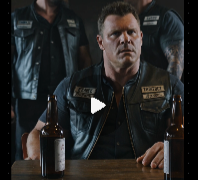
The door hit the wall when he came through it.
That was the first sound — the bang of cheap wood against a doorstop, cutting through the jukebox and the low conversation and the particular thick air of a bar that had never needed to be anything other than what it was. Then the boy was inside, and he was shouting before his eyes had adjusted to the dark.
“Please! Help me!”
The Rusty Spoke was not the kind of place that got children.
It was the kind of place that got men who had been somewhere and come back changed, men who wore what they’d been through on their skin in ink and scar tissue, men who had arrived at this particular bar on this particular Tuesday night because the alternative was being alone with their thoughts and the bar was better than that.
Fourteen of them.
They all stopped.
The jukebox kept playing for four more seconds — something old and twanging — and then someone pulled the plug, and the silence that followed was the silence of a room that had collectively decided to pay attention.
The boy was six, maybe seven. Barefoot on the bar floor that nobody cleaned often enough. Torn clothes. Dirty face with tear tracks cutting through the grime. He was breathing in the jagged way of someone who had been running — really running, the kind that comes from fear rather than exercise.
He looked around the room with wide eyes.
Then he moved.
Not toward the bar. Not toward the door. Directly — with purpose — toward the far corner table, where a man sat alone with a glass of whiskey and three empty beer bottles and the specific stillness of someone who had learned, through long practice, how to take up as little space as possible while still being the largest presence in a room.
His name was Dex Calloway. He had a scar that ran from his left ear to his chin that people didn’t ask about, and hands that had done things he didn’t discuss, and eyes that processed threat assessments the way other people processed weather.
The boy stopped in front of his table.
“Please.” His chin was shaking. The tears on his face were fresh but his voice was trying to be steady, which was somehow worse — a child attempting courage in a room full of men who knew what courage cost. “My father said if I was ever in trouble, I should come here. He said come to this bar and ask for help.”
The room was completely silent.
Dex set his glass down.
He leaned forward.
“What’s your father’s name, kid?”
The boy looked at him.
He had the eyes of someone who had been told to say a specific thing and had rehearsed it and was now at the moment of saying it and understanding for the first time that he didn’t fully know what it meant.
“John Wick.”
The silence that followed was a different kind of silence.
The first silence had been the silence of surprise — of a room that hadn’t expected to be interrupted. This silence was the silence of impact. Of a room receiving information it didn’t know how to process.
Dex Calloway did not move.
His expression did something complicated — moving through hardness and disbelief and something older and more private before landing somewhere that had no clean name.
“Say that again,” he said. His voice came out quieter than he intended.
“John Wick.” The boy held his ground. “That’s my father’s name.”
At the table nearest the window, a man named Sal — fifty-three years old, forearms like bridge cable, a man who had not registered genuine surprise in over a decade — turned to the man beside him and said nothing, because there was nothing to say.
“That’s impossible,” Dex said.
“That’s what my dad’s name is.”
“Kid.” Dex’s voice was careful now, in a specific way. The way you are careful around things that matter. “Where did you hear that name?”
“He told me.” The boy’s voice cracked. “He told me before he — before the men came. He said memorize this bar and memorize this address and if anything ever happens to me, you go there, you find anyone inside, and you say that name.” He wiped his face with the back of his hand. “He made me say it back six times. He said they’d know what to do.”
Dex was quiet for a long moment.
“What men?” he asked. “You said before the men came.”
“Four of them.” The boy’s composure, which had been fragile from the beginning, began coming apart. “They came to the house tonight. Dad made me hide in the basement and he said don’t come out and don’t make a sound and I heard—” He stopped. His jaw was shaking. “I heard things.”
“Is your dad—”
“I don’t know.” The words came out fractured. “I don’t know. I couldn’t see. I waited like he said and then it went quiet and I came out and he wasn’t there and I ran. He made me memorize the route from the house. He made me practice it.”
Dex looked at the boy’s feet. At the bare soles that had run however many blocks of city sidewalk to get here.
“How far did you run?”
“Fourteen blocks.” The boy said it with the precision of someone who had counted because his father had told him to count. “He said count the blocks so you know you’re going the right way.”
Sal stood up from his table.
Then three others.
Not dramatically. Just standing, the way men stand when they’ve made a decision and the decision involves moving.
“What’s your name?” Dex asked.
“Danny.”
“Danny.” He said it once, like filing it. “How long ago? When did you leave the house?”
“Maybe twenty minutes. I ran fast.”
Twenty minutes. Dex ran the math that needed running — the kind of math that had nothing to do with numbers and everything to do with experience.
“Did any of the four men see you leave?”
“I don’t think so. There was a window in the back of the basement.” Danny looked at him. “Dad showed me. He said it was the exit. He said only use it if things go bad.”
“Smart man,” Dex said.
“You know him.” Danny said it not as a question but as a statement — reading something in Dex’s face that he didn’t have the vocabulary to name but understood instinctively. “You actually know him.”
Dex picked up his glass. Set it back down without drinking.
“I knew someone by that name,” he said carefully. “A long time ago.”
“He said you’d say something like that.” Danny’s eyes were absolutely certain. “He said if someone tells you they knew him a long time ago or that it’s impossible or that the name doesn’t mean what you think it means—” He paused. “He said tell them: the marker is still owed.“
The bar went so quiet you could hear the cooling pipes in the ceiling.
Sal’s hand stopped moving toward his jacket.
Dex’s face did something that none of the men in the room had ever seen it do.
“He told you to say that,” Dex said. “Specifically. Those words.”
“He made me memorize it too.” Danny looked up at him. “He said those words would make people understand.”
“They do,” Dex said quietly.
He stood up.
He was a large man — the kind of large that accumulates over years of hard living rather than the gym — and when he stood in the Rusty Spoke’s low light he seemed to fill more space than the room had previously allocated for him.
He looked at Sal.
Sal was already reaching for his phone.
He looked at the other men who had stood.
They were already moving toward the door with the quiet efficiency of people who have been waiting for something to do and have just been given it.
“Danny.” Dex crouched down — the same thing the young doctor had done in the hospital corridor, the same thing the young woman had done on the subway platform, because some instincts cross all demographics. He got down to the boy’s level and looked at him directly. “Did your dad tell you anything else? Anything at all?”
Danny thought about it.
“He said one more thing,” he said. “He said if I found the right people — if the name worked — I should say thank you.” He looked at Dex steadily. “He said tell them he’s sorry he couldn’t say it himself.”
Dex Calloway, who had not felt the particular sensation currently moving through his chest in a very long time, pressed his lips together and looked at the boy who had run fourteen blocks barefoot through a city night carrying his father’s name like a weapon.
“Your dad trained you well,” he said.
“He said I’d need it someday.”
“He was right.” Dex stood. “Stay close to me. Don’t run. Don’t make noise. Do exactly what I say.”
“Are we going to find him?”
Dex put his hand on the boy’s shoulder.
“Yeah,” he said.
He looked at his men.
They were ready.
“We’re going to find him.”
