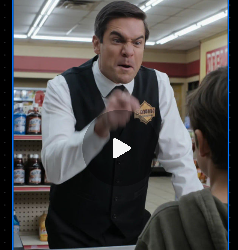
The clerk’s voice cut through the store like something meant to embarrass.
“Pay for it or leave!”
It landed on the boy the way those words always land on someone with nothing — not just as a command, but as a verdict. An announcement made to the full room that this child was the kind of problem that needed solving loudly.
The boy didn’t run.
That was the thing. He stood at the counter with the loaf of bread pressed against his hoodie — torn at the left shoulder, stained in ways that told a story nobody in that store was interested in hearing — and he absorbed the attention of twelve strangers and he did not run.
His name was Tyler. He was eight years old. He had been walking for forty minutes.
The Kwik-Mart on Route 9 was the kind of store that existed in the gap between places people actually wanted to be — fluorescent and eternal, smelling of burnt coffee and the pine-shaped air fresheners rotating slowly near the door. It was eleven-fourteen at night.
Tyler had found the bread on the third shelf. White bread, the cheap kind, the kind that comes in the bag with the colorful dots. He had carried it to the counter because his mother had told him once, when he was very small, that you don’t take things without paying, and he held onto that instruction the way he held onto most things she’d told him — carefully, as one of the remaining fixed points.
He did not have money.
He had known that before he picked up the bread.
He had hoped, in the specific way of hungry children, that something would work out.
“I asked you a question.” The clerk — mid-twenties, name tag reading DEREK, the expression of someone having a bad shift and choosing a target — leaned forward on the counter. “Are you paying or not?”
“I—” Tyler’s voice came out smaller than he wanted. “I don’t have — I was going to—”
“So that’s a no.” Derek straightened. Projected. “Okay. So either you put it back or I call someone.”
Tyler held the bread tighter.
The customers in the nearest aisle had stopped pretending to shop. One woman with a handbasket took one small step in his direction and then stopped, the way people stop when they’ve started to do something and then reconsidered whether it was their business.
Two men near the refrigerators exchanged a look that was not kind.
Someone took their phone out.
“Put it back,” Derek said. “I’m not going to keep asking.”
“Please.” Tyler looked up. His eyes were dry — he wasn’t going to cry in here, had made that decision somewhere on the walk over, had committed to it. But the word came out with everything it was carrying. “Please. My mom doesn’t — we don’t have anything at home. I’ve been walking and I just—”
“That’s not my problem, kid.”
“Derek.” A woman in line said it quietly.
“What?”
“He’s a child.”
“And this is a business.” Derek’s voice was flat. “I don’t run a charity. You want to pay for him?”
The woman looked at Tyler. Looked at her purse. Made a calculation that came out wrong and went quiet.
Tyler looked at the bread in his hands.
He started to put it back.
The doors opened.
The night air came in first — cold, carrying the smell of exhaust and October — and then the man filled the doorway.
He was large in the way that isn’t gym-large but life-large. Worn leather jacket with a vest over it, patches that were none of anyone’s business. A beard that had been growing for years without any particular attention. Boots that had covered real distance.
He moved slowly because he always moved slowly — not out of laziness but the deliberate pace of someone who has learned that arriving too fast tends to make situations worse.
He registered the scene in the time it took to walk from the door to the counter.
The boy with the bread. The clerk with the expression. The room of people who had chosen comfortable positions around something uncomfortable.
He didn’t stop at the refrigerators. He didn’t browse. He walked directly to the counter and stood beside Tyler, and he looked at Derek with eyes that were not angry — anger would have been easier to dismiss — but steady in a way that had weight.
He reached into his jacket.
He put cash on the counter.
“I’ll pay for him.”
The store went completely silent.
Derek looked at the money. At the man. At the money again.
“He was trying to steal—”
“He was holding a loaf of bread and asking.” The biker’s voice was quiet. The kind of quiet that doesn’t need volume. “I’m paying for it. We done?”
Derek took the money.
He didn’t say anything else.
The biker looked down at Tyler.
Tyler was staring up at him with the bread still pressed to his chest, trying to work out what protocol applied to this situation — whether to say something, whether to run, whether this was the kind of thing that came with a cost he couldn’t afford.
“Thank you,” he said. The words came out careful and complete.
“You walking home?” the biker asked.
“Yes sir.”
“How far?”
“About forty minutes.”
The man looked at the door. At the October night on the other side of it.
“You eat today?”
Tyler hesitated.
“Some,” he said.
The biker turned back to the counter.
“Add whatever he wants,” he said to Derek. “Anything in the store.”
Derek opened his mouth.
“I’ll cover it,” the biker said. One more time. Like it was already decided.
They were standing near the door seven minutes later — Tyler with the bread and a bottle of juice and a package of crackers and a chocolate bar that the biker had pointed at and said grab that too — when Tyler looked up at him.
“Why’d you do that?” he asked.
The biker looked at him. He had a scar along his jaw and eyes that had seen a considerable amount, and he didn’t answer immediately, which Tyler had learned meant the person was taking the question seriously.
“Because someone did it for me once,” he said. “Long time ago. Different store. Different night.”
“Were you scared?”
“Yeah.”
“Did it work out?”
The biker looked at the night outside the glass doors. At the road. At whatever was visible to him that Tyler couldn’t see.
“Took a while,” he said. “But yeah.”
Tyler held his groceries.
“I should go,” he said. “My mom’s going to be worried.”
“You said forty minutes walking.”
“It’s okay. I know the way.”
The biker pushed the door open and held it.
“I’ve got a bike,” he said. “I can get you there in five. If you want.”
Tyler looked at him.
He’d been taught not to get on strangers’ bikes. He’d been taught a lot of things about strangers, actually, most of which boiled down to be careful and trust your gut.
His gut was telling him something specific.
“Okay,” he said.
The biker nodded.
“What’s your mom’s name?” he asked, leading Tyler toward the parking lot.
“Donna,” Tyler said. “Donna Walsh.”
The biker stopped walking.
Tyler looked back at him.
The man was standing very still in the convenience store parking lot under the sodium lights, with an expression that Tyler didn’t have the context to read.
“Walsh,” he said. Like checking the sound of it.
“Yeah.” Tyler shifted his groceries. “You know her?”
The biker looked at him.
At his face.
At the specific way Tyler’s eyes caught the light.
“She ever mention a guy named Ray?” he asked. His voice had changed. Something had moved out of it and left something rawer in its place.
Tyler tilted his head.
“My dad’s name was Ray,” he said. “She doesn’t talk about him much. She says he left before I was born.” He paused. “She says he didn’t know about me.”
The parking lot held them both.
The fluorescent light from the store fell across the man’s face, and Tyler looked at him — really looked, the way he hadn’t before — and tried to understand the expression of a man who has just been handed a piece of information that reorganizes everything he thought he knew about the last eight years.
“How old are you?” the man asked.
“Eight,” Tyler said. “In November.”
The biker put one hand on the seat of the motorcycle.
His knuckles were white.
“What’s your address?” he said. “For your mom.”
Tyler told him.
The man got on the bike.
He sat there for a moment without starting it, looking at the road ahead, and Tyler watched him and waited.
“Get on,” the man said finally. “Hold the bag.”
Tyler climbed on.
“Are you okay?” Tyler asked.
Ray Walsh — because that was who he was, that was who he had always been, that was who had been moving through eight years of a different life with a gap in it shaped exactly like this — started the bike.
“Yeah,” he said.
He drove toward the address he hadn’t known he was looking for.
