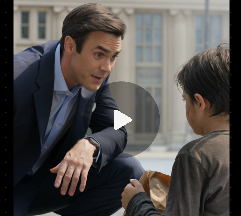
She saw him first.
That was always how it was with Lily — she saw everything first, processed it through whatever unfiltered frequency children operate on, and reported her findings before the adults around her had finished deciding whether to look. She was seven years old and she had her father’s eyes and her mother’s complete absence of social hesitation, and she used both constantly.
“Daddy.” She tugged his hand. “That boy looks like me.”
It was a Wednesday in October. The kind of afternoon that couldn’t decide between autumn and something colder — bright enough for sunglasses, cold enough that the fountain mist carried a chill. The park around the fountain was moderately populated: lunch-hour stragglers, a nanny with a stroller, two college students on a bench.
And one boy, sitting alone on the fountain’s edge with a worn paper bag in his lap and his eyes on the ground.
He was maybe eight years old. His clothes were wrong for the weather — a jacket too thin, jeans with a tear that wasn’t fashion. His hair needed attention. His shoes had been repaired with something that wasn’t the original material.
Lily was already pulling toward him.
Michael Rourke was a man who had built a very organized life. Forty-one years old, partner at a firm that rewarded precision, father of one daughter, recently divorced in the way that leaves everything technically functional and nothing quite right. He wore navy suits because he had eight of them and it simplified mornings.
He followed his daughter.
The boy didn’t look up when they approached. He’d learned, presumably, that looking up invited interactions that were usually one of two things: pity or removal. He sat very still with the paper bag in his lap and waited for whatever was going to happen.
Lily stopped two feet away and looked at him with the direct, untroubled attention of a child who hasn’t learned yet that staring is rude.
Michael crouched down to the boy’s level.
“Hey,” he said. Gently. The voice he used for Lily when she was upset — low and unhurried.
The boy’s eyes came up. Dark. Careful. Older than they should have been.
“What’s your name?” Michael asked.
A pause. The calculation of whether to answer.
“Ethan,” he said. Barely a sound.
“Ethan.” Michael nodded, like this was important information, which it was. “I’m Michael. This is my daughter, Lily.”
Lily smiled with her whole face. “Hi. That’s my dad. He fixes things.” She considered this. “Legal things. But still.”
Something moved at the corner of Ethan’s mouth. Not quite a smile. The memory of one.
“Are you here with someone?” Michael asked. “Parents? Anyone?”
Ethan looked at the fountain.
“My mom was supposed to meet me here,” he said. “She said to wait. She had to go do something and she said wait by the fountain and she’d be back.”
“How long have you been waiting?”
A pause longer than it should have been.
“A while,” Ethan said.
Michael looked at the boy’s jacket. At the paper bag. At the shoes.
“Ethan,” he said carefully. “Is today the first day you’ve been waiting, or has it been more than one day?”
Ethan didn’t answer.
Which was its own kind of answer.
Lily had sat down beside him on the fountain’s edge without asking, the way children insert themselves into spaces because no one has told them not to yet. She was looking at the paper bag with open curiosity.
“What’s in there?” she asked.
Ethan looked at the bag.
Then at Michael.
Then, with a deliberateness that suggested he had been waiting for this moment and was not entirely sure he was ready for it, he reached inside.
“My mom said something,” he said. His voice had changed — more careful now, each word placed. “Before she left. She said if I was ever by myself and I ever saw a man in a blue suit—” He paused. “She said ask him something.”
Michael went very still.
“Ask him what?” he said.
Ethan pulled out the photograph.
It was old — not ancient, but handled enough to have acquired the softness of a thing that has been touched many times by someone who needed to touch it. Sepia-toned edges. A crease across the middle where it had been folded and unfolded.
He held it out.
His hand was shaking.
“She said ask if he’s my dad,” Ethan said.
Michael took the photograph.
He looked at it.
The fountain kept running. Somewhere behind them, a dog barked. The college students on the bench were laughing about something. The world maintained its ordinary momentum completely indifferent to what was happening on the edge of the fountain.
Michael looked at the photograph.
And the world went away.
The photograph showed a woman — mid-twenties, dark hair, laughing at the camera in the way of someone who didn’t know they were going to be photographed and didn’t mind when they realized they had been. Behind her was a waterfront he recognized. He recognized it because he had been there, eleven years ago, on a summer he had spent three years afterward trying to place correctly in the narrative of his life.
He recognized the woman.
He recognized her because he had known her for four months in that summer — four months that had ended with the particular abruptness of two people who were going different directions and didn’t yet know how to say so. He had thought about her intermittently for years with the specific quality of unfinished thoughts.
He had never known she was pregnant.
He had never known because she hadn’t told him.
He had never known because — and this arrived with the force of something finally explained — she had apparently decided to raise the result of that summer alone, and to carry a photograph of a man in a navy suit in a paper bag, and to tell her son: if you ever see him, ask.
“Daddy?” Lily was watching his face. “Are you okay?”
He was not okay.
He was doing the math — the terrible, simple math of a child who was eight years old and a summer that was nine years ago, and the margin of error was not large enough to provide comfort.
“Ethan.” His voice came out as something he didn’t recognize. “The woman in this photograph. What’s her name?”
“Claire,” Ethan said. “Claire Rourke.” He paused. “She kept your name. She said she wanted me to have it too.”
Michael looked up from the photograph.
At the boy on the fountain’s edge.
At the eyes he had been looking at for six minutes without understanding why they felt like looking in a mirror.
“You have her mouth,” he said. His voice was somewhere between a whisper and nothing. “But everything else—”
He stopped.
Lily looked between her father and the boy, following the calculus of something she couldn’t fully add up yet.
“Daddy,” she said slowly. “Is Ethan—”
“Where is your mother right now?” Michael asked. “You said she went to do something. Where, Ethan? Where did she go?”
Ethan’s face changed.
The careful composure — the held-togetherness of a child who has been managing alone and has gotten good at it — cracked at the edges.
“She’s sick,” he said. “She’s been sick for a while. She said she had to go to the hospital to get something checked and she’d be back by afternoon.” His chin was trembling. “She made me promise to wait. She always comes back when she says she’ll come back.” He looked at Michael with eyes that needed the answer to be a specific thing. “She always comes back.”
Michael put the photograph down on his knee.
He looked at his daughter. At this boy. At the paper bag and the too-thin jacket and the shoes that had been repaired by someone who cared enough to repair them but didn’t have the resources for new ones.
“What hospital?” he asked. “Do you know which one?”
“St. Catherine’s,” Ethan said. “Four blocks north. She pointed it out once. She said it was good to know where things were.”
Michael stood.
He held out his hand.
Ethan looked at it.
“You don’t know if it’s true yet,” Ethan said. Not as a challenge — as a fact. As the careful, protective disclaimer of a child who has learned not to want things before they’re confirmed.
“No,” Michael said. “I don’t. But I know you’ve been waiting alone long enough.” He kept his hand out. “And I know your mother is at a hospital four blocks away. And I know that regardless of anything else — that means right now, we go find her.”
Ethan looked at the hand for three seconds.
He took it.
Lily took his other hand without being asked.
The three of them walked away from the fountain, and the photograph was in Michael’s pocket, and the paper bag was tucked under Ethan’s arm, and the ordinary Wednesday afternoon continued around them as if nothing had permanently changed.
It had.
