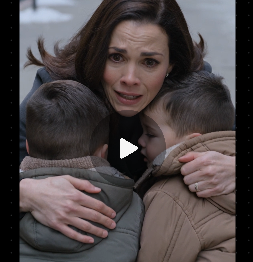
The Manhattan sidewalk doesn’t care about your grief.
It just keeps moving.
Claire Whitmore had learned that years ago. After the hospital fire. After they handed her only one baby and told her the other was gone. She’d pressed the lesson down so deep it became architecture — the elegant coat, the controlled posture, the careful life built around a single son.
Ethan was everything she had left.
She was checking her phone when he yanked his hand free.
Her bag hit the pavement. She spun. And her five-year-old was already sprinting through the crowd — not toward a taxi, not toward a store window — but toward a shape curled against the wall of a brownstone, barely visible between two garbage bags.
“Ethan!” Her voice cracked against the traffic noise.
She shoved through people. A tourist muttered. Someone filmed.
By the time she reached him, Ethan was already on his knees. He’d placed half his sandwich into the hands of a small boy who sat against the building wall, wrapped in a jacket two sizes too big, face hollow and still.
The homeless child stirred. His eyes opened slowly.
Claire’s whole body stopped.
Not her feet. Not her breathing. Something deeper.
Because the face looking back at her from the pavement was a face she already knew. The same wide-set eyes. The same sharp chin. The same expression — that particular expression Ethan wore when he was scared but trying not to show it.
Just thinner. Older somehow, though he couldn’t be more than five.
A woman near the bus stop lowered her phone.
“Mom,” Ethan said, looking up. “Why does he look like me?”
She couldn’t answer. The question was a scalpel.
The homeless boy pushed himself up against the wall. Weak, but watching her with an intensity that made her chest cave. Not a stranger’s eyes. Something older than a stranger.
He said, quietly, “You came back.”
Claire’s breath broke apart like something that had been sealed for years and finally gave way. Her gloved hand rose to her mouth. Her knees hit the freezing pavement without her deciding to kneel.
The crowd had stopped. Not all of it — the city never fully stops — but the small radius around them had gone quiet in the particular way that happens when something true is happening in public.
Ethan frowned. “Mom?”
She was staring at the boy’s wrist.
His sleeve had slipped back. And there, worn to near-invisibility but still intact, was a hospital bracelet — the kind they put on newborns, the plastic kind with tiny printed letters. She didn’t need to read it. She knew the font. She’d stared at an identical one on Ethan’s wrist in the NICU for eleven days.
Her body made a sound she didn’t recognize as her own.
The boy watched her cry with an expression that wasn’t confusion. It was recognition. Recognition that had been waiting somewhere, carried without context, for years.
“They told me only one baby survived,” she whispered. The words felt like confessing something that had been eating her alive. “There was a fire. In the hospital. They told me — they said —”
She couldn’t finish. Her throat closed.
“I remember fire,” the boy said, very quietly. His eyes went somewhere else for a moment. “And someone carrying me. And then I was outside. And no one came.”
Claire let out a sound that had no name.
She reached for him and stopped herself — afraid, absurdly, that if she touched him he might not be real. That this might be one of the hundred times over five years she’d thought she saw something familiar in a stranger’s face and had been wrong.
Ethan looked between them. He was still processing, his child’s mind working visibly.
Then he did what he always did when something was wrong. He moved toward it.
He sat down next to the boy on the cold pavement, and he took his hand.
“We found you,” Ethan said simply. “That’s the part that matters.”
The homeless boy looked down at their joined hands for a long moment. Then up at Claire. Something shifted in his expression — the wariness didn’t vanish, but something underneath it loosened. Like a door opening just slightly.
“Am I part of your family?” he asked.
Claire stopped trying to hold herself together.
She pulled both boys into her arms on that Manhattan sidewalk, in the cold, in front of everyone, and she held on like a woman who understood — finally, physically understood — that she had been living half a life without knowing it.
The city moved around them.
People walked past. Taxis honked.
But inside that small circle on the pavement, five years of wrongness began, slowly, to right itself.
Within an hour, a social worker arrived. Within a week, the DNA results confirmed what Claire had already known from the moment she looked into his eyes. The hospital’s records from the night of the fire were subpoenaed. A nurse who had worked the maternity ward that night, now retired in Queens, confirmed under oath that she had carried a second infant outside during the evacuation and handed him to a paramedic who never documented the handoff. An investigation was opened. Heads rolled.
The boy’s name had been a rotating series of names given by shelters. His first real name — the one on the bracelet — was Noah.
He got it back.
Six months later, Claire sat at a kitchen table she’d bought bigger specifically for this moment, watching her twin sons argue about whether a grilled cheese counted as a real dinner.
She had lost time. She knew that. Nothing would give it back.
But Noah was eating. He was warm. He was calling her Mom in the careful, deliberate way of someone who had learned not to trust good things — but was starting to.
That would have to be enough.
It was more than enough.
